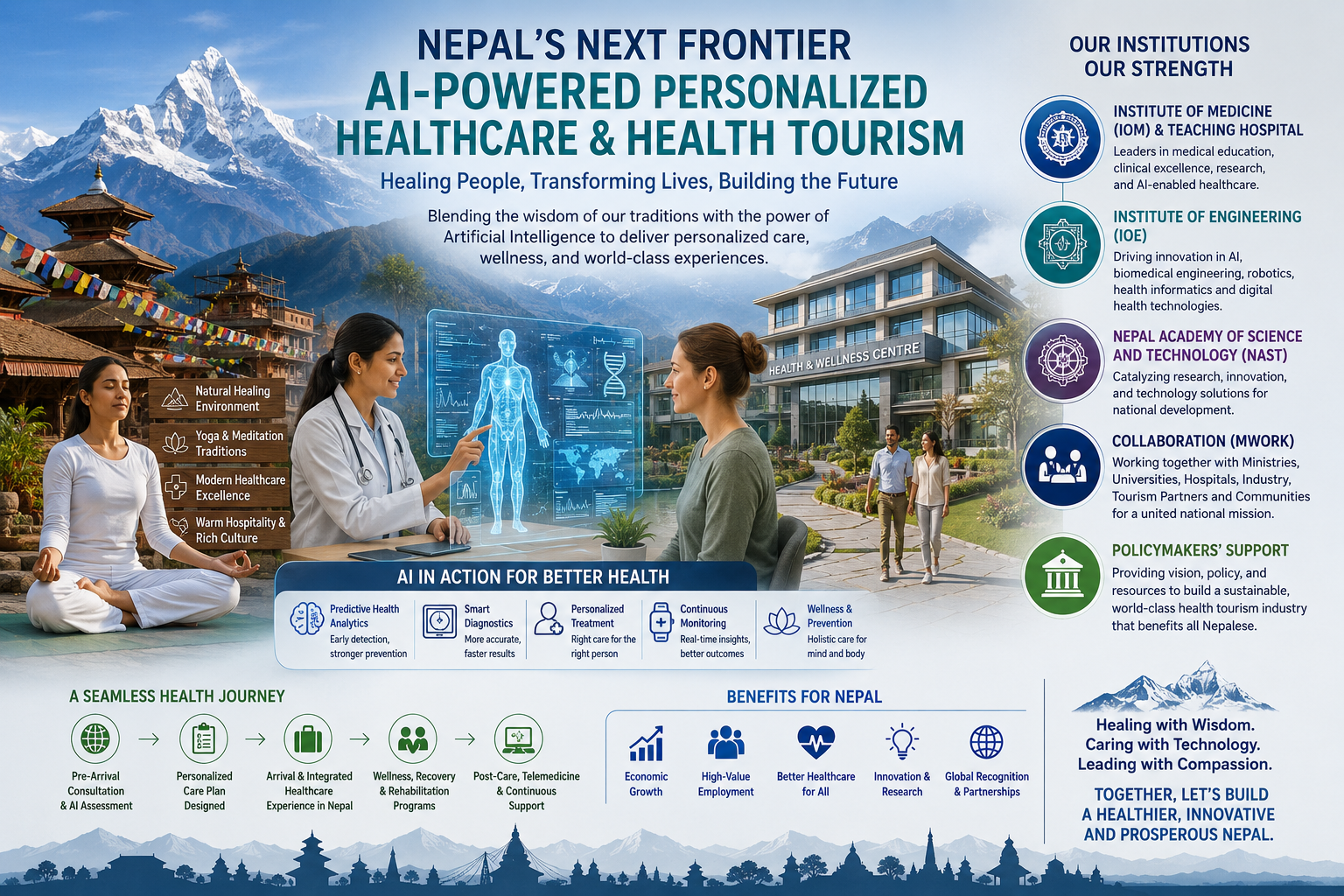
For generations, Nepal has been known around the world as the land of the Himalayas, a destination for adventure, spirituality, culture, and natural beauty. Millions of visitors have come to experience its mountains, temples, heritage sites, and diverse communities. Yet in the twenty-first century, Nepal has an opportunity to create a new identity—one that combines its natural strengths with cutting-edge technology and healthcare innovation. That opportunity lies in becoming a global destination for AI-powered personalized healthcare and health tourism.
Around the world, healthcare is undergoing a profound transformation. Traditional healthcare systems have largely followed a one-size-fits-all model, where treatments and interventions are designed for average populations. However, every individual is unique. Differences in genetics, lifestyle, environment, medical history, and social circumstances mean that healthcare should be tailored to each person. This is the foundation of personalized healthcare.
Artificial Intelligence is accelerating this transformation by enabling healthcare providers to analyze vast amounts of data, predict disease risks, improve diagnosis, recommend personalized treatments, and monitor patients continuously. Instead of simply treating illness after it occurs, healthcare systems are increasingly focusing on prediction, prevention, and early intervention.
At the same time, health tourism is evolving. Patients are no longer traveling abroad solely for surgeries or specialized treatments. They are seeking comprehensive experiences that combine healthcare, wellness, rehabilitation, healthy aging, mental wellbeing, and preventive care. These global trends create a unique opportunity for Nepal.
Nepal possesses assets that few countries can match. Its clean mountain environment, traditions of yoga and meditation, rich heritage of wellness practices, growing healthcare infrastructure, and renowned hospitality provide a strong foundation for a new model of health tourism.
By integrating these strengths with artificial intelligence and digital health technologies, Nepal can move beyond conventional tourism and position itself as a destination for healing, recovery, wellness, and personalized healthcare.
Imagine an international visitor planning a health and wellness journey to Nepal. Before leaving home, the individual securely uploads medical records through an AI-enabled platform. Healthcare professionals review the information, while AI systems analyze risk factors and generate preliminary recommendations. A personalized healthcare plan is then developed, combining specialist consultations, preventive screenings, rehabilitation services, nutrition programs, wellness therapies, and follow-up care.
Upon arrival in Nepal, hospitals, wellness centers, rehabilitation facilities, hotels, and tourism providers work together through a connected digital ecosystem. Following treatment or wellness programs, the patient continues receiving support through telemedicine and remote monitoring after returning home. This integrated approach transforms health tourism from a one-time service into a long-term healthcare relationship. However, technology alone will not make this vision a reality. The most important ingredient is human capital.
History shows that nations do not achieve sustainable development through infrastructure alone. Their success depends on the knowledge, skills, creativity, and innovation of their people. If Nepal is to become a leader in AI-powered health tourism, it must invest heavily in developing the workforce needed to support this emerging sector.
The future ecosystem will require professionals skilled in medicine, artificial intelligence, data science, biomedical engineering, health informatics, cybersecurity, digital governance, tourism management, rehabilitation sciences, and healthcare administration. This calls for a national strategy that connects education, research, innovation, healthcare, and economic development.
The Institute of Medicine and Tribhuvan University Teaching Hospital are uniquely positioned to lead this transformation. As Nepal’s premier medical education and healthcare institutions, they can become centers of excellence for personalized medicine, digital health, clinical AI applications, telemedicine, and health tourism services.
Teaching hospitals can serve as living laboratories where healthcare innovations are tested, evaluated, and adapted to Nepal’s unique needs. They can train future physicians and healthcare professionals to work effectively alongside AI systems while maintaining the human compassion that remains central to quality healthcare.
The Institute of Engineering has an equally important role. Modern healthcare increasingly relies on advanced technologies, including medical devices, AI systems, wearable technologies, robotics, cloud computing, health information systems, and cybersecurity infrastructure.
Engineers will be essential partners in designing and maintaining the technological foundations of Nepal’s digital health ecosystem. Interdisciplinary programs in biomedical engineering, health informatics, AI in healthcare, and healthcare cybersecurity can help create a new generation of professionals capable of bridging medicine and technology.
The Nepal Academy of Science and Technology, or NAST, can serve as a national catalyst for research, innovation, and technology transfer. By fostering collaboration among universities, hospitals, government agencies, startups, and international partners, NAST can help build a vibrant innovation ecosystem that supports both healthcare and economic growth. The success of this vision requires collaboration far beyond individual institutions.
The Ministry of Health and Population, Ministry of Education, Science and Technology, Ministry of Communication and Information Technology, Ministry of Culture, Tourism and Civil Aviation, Ministry of Industry, provincial governments, universities, research centers, hospitals, private healthcare providers, tourism operators, technology companies, and development partners must work together within a common national framework. Such collaboration can help align policies, reduce duplication, improve resource utilization, identify regulatory gaps, and accelerate innovation.
Policymakers will require strong evidence, research, and technical expertise to navigate emerging challenges related to AI governance, data privacy, cybersecurity, ethics, workforce development, and international competitiveness. Academic and research institutions can provide the knowledge base needed to support informed decision-making and effective regulation.
For this reason, many experts advocate strengthening key institutions through greater autonomy, long-term investment, and recognition as Institutions of National Importance. Institutions such as the Institute of Medicine, Tribhuvan University Teaching Hospital, the Institute of Engineering, and NAST can serve as strategic pillars supporting Nepal’s transition toward a knowledge-based economy. Their contributions would extend beyond health tourism. They would support national priorities in healthcare, education, technology, innovation, industrial development, and human capital formation.
The benefits of such a transformation could be substantial. Nepal could attract international patients and investment, create high-value employment opportunities, stimulate research and innovation, strengthen healthcare infrastructure, and generate valuable foreign exchange earnings. Importantly, investments made for international visitors would also improve services available to Nepali citizens. Yet the ultimate goal should not simply be economic growth. The deeper objective is to build a healthier, more innovative, and more inclusive society.
As Nepal embraces artificial intelligence and digital transformation, policymakers must ensure that rural communities, women, older adults, persons with disabilities, and economically disadvantaged populations are not left behind. Digital health technologies should reduce inequalities, not deepen them. The future of healthcare is personalized. The future of tourism is experiential. The future of development is driven by knowledge, innovation, and human capital.
By bringing these forces together, Nepal has the opportunity to create a distinctive model of AI-powered personalized healthcare and health tourism that reflects its unique strengths and aspirations. The country that gave the world the inspiration of the Himalayas can also become a destination for healing, wellness, recovery, healthy aging, and compassionate innovation. The journey begins not with technology alone, but with investment in people, institutions, and a shared national vision for the future.