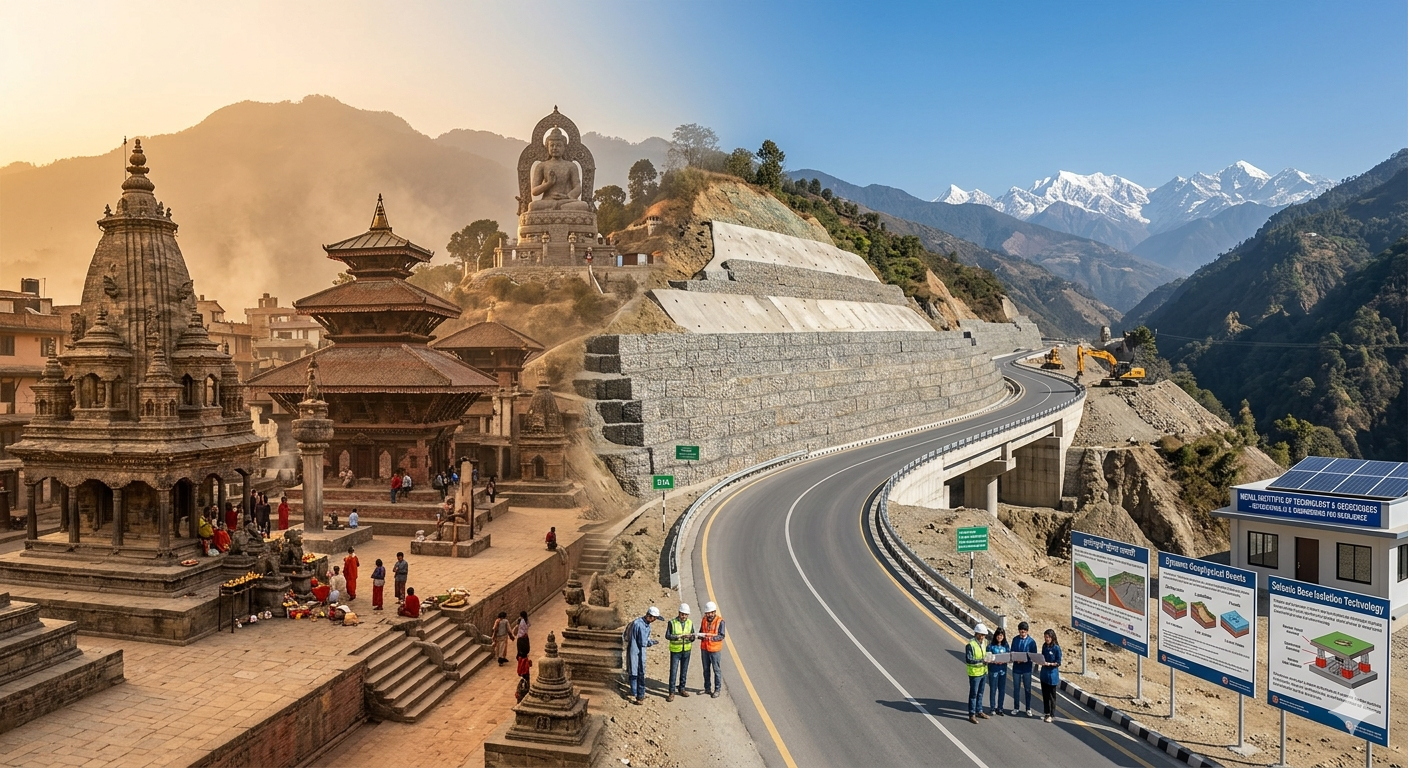
For generations, massive amounts of community wealth, hard labor, and tax money across our region have been spent on building religious monuments, funding expensive rituals, and maintaining properties that don't produce anything for the public. Imagine if these vast resources had been used instead for solid stone walls to stop floods, permanent mountain highways, and proper irrigation systems. If we had done that, far fewer people would have died in past natural disasters. Our ancestors were led down the wrong path. Today, some groups still use disasters to push old superstitions. They do this because science demands proof and accountability, while blaming "fate" gives politicians an easy way out when things go wrong.
To break this cycle, Nepal must stop trying to please everyone and start prioritizing safe, honest engineering. We live in one of the most earthquake-prone and environmentally fragile places in the world. We can no longer afford to gamble our public money on unscientific, temporary fixes. True progress will only happen when citizens demand to know exactly where their tax money goes. Every single rupee should be visibly spent on testing concrete, studying the environmental impact of mountain roads, and modernizing our country's infrastructure.
It’s Not Just a Lack of Engineering; It’s a Lack of Leadership
At its core, this problem comes down to bad governance. Local politicians often promise quick, cheap roads just to win votes. Because of this, speed is put ahead of human safety. To fix this, we must make it a law that experts check the soil and rocks before any local budget is approved. We must strictly enforce environmental safety rules and properly train the people who operate heavy construction machinery. This is the only way to make sure that bringing a road to a village doesn’t end up destroying it in the next landslide.
This brings us to a harsh truth: faith might comfort us after a tragedy, but good engineering is what keeps the roof from falling on our heads in the first place. By forcing local leaders to respect science instead of spending money on symbolic gestures, our generation can save lives rather than repeating the costly, unscientific mistakes of the past.
Spending on Safety, Not Superstition
Cutting back on the money wasted on superstition is not about taking away anyone's freedom of religion. It is about protecting public funds and saving lives. In a high-risk country like Nepal, we must realize a simple truth: every rupee spent on an unscientific ritual is a rupee stolen from a retaining wall, an earthquake sensor, or a safe bridge.
True national pride does not come from building the tallest religious statue; it comes from building a society that is safe from disasters, highly educated, and scientifically advanced.
In our schools, earthquakes, landslides, and floods must be taught strictly as natural forces. Children need to learn that a house survives an earthquake because it was built with flexible, strong designs—not because of divine intervention.
Preparing for the Future
This does not mean Nepal should stop teaching arts or literature. Instead, our universities need to bring technology into every field. We need to constantly update what students learn and expand programs in practical fields like AI, cybersecurity, robotics, and data science. We also need degrees that combine technology with everyday sectors like health, tourism, farming, and public policy. This is exactly what Nepal needs to prepare our youth for a modern economy where technology is everywhere.
The Role of Our Leaders
Finally, there is a delicate debate about whether high-ranking police officers should publicly speak out against traditional religions, the caste system, and superstition. It is a tough balance between pushing for social change and keeping the political neutrality required of anyone in uniform.
But ultimately, law enforcement leaders do not need to fight a war against faith to create a modern society. They can achieve a fairer, more rational Nepal simply by fiercely enforcing the progressive laws that are already written in our constitution.