My recollections of my father’s aunt, Maya Nini, are deeply valuable; they preserve a living connection between Kathmandu’s traditional Buddhist-Newar families and the trans-Himalayan Buddhist revival centered in places like Kushinagar, India. Memories like mine often survive only through oral family narratives; if they are not recorded now, entire chapters of social and cultural history may disappear.
My cousin, Keshari Laxmi, suggested that Maya Nini’s formal name was "Moti Lakshmi Upasika." This is likely correct, as many Newar Buddhist women who dedicated themselves to religious life outside Kathmandu were remembered by honorific or devotional names rather than their birth names. "Upasika" refers to a devoted female lay practitioner, and it is probable that Maya Nini became known by this title after settling in Kushinagar.
I arrived in Kushinagar alone from Kanpur in the early 1970s. At that time, the area was relatively undeveloped compared to today’s pilgrimage infrastructure. The flooding, failed drainage, darkness, and isolation I experienced were the harsh realities of small North Indian towns during the monsoon season. Yet, despite that frightening arrival, I was met with immense warmth and care from the monastery community and from Maya Nini herself.
Ratnadas Tuladhar had three daughters: one was Tata’s mother, another was Mhaya Nini, and Maya Nini was the third. Maya Nini eventually left Kathmandu permanently to dedicate her life to Buddhist service in Kushinagar. Her journey reflects a larger, under-documented history of Newar Buddhist migration and patronage within India’s pilgrimage circuit during the 20th century. Many Nepal Bhasa-speaking families maintained strong links with sacred sites such as Lumbini, Kushinagar, Sarnath, and Bodh Gaya.
Women, in particular, played foundational roles as caretakers, donors, translators, and spiritual supporters, yet their histories were rarely formally archived. As the saying goes, "If we don’t ask for details, the history of our Nini will be lost." This is how social history vanishes—not for a lack of importance, but for a lack of records.
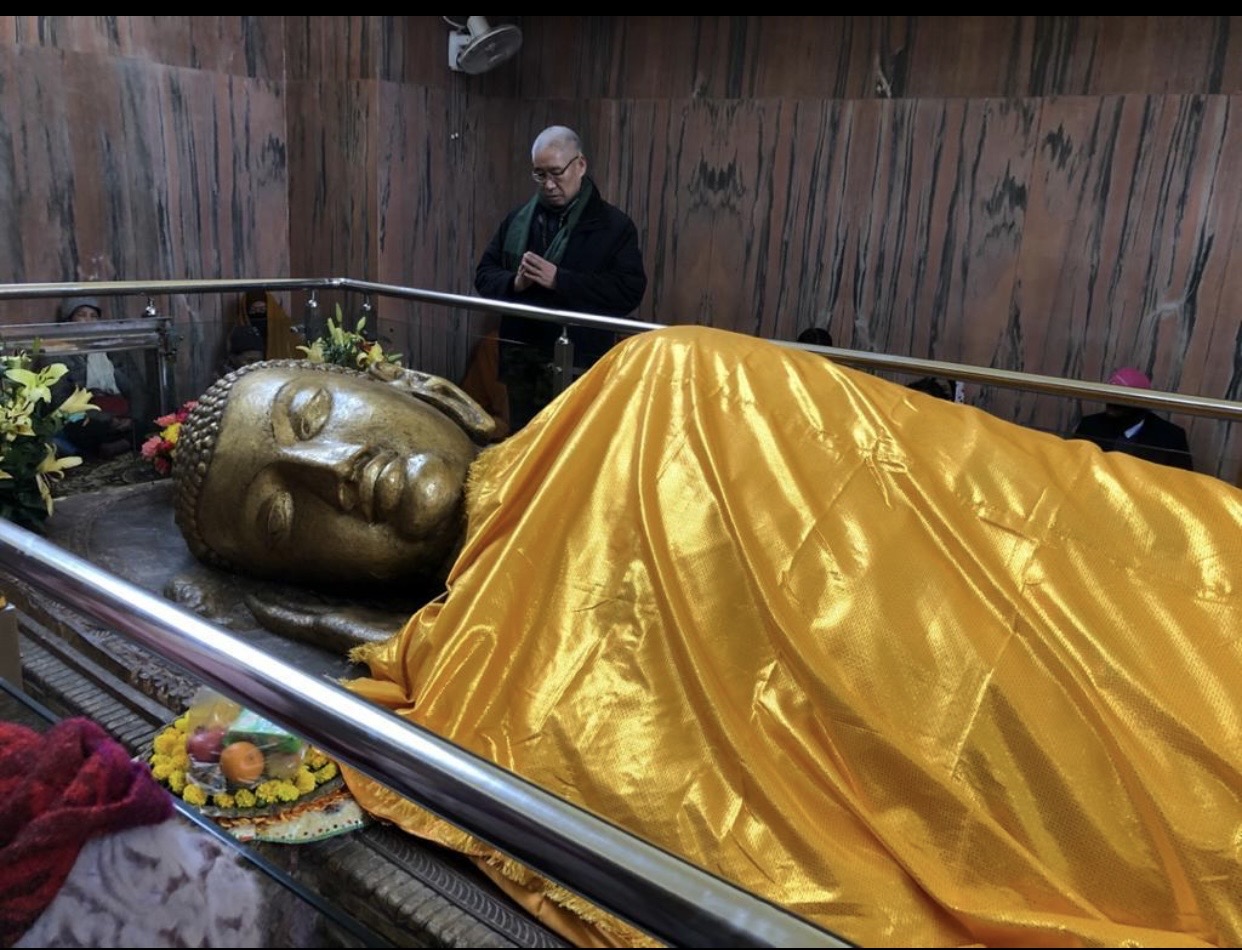
Our collective memories contain vital historical clues regarding family lineage, migration, women’s Buddhist networks, and the emotional world of women who left Kathmandu for a life of religious dedication. Keshari Tata mentioned that there is even a statue of her in a Nepalese museum in Kushinagar, which is truly remarkable.
There is still an opportunity to reconstruct her story by speaking with surviving relatives—such as Shanti Mama, Muma (wife of late Pushpa Kaka) I forgor to ask Budhalaxmi. Muma Sundari and Biswalakshmi Nini—who may have remembered fragments of her early life. Though I forgot to ask what specifically inspired her to leave home, or the details of her marital status, the story remains significant.
Even my own journey to meet her is a piece of that history. A young Nepali woman traveling alone by train in the early 1970s to visit a renunciant relative reflects the shifting educational, cultural, and social landscapes of Newar families in that era.