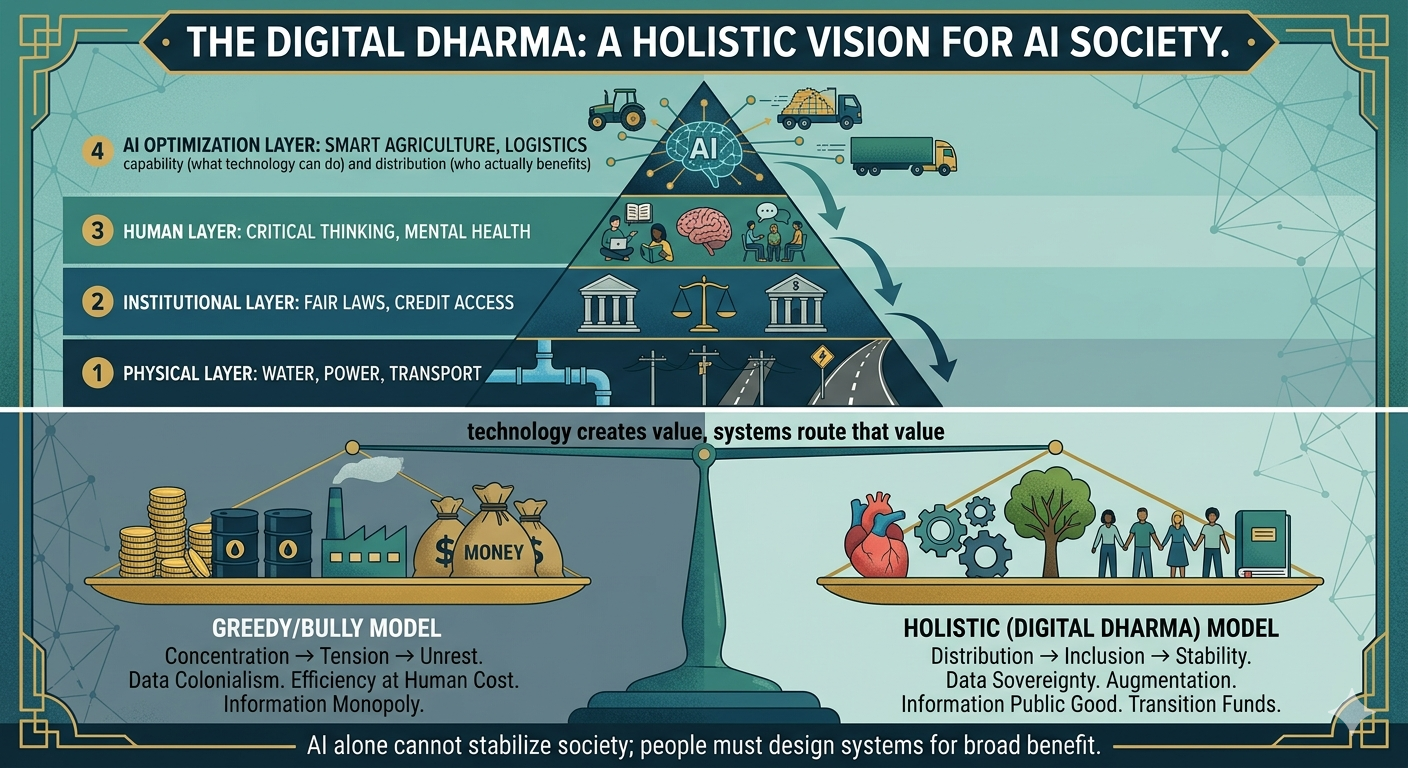
The global conversation surrounding Artificial Intelligence is currently obsessed with capability—what the machine can do. But for those of us observing the impact in developing economies and shifting labor markets, the more urgent question is distribution—who actually benefits.
We must accept a hard truth: Technology is an amplifier, not a stabilizer. It makes whatever system it sits in work faster and at a larger scale. In a greedy system, it accelerates inequality. In a holistic system, it democratizes progress. To stabilize society, we must stop trying to slow down the tools and start upgrading the systems that route their value.
The Hierarchy of Needs
A truly holistic vision for AI recognizes that you cannot build a digital skyscraper on a mud foundation. We often see a "tech-first" failure in sectors like agriculture. In India or Nepal, giving a farmer a smartphone with AI-driven crop advice is futile if there is a fundamental scarcity of water. A Digital Dharma—a moral and systemic framework for technology—requires a logical sequence ensuring water, reliable power, and transport, creating fair laws and credit access to prevent "resource bullies" from capturing all the gains, investing in mental health and critical thinking to navigate an automated world and applying the technology as the final optimization step.
Addressing the "Greedy" System
History—from the French Revolution to the World Wars—shows that social explosions occur when systems fail to balance power and opportunity. Today, greed manifests as a "clog in the pipes," ensuring that AI value flows only to a narrow elite. To prevent this, we must address three specific systemic flaws. We must shift away from corporations harvesting collective intelligence for free. Communities should own their data and receive a "dividend" for the knowledge they provide. We need a Social Impact Tax. If a company replaces a workforce with AI to increase short-term margins, a portion of those savings must be redirected into national "Transition Funds" for retraining and mental health support. We must treat "decision-grade" information like water or roads. Governments should invest in open-source, high-quality local AI models to ensure the poor aren't bullied by misinformation and paywalled truths.
The Choice Before Us
The difference between a difficult transition and serious social unrest is how early the response happens. We can look to the Scandinavian "Social Contract" as proof that societies can choose to spread both risk and opportunity.
AI will not decide who prospers—people will. Left to run on existing incentives, AI will deepen divides. Shaped deliberately, it can expand capability and dignity at scale. The real policy challenge of our generation is not "fixing" AI, but making greed unprofitable by designing systems where a company cannot succeed unless the community thrives alongside it. If we upgrade our systems as fast as our tools, disruption becomes progress. If not, disruption becomes instability. International Policy makers, STE(A)M Educators, academia, youth forces and AI Governance experts should be engaged in serious dialogue.
Translation editing required
डिजिटल धर्म: उपकरणले होइन, प्रणालीले हाम्रो भविष्य तय गर्नेछ
आर्टिफिसियल इन्टेलिजेन्स (AI) सँग सम्बन्धित विश्वव्यापी बहस हाल यसको क्षमतामा मात्र केन्द्रित छ—अर्थात् मेसिनले के गर्न सक्छ। तर विकासोन्मुख अर्थतन्त्र र बदलिँदो श्रम बजारमा यसको प्रभावलाई नियालिरहेका हाम्रा लागि, योभन्दा महत्त्वपूर्ण प्रश्न वितरणको हो—अर्थात् यसबाट वास्तवमा लाभ कसले पाउँछ।
हामीले एउटा कठोर सत्यलाई स्वीकार गर्नैपर्छ: प्रविधि एक 'एम्प्लीफायर' (बढावा दिने माध्यम) हो, 'स्टेबिलाइजर' (स्थिरता दिने माध्यम) होइन। यसले जुन प्रणालीमा बसेको छ, त्यसैलाई तीव्र गति र ठूलो स्तरमा सञ्चालन गर्छ। लोभी प्रणालीमा यसले असमानतालाई बढावा दिन्छ। एक समग्र (होलिस्टिक) प्रणालीमा यसले प्रगतिलाई लोकतन्त्रीकरण गर्छ। समाजलाई स्थिर राख्न, हामीले उपकरणहरूको गति ढिलो गर्ने प्रयास छोडेर तिनको मूल्य निर्देशित गर्ने प्रणालीहरूलाई सुधार्न सुरु गर्नुपर्छ।
आवश्यकताको सोपान (The Hierarchy of Needs)
AI का लागि एक वास्तविक समग्र दृष्टिकोणले यो स्वीकार गर्छ कि तपाईं हिलोको जगमा डिजिटल गगनचुम्बी भवन बनाउन सक्नुहुन्न। हामीले अक्सर कृषि जस्ता क्षेत्रहरूमा "प्रविधि-प्रथम" असफल भएको देखेका छौं। भारत वा नेपालमा, यदि पानीको आधारभूत अभाव छ भने कृषकलाई AI-आधारित बाली सल्लाह दिने स्मार्टफोन उपलब्ध गराउनु निरर्थक हुन्छ। एक डिजिटल धर्म—प्रविधिका लागि नैतिक र प्रणालीगत रूपरेखा—का निम्ति एक तार्किक क्रम आवश्यक हुन्छ:
• पानी, भरपर्दो बिजुली र यातायात सुनिश्चित गर्ने।
• निष्पक्ष कानुन र कर्जाको पहुँच निर्माण गर्ने ताकि "श्रोतका दादाहरू" (resource bullies) ले सबै लाभ कब्जा गर्न नसकून्।
• स्वचालित संसारमा बाँच्नका लागि मानसिक स्वास्थ्य र तार्किक सोचमा लगानी गर्ने।
• र अन्त्यमा, प्रविधिलाई अन्तिम अनुकूलन (optimization) चरणको रूपमा लागू गर्ने।
"लोभी" प्रणालीको सम्बोधन
फ्रान्सेली क्रान्तिदेखि विश्वयुद्धसम्मको इतिहासले देखाउँछ कि जब प्रणालीले शक्ति र अवसरलाई सन्तुलनमा राख्न असफल हुन्छ, तब सामाजिक विस्फोट हुन्छ। आजको लोभ "पाइपको अवरोध" जस्तै प्रकट भएको छ, जसले AI को मूल्य केवल एक सीमित सम्भ्रान्त वर्गमा मात्र प्रवाहित हुने सुनिश्चित गर्दछ। यसलाई रोक्न हामीले तीन विशिष्ट प्रणालीगत त्रुटिहरूलाई सम्बोधन गर्नुपर्छ:
१. डेटाको स्वामित्व: कर्पोरेसनहरूले सामूहिक बौद्धिकता नि:शुल्क संकलन गर्ने परिपाटी अन्त्य हुनुपर्छ। समुदायले आफ्नो डेटाको स्वामित्व राख्नुपर्छ र उनीहरूले प्रदान गरेको ज्ञानको बदलामा "लाभांश" प्राप्त गर्नुपर्छ।
२. सामाजिक प्रभाव कर (Social Impact Tax): यदि कुनै कम्पनीले अल्पकालीन नाफा बढाउन कामदारहरूलाई AI मार्फत प्रतिस्थापन गर्छ भने, त्यस बचतको एक हिस्सा पुनः तालिम र मानसिक स्वास्थ्य सहयोगका लागि राष्ट्रिय "संक्रमण कोष" (Transition Funds) मा निर्देशित गरिनुपर्छ।
३. सूचनाको पहुँच: हामीले "निर्णय-स्तर" को जानकारीलाई पानी वा सडक जस्तै व्यवहार गर्नुपर्छ। सरकारले खुला स्रोत र उच्च गुणस्तरका स्थानीय AI मोडेलहरूमा लगानी गर्नुपर्छ, ताकि गरिबहरू गलत सूचना र महँगो शुल्क तिर्नुपर्ने सत्यको चपेटामा नपरुन्।
हाम्रो सामुन्नेको छनोट
कठिन संक्रमण र गम्भीर सामाजिक अशान्ति बीचको भिन्नता भनेको प्रतिक्रिया कति चाँडो आउँछ भन्ने कुरामा भर पर्छ। हामी स्क्यान्डिनेभियन "सामाजिक सम्झौता" लाई उदाहरणको रूपमा लिन सक्छौं, जसले प्रमाणित गर्छ कि समाजले जोखिम र अवसर दुवैलाई समान रूपमा बाँड्ने विकल्प रोज्न सक्छ।
AI ले कसको उन्नति हुन्छ भन्ने निर्णय गर्दैन—मानिसहरूले गर्नेछन्। यदि विद्यमान प्रोत्साहनहरूमा मात्र छोडियो भने, AI ले विभाजनलाई अझ गहिरो बनाउनेछ। सचेत रूपमा आकार दिइयो भने, यसले ठूलो स्तरमा क्षमता र मर्यादा विस्तार गर्न सक्छ। हाम्रो पुस्ताको वास्तविक नीतिगत चुनौती AI लाई "सुधार्नु" मात्र होइन, बरु यस्तो प्रणालीको निर्माण गरी लोभलाई निरुत्साहित गर्नु हो, जहाँ समुदायको उन्नति नभई कम्पनी सफल हुन सक्दैन।
यदि हामीले हाम्रा उपकरणहरू जत्तिकै छिटो प्रणालीलाई पनि अद्यावधिक गर्यौं भने, अवरोध प्रगतिमा परिणत हुनेछ। यदि गरेनौं भने, अवरोध अस्थिरता बन्नेछ। यसका लागि अन्तर्राष्ट्रिय नीति निर्माता, STE(A)M शिक्षक, शिक्षाविद्, युवा शक्ति र AI सुशासन विज्ञहरू गम्भीर संवादमा जुट्नु आवश्यक छ।