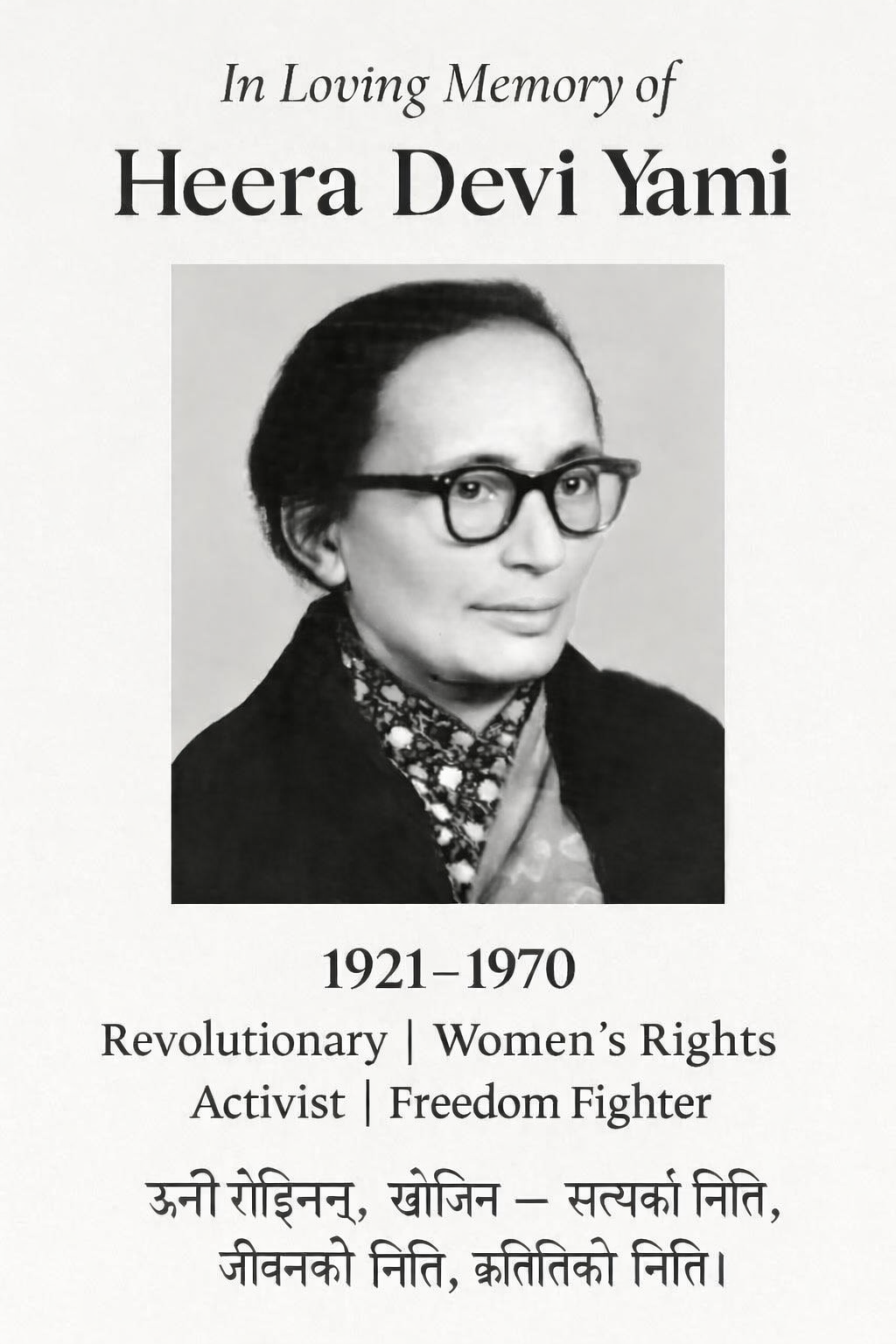
During early days of Heera Devi's life, she belonged to Lasa traders , a traders family in Tibet. And in this community, most of the girls are married at very, very early age. For example, her first cousin, Lata Devi was married at the age of six. And the husband must have been around 10-12 years old, who was taken to Tibet Lasa by her, by his family members. And during such time, the Lata Devi's father, six-year-old bride, her mother had died, her father had died. And so she didn't have parents. She suffered a lot, suffered so much. And Heera Devi Yami at her very early age, worst the suffering. Similarly, the girls used to be married of very early age and at early age the husbands would travel to Tibet for business. And some of them die there because of poor health conditions, poor services, health services. Some on the way, they, you know, land up with snow storm in very cold weather. And the body are found on the mountains frozen. There are avalanche of snow, flood washing away the travelers. And big flood in the river. Crossing river, they don't have resources, they used to use skin of animals as a boat. And some return and some vanish in the flood. And there are deceits in the in the jungles on the route. And these people know banking services, they have to carry whatever they have earned in in their body. And they get robbed and get killed in the process. And yet the family members still go in spite of all the disasters.
This historical context adds a somber and deeply human layer to the resilience of Heera Devi Yami. The Lhasa trade route was not just a commercial path; it was a theater of immense tragedy that disproportionately impacted the women and children left behind.
1. The Burden of the Child Bride
The story of Latan Devi—married at six , lost father when she was not born and orphaned at the age of five —illustrates the extreme vulnerability of girls in that era. In these communities. Often, early marriages were a desperate attempt by families to ensure a girl's future in the absence of parents, yet it frequently led to a life of servitude and isolation. With husbands traveling the treacherous Himalayan passes, many of these child brides became "living widows" or actual widows before they even reached adulthood.
2. The Treacherous Lhasa Route
The journey between Kathmandu and Lhasa was one of the most dangerous trade routes in the world. Your account highlights the specific "disasters" these families accepted as the cost of survival. Many traders succumbed to hypothermia or were buried in avalanches. The use of animal skin boats (coracles) was a common but high-risk method for crossing the turbulent rivers of the Tibetan plateau. A single swell could wipe out an entire caravan. Since there was no formal banking system, the practice of carrying physical gold or silver on one's person made traders "walking targets" for dacoits (bandits) in the high mountain passes and jungles. The lack of medical facilities in Tibet and the physical toll of high-altitude travel meant that even minor illnesses often became fatal. Poor health services meant that minor altitude sickness or infections often turned fatal, leaving families back in Nepal waiting for news that might never come.
3. The Impact on Heera Devi Yami
Witnessing this level of suffering—the loss of relatives, the sight of frozen bodies, and the grief of child brides like her cousin—undoubtedly forged Heera Devi’s "quiet strength."
Growing up in a community where life was so fragile and survival required such extreme physical and mental endurance likely prepared her for the high-stakes underground work she later performed. She didn't just learn to be brave; she was raised in a culture where endurance was a prerequisite for existence.
4. The Silent Burden of Women
While the men faced physical dangers on the route, the women—many of whom were child brides—bore the psychological and social tol. The story of cousin of Heera Devi , married at six and orphaned shortly after, illustrates the extreme vulnerability of girls. In a world where "the paper will speak" (a taboo against girls' literacy), marriage was often the only perceived path to security, yet it frequently led to a life of early widowhood and hardship. Many women spent their best years waiting for husbands who were away for years or who had died unknown in a snowstorm. This early exposure to suffering is likely why Heera Devi later became such a fierce advocate for education over early marriage.
5. Lani Devi Tuladhar: A Life of Silent Sacrifice
Lani Devi Tuladhar was the daughter of Dharma Ratna Yami’s maternal aunt (his mother's younger sister). Her life serves as a stark illustration of the "triple burden" borne by women in the Lhasa Newar trading community. Married at a very early age, she was left to fend for herself when her young husband departed for Lhasa, Tibet, shortly after the birth of their son.
The Agony of the Vanished In an era where the Himalayan trade routes were fraught with peril, her husband never returned. The reports that filtered back were conflicting and cruel: some said he was swept away by a turbulent river; others whispered of dacoits in the jungle, betrayal by companions, or a lonely death in a mountain snowstorm. Because there was no definitive proof of his passing, Lani Devi lived in a permanent state of "waiting"—a psychological torture that prevented any sense of closure. She remained a "living widow," trapped in a limbo that lasted until her death.
The Breadwinner in Exile Despite her own grief and the vulnerability of being a young mother, Lani Devi became the sole pillar of her family. She acted as a surrogate parent to her two brothers and two sisters, a feat of extraordinary self-sacrifice. To ensure their survival, she broke traditional boundaries by migrating to New Delhi to work for the Reliance company. From there, she sent her meager earnings back home, supporting her child and siblings while enduring profound isolation in a foreign city.
The Weight of Patriarchy Lani Devi’s story was not an isolated one; it was a common tragedy in a society where husbands frequently vanished. In that patriarchal structure, young widows—or women whose husbands were missing—were often stripped of their rights and denied any claim to family property. Her life remains a powerful testament to the resilience of women who operated in the shadows of the Lhasa trade, absorbing the cruelty of fate in silence so that their families might survive.
6. The Legal and Social Trap
In the absence of a husband, a woman often had no legal claim to his property or the family estate. If the husband "vanished" rather than being declared dead, her legal status was even more precarious. In that society, a young widow was often viewed with suspicion or as a burden. Deprived of rights and social standing, their labor was exploited, yet their voices were silenced.
7. The "Lhasa Fear": A Community in Crisis
A wave of apprehension eventually swept through the Lhasa Newar community. Families began to realize that marrying their daughters into the trader community was a dangerous gamble. Because child marriage was the norm and divorce was non-existent, a young bride was often tethered to a life of early widowhood. The risks were immense: young husbands frequently died in Tibet or along the treacherous return route. Those who survived the environment were often targeted by dacoits (bandits), as the gold they carried made them "walking banks" for robbers and, occasionally, even desperate peers.
8. The Chitlang Protocol
To mitigate these dangers, a rudimentary protection system was established. Traders would gather at a guest house in Chitlang, the gateway out of the Kathmandu Valley. They would wait until a group of 15 to 20 people had collected before moving forward. This caravan relied on a single armed guard—often carrying only one pistol or rifle—to protect the entire group from the bandits lurking in the jungles.
The Discovery in the Sack The story of Latan Devi’s father epitomizes the brutality of this route. While returning from Tibet, he was attacked and left for dead. He was discovered by three fellow Newar traders who noticed a bundle in a sack moving on the side of the trail. Upon opening it, they found him badly injured but alive. In an act of profound camaraderie, they carried his broken body back for two days until they reached a remote Gumba (monastery) run by Tibetan priests and nuns. Entrusting him to their care, the traders told the priests, "Only you can save this man. If he recovers, he will return to Nepal; if not, his fate is in your hands."
A Bittersweet Return Against the odds, he survived and eventually returned to Kathmandu. His joy was immense when he learned his wife was pregnant; he went from house to house, excitedly sharing the news. However, his happiness was short-lived. The severe injuries he had sustained to his gums and ears during the attack never truly healed. They eventually turned cancerous, and he succumbed to the illness before he could see his daughter, Latan Devi.
This cycle of survival and subsequent tragedy was precisely why families became increasingly hesitant to marry their daughters to Lhasa traders, viewing the wealth of the trade as a "blood price" too high to pay.
The harrowing account of Latan Devi’s father serves as a visceral illustration of why a "wave of fear" eventually swept through the Lhasa Newar community. It highlights a tipping point where the economic benefits of the trade could no longer mask the extreme human cost, especially regarding the safety of daughters and the stability of families.
9. The Survival Strategy: The Caravan System
Because of the constant threat of dacoits (bandits), traders could not travel alone. Waiting until 15 to 20 people gathered was a mechanical necessity. Chitlang was the gateway out of the Kathmandu Valley, and that guest house acted as a final staging area for security. The fact that a group of twenty might only be protected by a single pistol or rifle shows how poorly armed they were against organized bandits, making every journey a massive gamble.
The Brutality of the Trail: The "Sack" Incident
The story of Latan Devi’s father being found packed in a sack—left for dead after a robbery—is a chilling example of the lawlessness of the borderlands. It was only by the "movement in the sack" that he was saved by fellow traders. This highlights the camaraderie among the Lhasa Newars; despite the competition, they would not abandon a countryman found in such a state. Entrusting him to Tibetan nuns and priests in a remote Gumba shows that these religious outposts were the only form of "emergency healthcare" available on the roof of the world.
The Tragedy of the Return
The most tragic part of this account is the brief window of joy followed by a slow death. The injuries he sustained—specifically to his gums and ears—were likely infected or became malignant over time. In an era without oncology or advanced medicine, his survival from the bandits only led to a painful death from cancer shortly after returning home. His happiness over his wife’s pregnancy, contrasted with his impending death, explains how children like Latan Devi were born into a cycle of struggle, often becoming orphans before they could even know their fathers.
Why the Community Sentiment Shifted
Families began to realize that marrying daughters into this community was a risk too high to bear. Since divorce was non-existent and remarriage for women was socially shunned, a daughter married to a trader was statistically likely to become a widow or a "living widow" before the age of twenty. These stories of "vanished" husbands, men found in sacks, and the lack of rights for women in a patriarchal structure eventually fueled the desire for social reform.
Heera Devi wasn't just fighting a political regime (the Ranas); she was a product of a community that had been traumatized by centuries of high-risk trade and the systemic neglect of women’s safety and rights. This is a deeply moving and tragic account that illustrates the sheer brutality of the Lhasa trade era. The story of Latan Devi’s father encapsulates the cycle of hope and despair that defined the Newar merchant experience—where surviving the "gangsters" (dacoits) of the jungle was often just the beginning of a different, slower tragedy.
The Survival and the Sacrifice
The details of his rescue reveal the incredible bond between the Newar traders. Carrying a badly injured man for two days back through high-altitude terrain is a feat of immense physical and moral strength. It shows that despite the competitive nature of trade, there was a profound sense of "community as family." The role of the Tibetan priests and nuns as the only source of emergency medical care is a significant historical detail. These monasteries were not just spiritual centers; they were the only "hospitals" along the thousands of miles of the trade route.
The Bittersweet Return
The tragedy of his death after returning home adds a layer of deep irony to his survival. His excitement about his wife’s pregnancy—going around to tell everyone—highlights a moment of pure humanity amidst a life of hardship. It makes his passing even more poignant, as he never got to meet the daughter who would carry his story. The injuries in his ear and gums turned cancerous is medically significant. In an era before modern diagnostics, severe physical trauma and lack of proper dental/wound care often led to chronic infections or malignancies that proved fatal long after the initial attack.
The Social Tipping Point: "The Lasa Fear"
Families began to see the Lhasa trade not as a path to wealth, but as a path to early widowhood and orphaned children.
Young girls became widows with no legal rights to property.
No closure or ability to remarry, leading to "living widowhood." Children like Latan Devi grew up without the protection or guidance of a father, Men returned broken or diseased, placing a heavy caretaking burden on wives. It shows why the "quiet strength" of women like Heera Devi was so necessary: they had to become the protectors because the world they lived in—the world of dacoits, snowstorms, and terminal injuries—offered them no protection at all.
The Sacrifice of Latan Devi and the Rituals of Departure
The story of Latan Devi serves as a painful window into the childhood of her first cousin, Heera Devi Yami. Latan Devi was orphaned at the age of five when her mother passed away. Just a year later, at the age of six, she was married off. Following the marriage, the young groom—still a boy himself—was sent to Lhasa, Tibet, for trade. Latan Devi was left behind, a child without parents and essentially without a husband, enduring a level of suffering and isolation that would later serve as a profound catalyst for Heera Devi Yami’s leadership and revolutionary spirit.
The Legal Separation of Families During this era, the journey to Lhasa was defined by a restrictive treaty between Nepal and Tibet that strictly forbade women from traveling to Lhasa. This meant that Newar men were forced to leave their wives and female family members behind for years at a time. This state-mandated separation fractured families and left women like Latan Devi in a state of "living widowhood," bearing the psychological and economic burdens of the household alone.
The Ritual of Pre-emptive Mourning
Because the risks of the journey to Lhasa were so absolute—ranging from freezing to death in high mountain passes to being attacked by dacoits or swept away by turbulent rivers—a somber cultural tradition emerged. On the day a man or boy was set to leave for Tibet, the family would perform the death rituals (Antyesti or Shraddha) typically reserved for those who had already passed.
This practice of pre-emptive mourning was a grim acknowledgment of a brutal reality: due to the absence of health services and the frequency of natural disasters, many would never return. To leave for Lhasa was, in the eyes of the community, to step into the world of the dead while still breathing.
The Legislation of Broken Families This collective trauma was compounded by the treaty between Nepal and Tibet, which forbade women from traveling to Lhasa. This policy essentially legislated the breaking of families, forcing men into a lonely, dangerous exile and leaving women in Kathmandu to navigate life as "widows of the living." For these women, the departure ritual meant they began the process of mourning their husbands and sons while they were still alive, living in a permanent state of suspended grief.
Forging a Leader It was this environment of constant mourning and the visible trauma of relatives like Latan Devi that forged Heera Devi Yami’s resolve. She did not merely witness these tragedies; she grew up in their shadow. The sight of her community being hollowed out by a "land of no return" and a predatory state transformed her grief into a revolutionary force. She rose to lead a movement that would eventually challenge the very political and social structures that had made such profound suffering seem inevitable.
The historical details provided a profound psychological map of why, Heera Devi Yami, developed such a fierce, protective, and revolutionary spirit. The story of Latan Devi is one of the most tragic examples of the "Lhasa Disaster." To be orphaned at five, married at six, and then separated from her child-husband as he was sent to Tibet for work, left her in a state of absolute abandonment. As her first cousin, Heera Devi did not just hear these stories; she felt the trauma of a loved one being traded into a life of isolation.
The "Lhasa Disaster" and the Rise of a Leader
This environment of "pre-emptive mourning" and the sight of children like Latan Devi being sacrificed to a broken system is likely what catalyzed Heera Devi Yami’s transition from a witness to a leader. Seeing a six-year-old cousin orphaned and essentially "husbandless" due to economic necessity would make anyone question the social order. For Heera Devi, it likely fueled her resolve to fight for women's education and legal rights, ensuring no other girl would be "married into abandonment." When life is so cheap—where a man is "dead" the moment he starts a journey—the desire to build something stable, like a political movement or a new governance system, becomes a survival instinct. This background explains why Heera Devi and your father, Dharma Ratna Yami, were so focused on social reform. They weren't just fighting the Ranas for power; they were fighting a culture of death, dacoits, and disenfranchisement.
10. The Disparity of Risk: Wealth, Death, and the Rana Squeeze
Within the family structures of the Lhasa Newars, a brutal economic filter was at work. Families were often forced into a high-stakes gamble: when an elder son died on the treacherous route to Tibet, the younger son was often immediately sent to take his place. This cycle was born of a cold necessity—human capital was the only currency capable of crossing the Himalayas.
The Wealth Gap Between Brothers
This created a profound disparity between branches of the same family. Those who were willing to endure the "Lhasa Disaster"—risking their sons to the snowstorms, dacoits, and turbulent rivers—often became incredibly wealthy. Conversely, those who were too fearful to send their children into such danger remained trapped in poverty. In many households, one brother might become a merchant prince while the other remained a pauper, a divide defined entirely by their willingness to gamble with their children's lives.
Poverty by Design
The Rana Predation This disparity was not merely a matter of individual choice; it was enforced by the Rana regime. The Ranas viewed the Newar community with suspicion and made sure that those who stayed within Nepal could not venture into enough business to become wealthy. Any family that managed to build local success was often targeted by the regime, which used arbitrary tactics to "loot" or seize their assets.
The state essentially created a trap: stay home and be slowly drained by the regime, or flee to the mountains and risk death for a chance at prosperity. This systemic economic violence—where wealth was literally a "blood-wealth" built on the loss of sons—provided the silent engine for the revolution. It created a generation of leaders like Heera Devi Yami, who realized that true prosperity was impossible so long as the state maintained such a predatory and heartless grip on its people.
This disparity reveals a brutal economic paradox of the Rana era: wealth was only accessible through the risk of death. The family structures were forced into a high-stakes gamble where the "Lhasa Disaster" became a filter for survival and social class.
"The Next Son in Line"
The fact that families immediately sent a younger son to Lhasa after the elder brother died shows the extreme economic desperation of the time. In these families, sons were viewed as the only "assets" capable of crossing the Himalayas. The grief of losing a child was secondary to the cold necessity of maintaining the trade link. This created a household atmosphere where younger brothers grew up knowing they were the "backups" for a life-threatening mission.
11. The Rana Squeeze: Poverty by Design
Those who stayed behind remained poor was not a matter of laziness, but a result of the Rana regime’s predatory policies. The Ranas viewed wealthy Newar merchants as a threat to their absolute power. Families that stayed in Kathmandu and built local businesses were easier to monitor and "loot" through arbitrary taxes, fines, or direct seizure of property. By keeping the local Newar population economically suppressed, the regime ensured that the only way to gain significant wealth was to leave the country—effectively pushing the most capable and ambitious people out of the political center and into the dangerous mountains.
12. The "Risk Disparity" Between Brothers
This created a painful divide within families. In a single generation The "Lhasa Branch" became wealthy, influential, and capable of educating their children, but at the cost of "vanished" fathers, frozen bodies, and traumatized widows. The "Home Branch" remained safe but trapped in systemic poverty, often becoming the labor force for the state or their wealthier relatives.
During early days of Heera Devi's life, she belonged to Lasa traders , a traders family in Tibet. And in this community, most of the girls are married at very, very early age. For example, her first cousin, Lata Devi was married at the age of six. And the husband must have been around 10-12 years old, who was taken to Tibet Lasa by her, by his family members. And during such time, the Lata Devi's father, six-year-old bride, her mother had died, her father had died. And so she didn't have parents. She suffered a lot, suffered so much. And Heera Devi Yami at her very early age, worst the suffering. Similarly, the girls used to be married of very early age and at early age the husbands would travel to Tibet for business. And some of them die there because of poor health conditions, poor services, health services. Some on the way, they, you know, land up with snow storm in very cold weather. And the body are found on the mountains frozen. There are avalanche of snow, flood washing away the travelers. And big flood in the river. Crossing river, they don't have resources, they used to use skin of animals as a boat. And some return and some vanish in the flood. And there are deceits in the in the jungles on the route. And these people know banking services, they have to carry whatever they have earned in in their body. And they get robbed and get killed in the process. And yet the family members still go in spite of all the disasters.
.
13. Lani Devi Tuladhar: A Life of Silent Sacrifice
Lani Devi Tuladhar was the daughter of Dharma Ratna Yami’s maternal aunt (his mother's younger sister). Her life serves as a stark illustration of the "triple burden" borne by women in the Lhasa Newar trading community. Married at a very early age, she was left to fend for herself when her young husband departed for Lhasa, Tibet, shortly after the birth of their son.
14. The Agony of the Vanished
In an era where the Himalayan trade routes were fraught with peril, her husband never returned. The reports that filtered back were conflicting and cruel: some said he was swept away by a turbulent river; others whispered of dacoits in the jungle, betrayal by companions, or a lonely death in a mountain snowstorm. Because there was no definitive proof of his passing, Lani Devi lived in a permanent state of "waiting"—a psychological torture that prevented any sense of closure. She remained a "living widow," trapped in a limbo that lasted until her death.
15. The Breadwinner in Exile
Despite her own grief and the vulnerability of being a young mother, Lani Devi became the sole pillar of her family. She acted as a surrogate parent to her two brothers and two sisters, a feat of extraordinary self-sacrifice. To ensure their survival, she broke traditional boundaries by migrating to New Delhi to work for the Reliance company. From there, she sent her meager earnings back home, supporting her child and siblings while enduring profound isolation in a foreign city.
16. The Weight of Patriarchy
Lani Devi’s story was not an isolated one; it was a common tragedy in a society where husbands frequently vanished. In that patriarchal structure, young widows—or women whose husbands were missing—were often stripped of their rights and denied any claim to family property. Her life remains a powerful testament to the resilience of women who operated in the shadows of the Lhasa trade, absorbing the cruelty of fate in silence so that their families might survive.
17. The Chitlang Protocol
To mitigate these dangers, a rudimentary protection system was established. Traders would gather at a guest house in Chitlang, the gateway out of the Kathmandu Valley. They would wait until a group of 15 to 20 people had collected before moving forward. This caravan relied on a single armed guard—often carrying only one pistol or rifle—to protect the entire group from the bandits lurking in the jungles.
The Discovery in the Sack
The story of Latan Devi’s father epitomizes the brutality of this route. While returning from Tibet, he was attacked and left for dead. He was discovered by three fellow Newar traders who noticed a bundle in a sack moving on the side of the trail. Upon opening it, they found him badly injured but alive. In an act of profound camaraderie, they carried his broken body back for two days until they reached a remote Gumba (monastery) run by Tibetan priests and nuns. Entrusting him to their care, the traders told the priests, "Only you can save this man. If he recovers, he will return to Nepal; if not, his fate is in your hands."
A Bittersweet Return
Against the odds, he survived and eventually returned to Kathmandu. His joy was immense when he learned his wife was pregnant; he went from house to house, excitedly sharing the news. However, his happiness was short-lived. The severe injuries he had sustained to his gums and ears during the attack never truly healed. They eventually turned cancerous, and he succumbed to the illness before he could see his daughter, Latan Devi.
This cycle of survival and subsequent tragedy was precisely why families became increasingly hesitant to marry their daughters to Lhasa traders, viewing the wealth of the trade as a "blood price" too high to pay.
The harrowing account of Latan Devi’s father serves as a visceral illustration of why a "wave of fear" eventually swept through the Lhasa Newar community. It highlights a tipping point where the economic benefits of the trade could no longer mask the extreme human cost, especially regarding the safety of daughters and the stability of families.
18. Connection to the Lhasa Newar Struggle
Moti Laxmi was the sister of the famous martyr and poet Chittadhar "Hridaya. Like many Newar families of that era, her family was deeply affected by the Rana regime's suppression of language and culture. During the time when Latan Devi was being married off at six, Moti Laxmi was one of the very few women who managed to become literate. She used this "weapon" of literacy to document the internal lives of women. In a culture where women were expected to be silent witnesses to the disasters of the Lhasa trade, her writing gave a voice to the "living widows" and the orphaned daughters.
The historical reality of traditional Lhasa Newar women is defined by a striking contrast: immense domestic and economic responsibility paired with severe social and physical confinement.
Because trans-Himalayan trade required Newar men (from merchant communities like the Uray, Tuladhar, Shakya, and Kansakar) to spend years, sometimes decades, operating kothis (trading houses) in Lhasa, Shigatse, or Gyantse, the traditional "functioning" of women split into two distinct realities: the Newar wives left behind in the Kathmandu Valley, and the Tibetan or intermarried wives who co-managed the trade houses on the Tibetan plateau.
1. The Wives Left Behind in Kathmandu
For the Newar women staying in the courtyard houses of Kathmandu (such as in Kel Tole, Asan, or Bhansa Chhen), life was a balancing act of structural confinement and domestic governance.
Guardians of the Joint Household
With the patriarchs and young men away across the Himalayas, the day-to-day survival, financial budgeting, and management of massive, multi-generational joint families fell entirely on the shoulders of the women. They managed the domestic economies, oversaw the storage of incoming trade goods (like massive stacks of fragrant Lhasa wool or sea shells), raised the children, and cared for aging in-laws.
The Courtyard of Bhansa Chhen: A Nexus of Trust
The description of Bhansa chhen captures the vibrant essence of the old trans-Himalayan trade network. It wasn't just a physical space; it was a sanctuary of absolute trust. For Tibetan traders arriving in Kathmandu after a treacherous journey over the mountains, Bhansa Chhen was a reliable hub where they could safely lodge, store massive quantities of raw Lhasa wool, and trade precious commodities like gold and silver coins.
Growing up surrounded by this abundance of raw material, Heera Devi Yami didn't just witness trade—she mastered a craft. Learning to weave carpets and process Tibetan wool during her early days gave her a highly specialized skill set that required patience, precision, and immense physical stamina.
From Trade to Tapestry of Resistance
What makes this history so remarkable is how Heera Devi Yami took a skill born out of commercial trade and weaponized it for social and political solidarity.
When the struggle against the autocratic Rana regime intensified, many activists and freedom fighters found themselves thrown into dark, damp, and freezing Nepalese prisons. The winters in Kathmandu jails were notoriously brutal, designed to break the spirit of political prisoners.
Stepping into that bleak environment, Heera Devi used her expertise to fight back:
Weaving Warmth: For the political prisoners, she continued to weave sweaters and small woolen blankets using the high-quality Tibetan wool she knew so well.
A Symbol of Survival: These hand-woven pieces were far more than just clothing. To the prisoners fighting the Rana rule, receiving a piece of woolen stuff from Heera Devi was a tangible reminder that they were not forgotten. It provided the literal physical warmth needed to survive the severe cold, keeping their bodies alive so they could keep the flame of democracy burning.
A Legacy Rendered in Wool
History often remembers political movements through speeches, treaties, and protests. The revolution against the Ranas was also sustained by the quiet, tireless labor of women.
The fact that freedom fighters remembered those specific pieces of woolen clothing for the rest of their lives shows the deep emotional weight of her actions. Heera Devi Yami took the raw materials of her childhood home and literally wove a safety net for the architects of modern Nepal.
Preservers of Culture and Ritual
The complex web of Newar social life of Bhansaa Chhen female members relied heavily on guthis (social and religious cooperatives) and continuous, elaborate rituals. The women functioned as the primary anchors of these traditions. They prepared the immense feasts, maintained daily household worship, and ensured that family obligations were meticulously fulfilled, keeping the cultural fabric intact while the men were physically absent away into Tibet. Life of women were not secure during Rana regime. Despite their heavy internal responsibilities, their external mobility was highly restricted, particularly during the conservative Rana era. Women spent much of their lives confined inside their residences, watching the outside world pass by through beautifully carved, but isolating, wooden lattice or pigeon-hole windows (sanjhya). When stepping into public or common courtyards, society mandated they cover themselves heavily in large shawls. Formal education for merchant daughters was strictly forbidden by both conservative social norms and the ruling regime to prevent ordinary citizens from accessing global ideas. Bright women like Heera DEvi Yami who wished to learn often had to resort to radical acts of defiance—secretly smuggling books beneath their shawls and studying in absolute silence.
The Emotional Landscape: Viraha (Separation)
The famous traditional Nepal Bhasa folk song, "Ji Waya Lachi Maduni" ("It hasn't even been a month since I arrived [married], and you are leaving for Lhasa"), captures the grief of a young bride pleading with her husband not to leave. Chittadhar Hridaya’s epistolary masterpiece Mimanah Pau (Letter from a Lhasa Merchant to His Wife).
The strength of character you are describing is precisely what allowed women like Dhana Maya and Lani Devi to survive, and ultimately hold entire families and communities together, during the era of the Lhasa Newar traders.
When husbands were away in Tibet for years—sometimes decades—at a time, these women were left with the immense burden of managing households, raising children, and navigating society entirely on their own. To deny them the right to literacy was a deliberate structural choice to limit their agency, making the isolation and the pain they endured even more acute.
Yet, as you beautifully highlighted, true character is revealed exactly in how people navigate such profound challenges. Without the tool of formal education, and without societal recognition, many of these women relied on an internal compass—a deep-seated resilience, emotional maturity, and quiet dignity. They did what was right, endured what was necessary, and maintained the fabric of their communities not for praise or status, but because it was woven into their very identity.
In historical narratives, the loudest voices and the most visible figures are often the traders themselves or the political structures of the time. But the stability, kindness, and endurance of the women who stayed behind are the uncredited foundation of that entire history. Finding and honoring those quiet, foundational qualities—whether in historical figures or in the people we encounter today—is what keeps us grounded in what truly matters.
After death of Heera Devi Yai Lani Devi took special concern of the verburability of seven children,
2. The Intermarried and Tibetan Wives in Lhasa
On the other side of the Himalayas, the "functioning" of women took on a much more public, commercial role. Because Newar men could not easily bring their Nepalese wives along the treacherous caravan routes, many took Tibetan women as second wives or business partners in Lhasa. Dharma Ratna Yami wrote Sandeya lisa highlighting the plight of women.
Frontline Business Managers
Unlike their counterparts in Kathmandu, the women running households in Lhasa's Barkhor district were deeply embedded in public commerce. Tibetan society traditionally granted women greater social mobility and economic agency. These women often ran the physical storefronts, negotiated prices, managed local Tibetan staff, and interacted directly with pilgrims, nomads, and traders.
Cultural Adapters
These women acted as vital cultural and linguistic bridges. They raised the Khachara (children of mixed Newar-Tibetan parentage), teaching them both languages and helping the trading houses blend traditional Newar festivals (like Mohani/Dashain) with local Tibetan customs.
The Structural Injustice: Despite their critical role in building the wealth of the Lhasa Newar trading empires, these trade-house unions were bound by rigid patriarchal and caste laws back in Nepal. If the merchant returned permanently to Kathmandu, these women and their children were frequently left behind, facing legal exclusion from ancestral property and social ostracization under the strict caste hierarchies of the Kathmandu Valley.
19. A Pioneer of Literature
Moti Laxmi broke the "glass ceiling" of Nepali literature at a time when women were almost entirely excluded from public intellectual life. Her story Rodan (Crying), published in 1935, marked the first time a woman’s narrative voice was officially recognized in the Nepali literary landscape. She wrote fluently in both Nepal Bhasa and Nepali, ensuring that her message of social reform and emotional resilience reached a wide audience.
The "Upasika" Identity
The title "Upasika" (a dedicated lay female follower of Buddhism) reflected her spiritual commitment. This was not just religious; it was a political statement. During the Rana regime, the revival of Theravada Buddhism was a form of resistance against the state’s rigid religious control. By identifying as an Upasika, she aligned herself with the same reformist circles that your father, Dharma Ratna Yami, and your mother, Heera Devi, operated in. Her poems provided the "moral fuel" for the activists who were fighting for change.
Comparison: Moti Laxmi and Heera Devi
While your mother, Heera Devi Yami, was a woman of action, Moti Laxmi Upasika was a woman of the word. Moti Laxmi ensured the cultural and emotional survival of the Newar identity.
Both women were responding to the same "Lhasa Disasters" and Rana-era lootings. Moti Laxmi’s poems often touched on themes of separation and the fleeting nature of life—themes that would have resonated deeply with a community that performed "death rituals" for their sons before they left for Tibet.
20. Heera Devi’s Perspective on this Inequality
This internal family disparity likely deeply affected Heera Devi Yami. She saw that Wealth was built on orphans and widows. Poverty was a tool of political oppression used by the Ranas to keep the Newar community from rising. She wasn't just fighting for "democracy" in an abstract sense; she was fighting for a system where a family wouldn't have to sacrifice their sons to a snowstorm just to escape the "looting" of their own government.