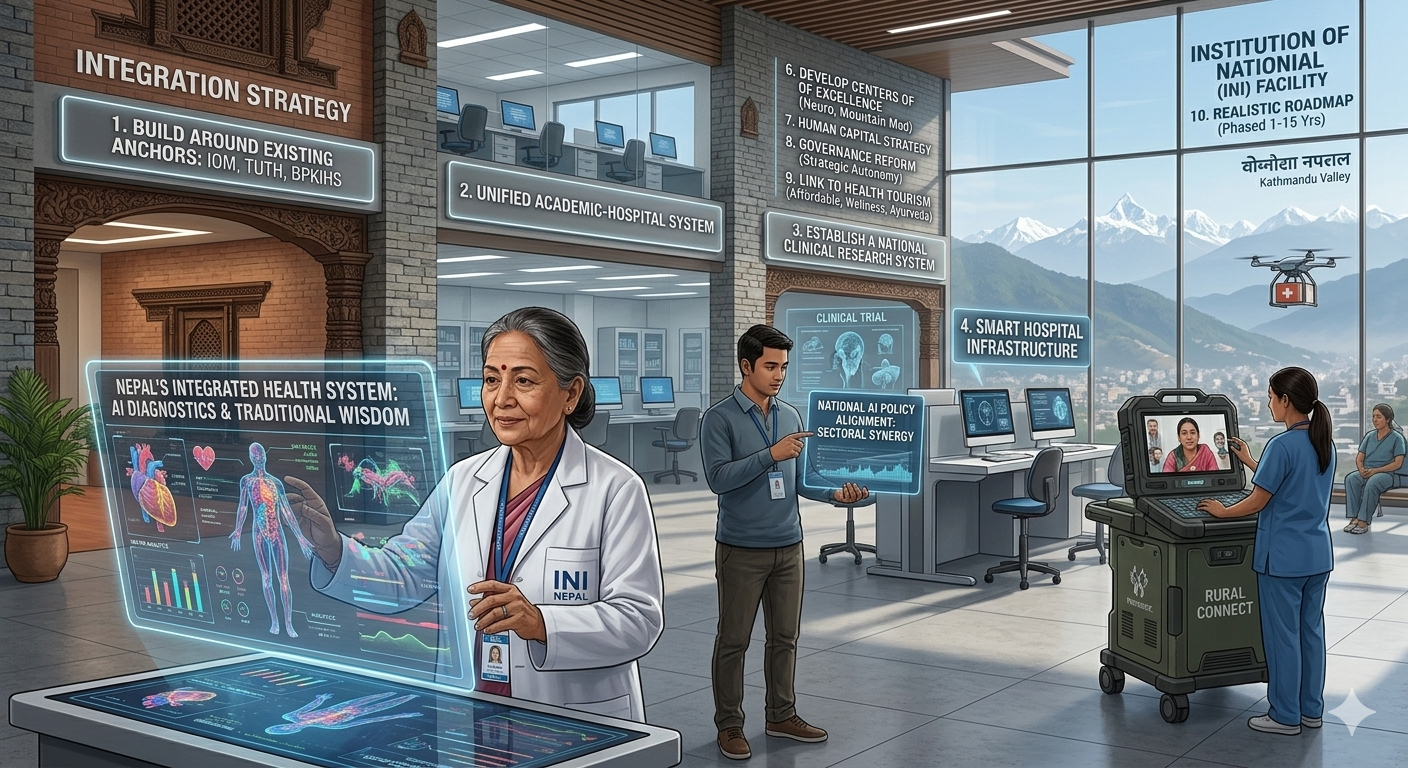
The path to revolutionizing healthcare in Nepal lies not in simply upgrading hospital wings, but in fundamental institutional reform. By adapting the University College London Hospital (UCLH) model—which thrives at the intersection of academic rigor, research funding, and institutional autonomy—Nepal can build a resilient, world-class health ecosystem.
This transition does not require starting from zero; rather, it demands the strategic integration and elevation of existing foundations.
1. Anchoring the System: From Fragmentation to Autonomy
Nepal already possesses "mini-ecosystems" that resemble the UCLH structure, such as the Institute of Medicine (IOM), Tribhuvan University Teaching Hospital (TUTH), and BPKIHS. However, these institutions are often hampered by a lack of financial independence. A critical first step is to designate 2–3 of these institutions as Institutions of National Importance (INI) through a Special Act of Parliament. This status ensures the academic and financial autonomy required to foster global positioning and integrated research pipelines.
2. The Academic-Hospital Synergy
The success of the UCLH model is rooted in the seamless integration of the hospital and the university. In Nepal, medical, engineering, and research bodies currently operate in silos. To mirror the best model, Nepal must bridge the gap between medicine and engineering. Collaborative programs involving the Institute of Engineering (IOE) and IOM should focus on Health AI and Medical Robotics utilizing AI-enabled technology to enhance clinical outcomes and Biomedical Engineering by developing local expertise in medical device maintenance and innovation.
3. Establishing a Clinical Research Frontier
A robust healthcare system must be a learning system. Currently, Nepal conducts limited clinical research and lacks a structured trial ecosystem. A National Clinical Research Authority should be established to oversee trials. Research should leverage Nepal’s unique geography and heritage, focusing on Mountain Medicine, Non-communicable diseases, and the scientific validation of Traditional Medicine.
4. Smart Infrastructure & Digital Integration
Modern healthcare requires "nervous systems," not just buildings. Infrastructure investment must prioritize technology that extends reach to the most remote communities. AI-Assisted Diagnostics should be implementing AI to support community nursing and rural health posts and building a national Electronic Health Record system that aligns with the Digital Nepal Framework.
5. Centers of Excellence and Health Tourism
Excellence is achieved through focus. By developing specialized centers, Nepal can become a regional hub for high-quality care. Strategic focus areas should include Oncology, Neurology, and High-Altitude Medicine. Once quality is established, Nepal can be positioned as a premier destination for Health Tourism, combining affordable high-tech care with wellness, Ayurveda, and the country's natural beauty.
The Bottom Line
The goal is not to "copy" a foreign model, but to adapt the universal principles of excellence: autonomous governance, academic integration, and research-driven accountability. With the right execution architecture and the push for INI legislation, Nepal can transform its health landscape into a beacon of innovation for South Asia.