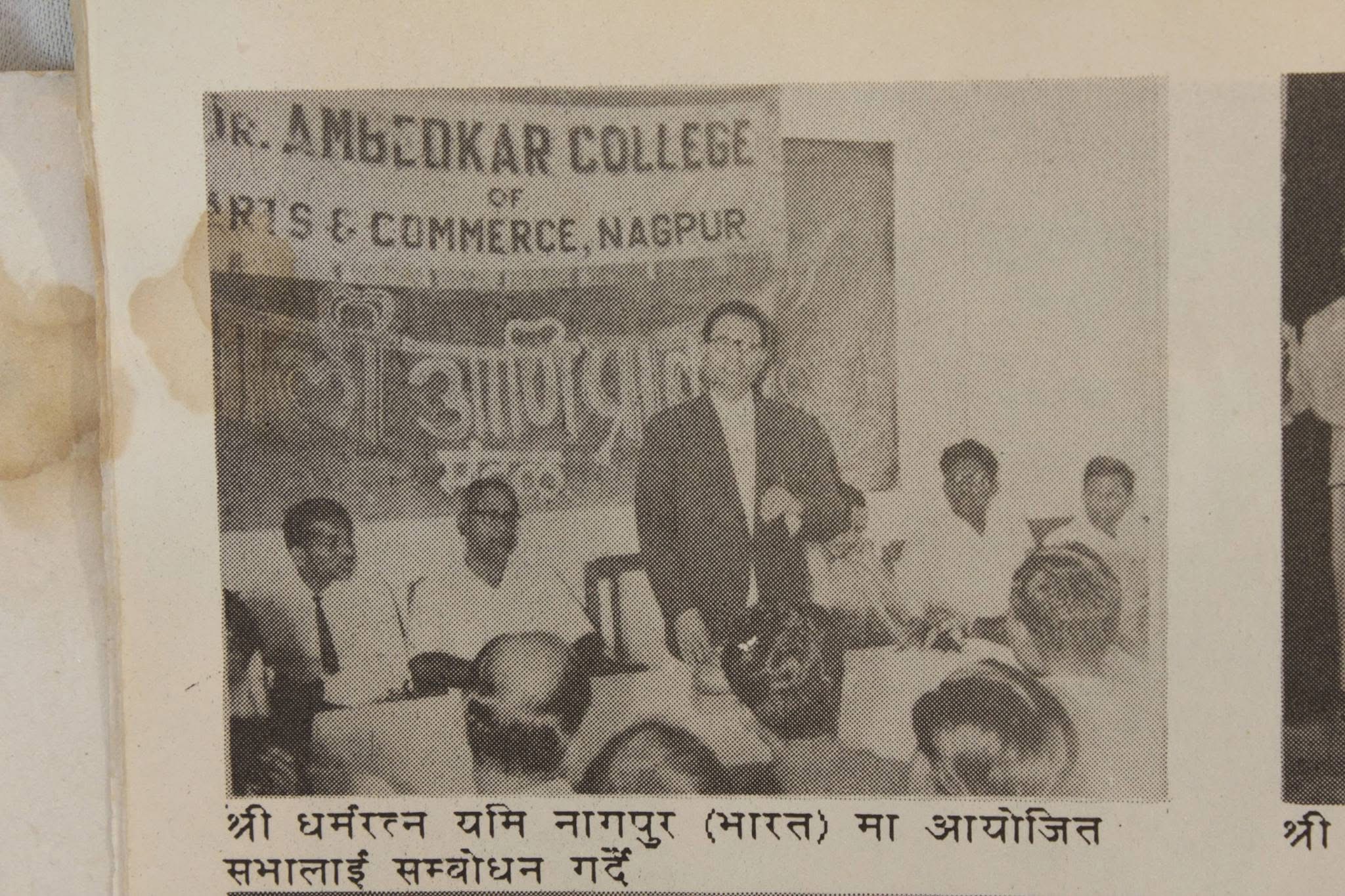
History has a curious way of catching up to its visionaries. In his own time, Dharma Ratna Yami was often a radical and lonely figure. His focus on the Human Buddha—a figure defined by logic, social justice, and intellectual revolution—clashed sharply with the ritual-heavy, orthodox environment of mid-20th century Nepal.
As the scholar Janak Raj Sharma once observed, while many in Nepal struggled to grasp his depth, the "great people of India" understood him immediately. He was a contemporary and kindred spirit to reformers like Dr. B.R. Ambedkar and Rahul Sankrityayan, who saw the Buddha not as a distant deity, but as a revolutionary leader of social equality.
Why He Was Misunderstood: A Clash of Worldviews
Dharma Ratna Yami's "misunderstanding" at home versus his "understanding" abroad was born from a profound cultural and political conflict:
-
The Threat of Rationalism: In a society where religious rituals upheld a strict social hierarchy (the Rana regime), the idea of a "Human Buddha" was dangerous. If the Buddha is a man of logic, then every human has the inherent right to challenge authority. To the traditionalists, this was heresy; to Indian reformers, it was the future.
-
Logic as a Practical Tool: Dharma Ratna Yami lived his philosophy. By hiring a cook from a marginalized caste and inviting the elite to a feast served by her, he turned Buddhist humanism into a radical social act. While local conservatives were horrified, visionaries abroad saw a man living the "Maha Manushya" (Great Human) ideal.
-
Intellectual Revolution: While those around him sought merit through ritual, Dharma Ratna Yami sought it through inner transformation. He championed the idea that peace comes from transforming our own understanding of society and ourselves—an "awakening" that felt decades ahead of its time.
The Digital Resurgence: AI and the New Generation
Fascinatingly, this "radical humanism" has found its perfect audience in the AI era. Today’s younger generation, often skeptical of rigid dogma, finds that the vision of the Human Buddha aligns perfectly with a data-driven, psychological world.
1. The "Algorithmic" Nature of Karma
Young people today understand the world through systems and feedback loops. Dharma Ratna Yami's focus on logic and cause-and-effect resonates with a generation that views life as a series of inputs and outputs. They don’t want a "heavenly judge"; they want to understand the "source code" of their suffering to rewrite it.
2. Intellectual Autonomy and Rebellion
In the Information Age, Yami's belief that "self-learning is a rebellion" has become a rallying cry for Gen Z and Millennials. They value direct experience over blind belief, seeking the intellectual independence that was the hallmark of his life.
3. The Human as a Fluid Process
The AI era asks: What makes us human? The concept of the Maha Manushya suggests that humanity is not a fixed status but a potential we must actively build. This mirrors the modern understanding of neuroplasticity—the idea that our "self" is an evolving process, a concept central to both advanced tech and Buddhist thought.
A Living Manifesto for Social Movements
Today, Yami’s work is not just a historical record; it is being integrated into new social movements as a living manifesto for secularism and justice.
-
Secular Humanism: Younger activists use the "Human Buddha" to advocate for a Nepal where dignity is based on action and intellect rather than divine birth or caste.
-
The "Maha Manushya" Blueprint: Modern "Engaged Buddhism" and youth-led equality movements cite his bold acts—like his parliamentary demands to scrap caste laws—as the bedrock of their current activism.
-
Global Connection: Just as he was linked to Indian reformers in the past, he is now connected to a global community that sees the intersection of mindfulness and social change.
A Legacy Reframed
The fact that Dharma Ratna Yami was once marginalized is perhaps the greatest evidence of his power. He was challenging a "ritual-heavy" status quo that society wasn't yet ready to question.
He wasn't just writing for his contemporaries; he was writing for the future. Today, as we build digital bridges to archive his legacy, we see that the Great Human he described has finally met a generation ready to listen, think, and act.
"Greatness comes from inner transformation, not divine birth." This distinction remains the core of his contribution to both Nepalese and global thought—a legacy that proves reason and empathy are the ultimate tools for liberation.