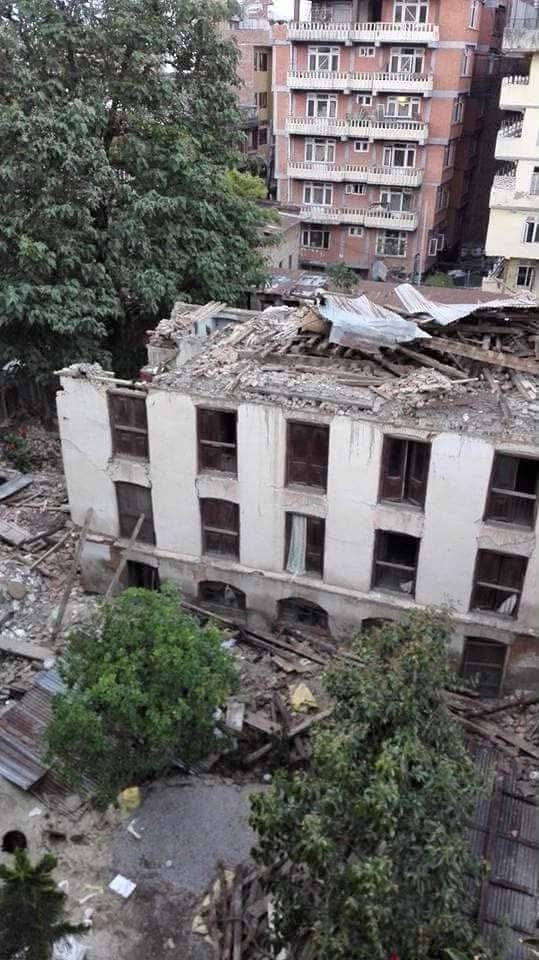
When Nepal faces its next major earthquake, flood, or landslide, what knowledge will truly protect our children and help rebuild our society?
Kathmandu has a rich cultural history, filled with sacred sites and Shiva lingas. Children naturally ask questions like, "Why are there so many lingas all over Nepal?" or "Why are women experiencing hallucinations often said to possess supernatural forces?" For generations, our ancestors passed down stories about women suffering from mental illness, explaining their experiences as supernatural possessions and claiming these individuals should be worshiped as goddesses. While we should respect our cultural history, we must also teach children the difference between tradition, personal belief, and empirical evidence.
When someone experiences hallucinations or mental health struggles, children should be taught about brain anatomy, neurology, psychology, and medicine—rather than automatically assuming a supernatural cause. The same logic applies to natural disasters. Understanding earthquakes, floods, landslides, and climate risks through a scientific lens directly saves lives. Our children need more than traditional stories; they need scientific literacy, critical thinking, disaster preparedness, and practical skills to navigate the real world.
Culture grounds us in our history, but science gives us the tools to protect our future. The real danger arises when children are taught to interpret mental illness, natural disasters, or physical phenomena primarily through supernatural explanations instead of learning neurology, psychology, medicine, geology, seismology, climate science, and evidence-based reasoning.
In an AI-dominated world, children need science, evidence, and education to thrive—not fear, superstition, and exploitation. Mythology has its place, but it cannot replace:
-
Earthquake Engineering & Geology
-
Disaster Preparedness & First Aid
-
Climate & Atmospheric Science
-
Critical Thinking & Modern Technology
When a crisis strikes, traditional myths offer no practical tools. Can a story teach a child how to pilot a drone over a flooded village to spot survivors? Can it guide them to locate someone trapped beneath a collapsed building? Can it help them read a hazard map, administer emergency CPR, or use AI to analyze satellite imagery for relief coordination?
A child cannot make this transformation alone. Mothers are the foundation of early childhood cognitive growth. Before Class 5, a child’s brain is rapidly forming neural connections, building habits of inquiry, confidence, and foundational logic. When a mother understands that STEAM is not a distant, technical luxury but a practical tool for life, she transforms every daily routine into an engine for learning.
When parents and families take this initiative at home, government and educational policies will finally succeed in the classroom. By encouraging children to pursue STEAM (Science, Technology, Engineering, Arts, and Mathematics) education, we equip them to solve real-world problems. We need an education system that builds genuine resilience—because practical skills, grounded in science, are what will save our future.