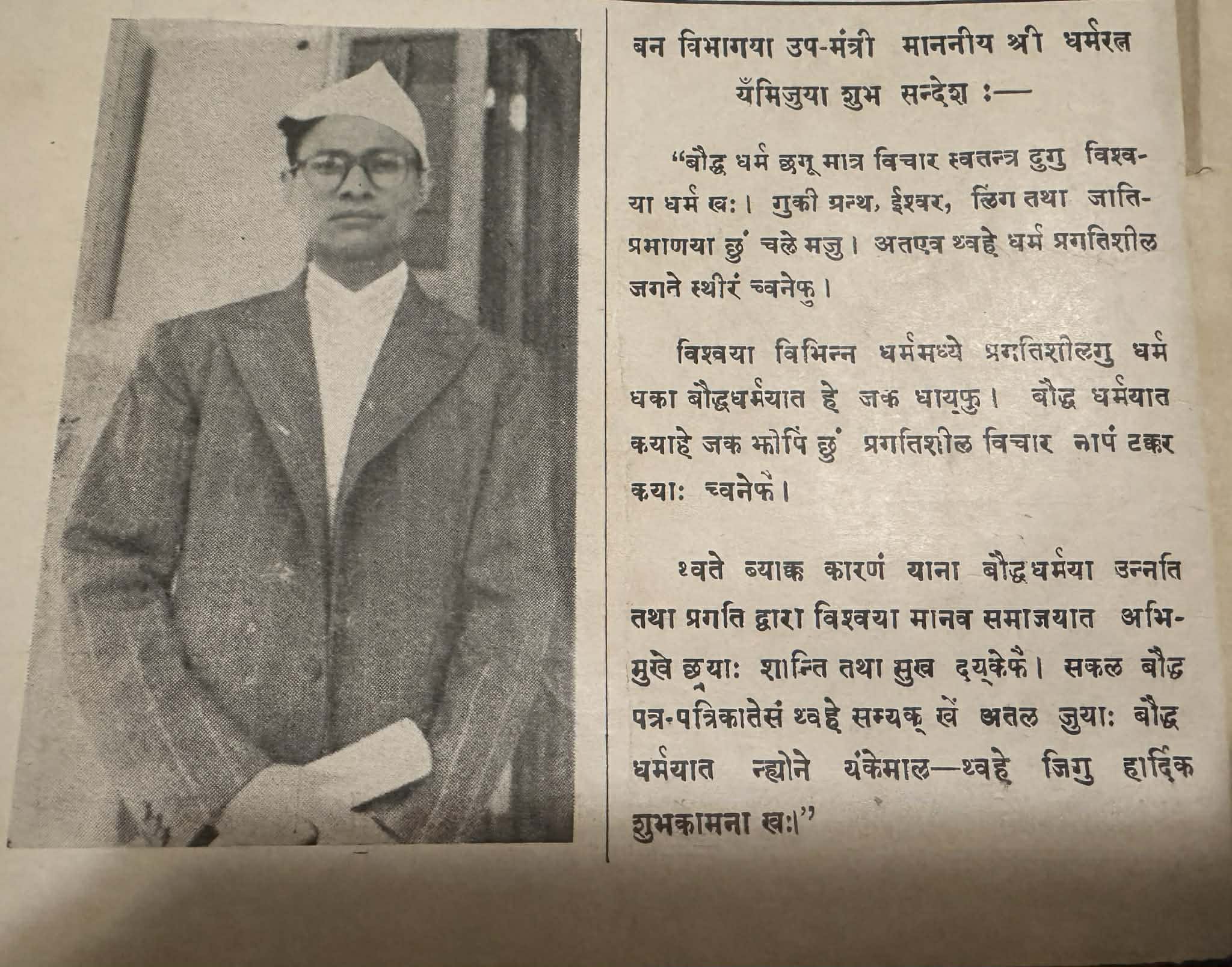
On Bhadra 25, 2032 B.S. (September 10, 1975), Buddhist scholar and anti-Rana movement freedom fighter Dharma Ratna Yami passed away at Bir Hospital at the age of 60.
Dharma Ratna Yami was born on Bhadra 02, 1915 B.S. in Asan Kamalakshi Tol, Kathmandu, as the son of father Bhavani Ratna Tuladhar and mother Devi Maya Tuladhar. Renouncing his original surname 'Tuladhar' and adopting 'Yami' to put social equality and a rebellious consciousness into practice was a revolutionary and idealistic step in his life.
In the society of that time, the surname 'Tuladhar' represented the high, elite, and wealthy merchant class of the Newar community. To oppose the prevailing caste system, class pride, and social discrimination, Dharma Ratna Tuladhar showed the courage to abandon his family's established identity and began writing 'Yami'. Since Kathmandu is called 'Yen' in the native Nepal Bhasa (Newari) and its residents are called 'Yami', he made this word his permanent surname to represent the land and the people rather than any specific caste or class. This decision proved that he was a true champion of creating a casteless and egalitarian society, not just in words, but in action.
Dharma Ratna Yami was an incomparable and multidimensional figure in Nepal's political, social, and literary transformation, dedicating his life to establishing democracy in the country by fearlessly raising his voice against the harsh oppression of the autocratic Rana regime. Having served in a vital role as a deputy minister in Nepal's first cabinet formed after the historic revolution of 2007 B.S. (1951), Yami made invaluable contributions to politics as well as to the promotion of Nepal Bhasa (Newari) language and literature. Strongly opposing the prevalent caste system, untouchability, and superstitions, he played a pioneering role in spreading awareness of Buddhist philosophy, peace, and social equality through platforms like the Nepal Youth Buddhist Council. This triangular contribution to revolutionary thought, literary pursuit, and the revival of Buddhism has established him as an ever-memorable and progressive hero in the history of modern Nepal.