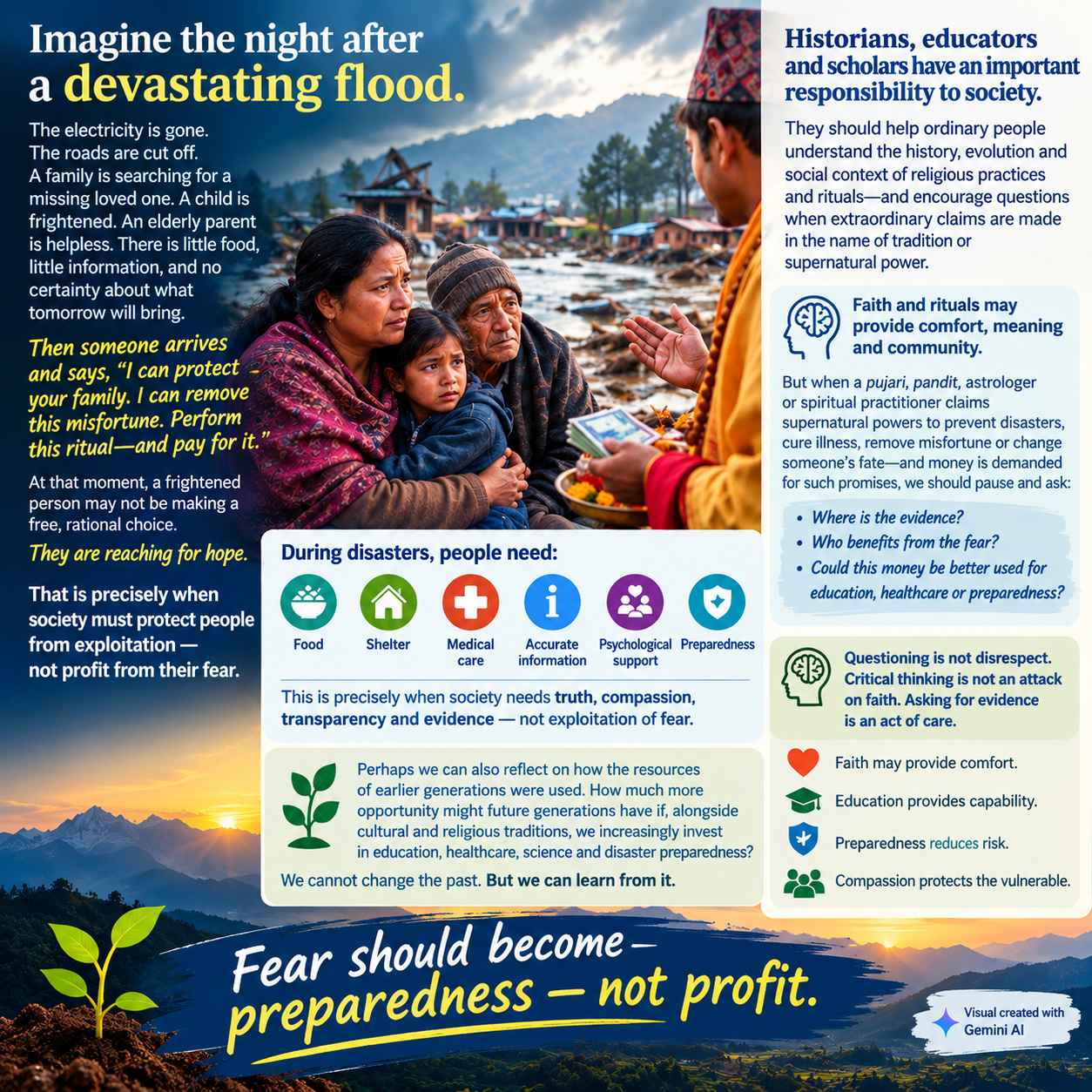
The night after a devastating flood, the electricity cuts out and roads are washed away. A family searches frantically for a missing loved one. A child is terrified. An elderly parent feels completely helpless. Food and reliable information are scarce, and no one knows what tomorrow will bring. In that moment of chaos, someone arrives with a seductive promise: “I can protect your family and remove your misfortune. Just pay for this ritual.” Overwhelmed by panic, a desperate person is not making a free, logical choice—they are grasping for hope. This is precisely when society must step in to protect vulnerable citizens from being financially exploited in their darkest hours.
Moving from Fear to Science and Technology
When crisis strikes, turning to supernatural promises is not the answer. Instead, we must anchor our response in higher education, science, and technology. Nepal must demand that its government establish Institutes of National Importance (INIs) through dedicated legislation and robust funding. By building top-tier, independent universities and research centers, our nation can foster genuine, long-term resilience.
Crucially, this strategy requires investing in Artificial Intelligence (AI) and modern computing infrastructure. When communities gain access to AI-driven early warning systems, satellite maps, and real-time data, they are no longer helpless in the face of disaster. Equipping families with these practical, scientific tools encourages the youth to embrace STEAM (Science, Technology, Engineering, Arts, and Mathematics) education—building a future grounded in real-world problem-solving rather than fear.
Stopping the Brain Drain
One of Nepal’s greatest tragedies is the persistent "brain drain." Every day, bright young minds and skilled experts leave the country—not because they lack talent or devotion to their homeland, but because our system fails to support them.
Nepal possesses ample intellect and vision; what we lack are the institutions and resources that allow talent to thrive at home. To reverse this trend, we must take concrete action:
-
Grant Universities Legal Autonomy: Pass an Act of Parliament designating premier academic institutions as Institutes of National Importance (INI). Too often, decision-makers lack the political vision to shield higher education from partisan interference and bureaucracy. Enacting statutory INI status creates a legally protected, autonomous space where researchers and educators can innovate without political meddling.
-
Build National AI Infrastructure & Educate Policymakers: Establish a National AI Centre and high-performance computing labs so young tech talents can build localized solutions for agriculture, healthcare, and disaster management. For this to succeed, policymakers must first be educated on AI's transformative potential to cultivate the political will needed to fund and sustain national-level tech infrastructure.
-
Empower Expert Task Forces & Mobilize the Diaspora: Place proven senior experts—rather than political appointees—in charge of critical policy decisions regarding disaster planning, AI strategy, and STEAM education. Furthermore, engaging Nepal’s global diaspora is essential; connecting overseas professionals with local institutions brings back world-class expertise, funding, and mentorship.
-
Fund Local Innovation & Modernize School Curricula: Establish government seed grants, R&D funds, and incubators to help young engineers launch startups and generate local jobs. This pipeline must begin early by modernizing school curricula to foster scientific inquiry and critical thinking. Additionally, mobilizing alumni networks can unlock private investment and mentorship for the next generation.
-
Bridge Youth and Experience Through Mentorship & Capital: Create structured mentorship programs where veteran experts guide young innovators—passing down decades of wisdom while adopting modern digital tools in return. Pair this with venture capital and angel investment to scale promising ideas into viable industries, supported by AI-literate lawmakers who craft policies that foster innovation rather than stifle it.
When we respect expertise and fund research, we give our youth a compelling reason to stay and build the nation.
The Power of Science and Critical Thinking
Educators, scholars, and historians play a vital role in helping society understand religious traditions while encouraging people to ask thoughtful questions when extraordinary claims are made.
When a practitioner claims they can avert a disaster, cure an illness, or alter fate—and demands money in return—we must pause and ask: Where is the evidence? Who profits from this fear? Could these funds be better spent on healthcare, education, or disaster preparedness?
Natural disasters—earthquakes, landslides, floods, and storms—are governed entirely by physical laws operating at planetary scales. Satellite data clearly demonstrates that weather patterns and tectonic shifts are driven by heat, pressure, and physics. No ritual, financial donation, or belief system can reduce tension along a fault line or reroute a storm's path.
Fostering scientific literacy shifts our focus toward actionable safety: constructing earthquake-resistant infrastructure, deploying satellite warning systems, managing land use responsibly, and providing medical and psychological relief during crises. Nepal already possesses valuable scientific assets—such as ICIMOD's satellite monitoring capabilities—alongside a passionate youth movement advocating for STEAM education. Bridging the generational gap through science will replace unverified practices with life-saving preparation.
We cannot change the past, but we can learn from it.
Questioning is not disrespect. Critical thinking is not an attack on faith. Asking for evidence is an act of care. Education provides capability, preparedness reduces risk, and compassion protects the vulnerable.
Fear must be transformed into preparedness—not profit.