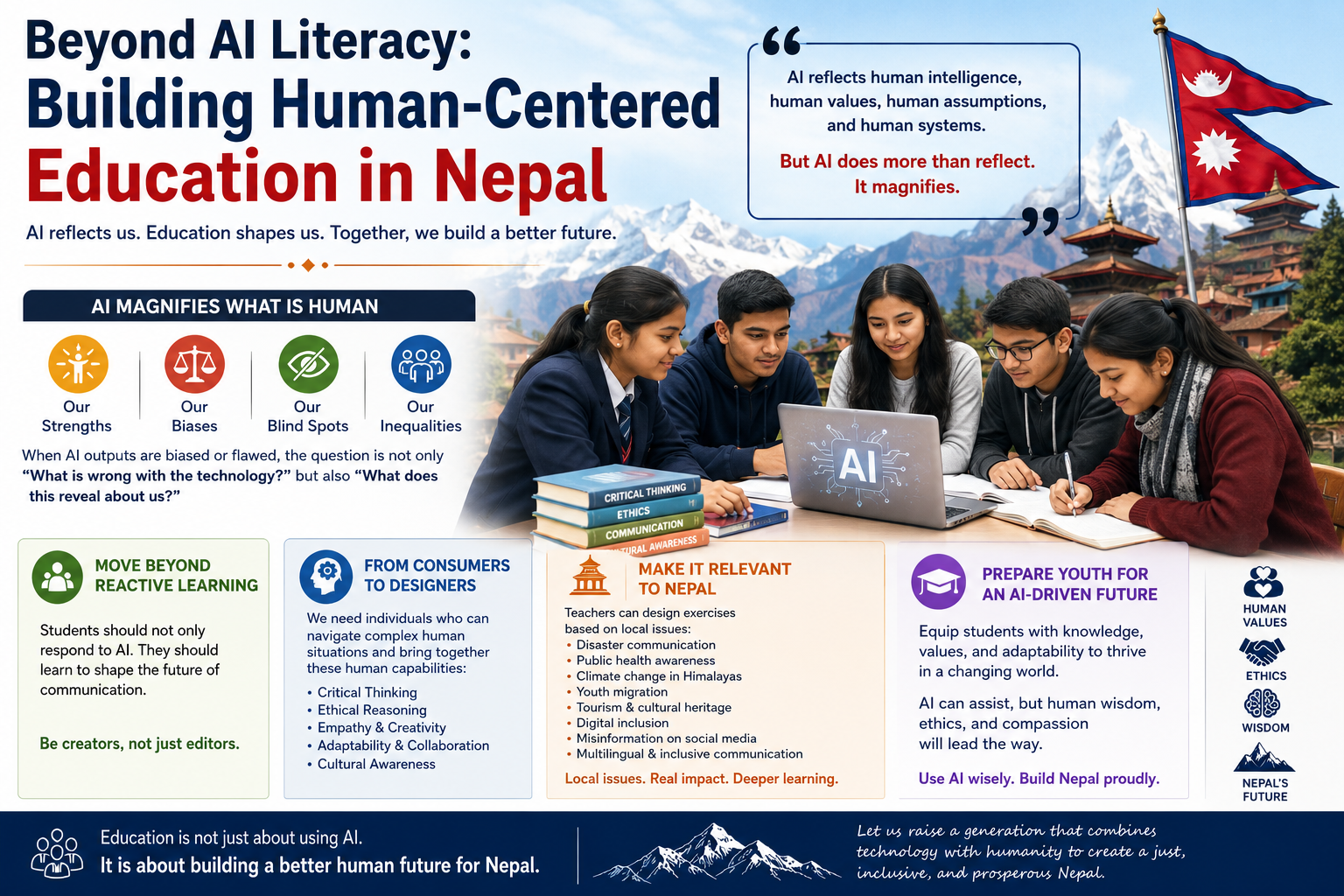
AI and the Future of Learning: Keeping Humanity at the Center
Artificial Intelligence (AI) is no longer a thing of the future—it is here, and it is changing how we live, work, and learn. In Nepal, AI is starting to touch everything from farming in rural villages to how adults learn new skills later in life. Whether we are using it to write emails, look up information, or automate daily tasks, AI has become a constant companion.
But as we get excited about this technology, we need to ask ourselves a deeper question: What does AI actually tell us about who we are as human beings?
Think of AI as a giant mirror. It doesn't think on its own; it learns from us. It studies the data we create, the languages we speak, and the choices we make. Because of this, it reflects both the best and worst parts of our world. When AI shows bias or makes a mistake, it’s usually because it learned that behavior from human history. It forces us to look in the mirror and ask: How can we do better?
Moving From "Tech Users" to "Tech Creators"
Right now, schools around the world are bringing AI into the classroom. A common lesson is to have students read an AI-written essay and point out the mistakes.
While this is helpful, it isn’t enough. It turns students into mere "editors" or "reactors." They are just cleaning up after the machine instead of using their own imaginations.
The future doesn’t just need people who can spot typos in an AI draft. We need young people who can invent entirely new ways to communicate, collaborate, and solve problems. We need to stop teaching students just how to use AI, and start empowering them to shape it.
What Money Can’t Buy: Uniquely Human Skills
Because AI can instantly generate facts and text, the old way of defining a "good education"—memorizing information—is officially outdated. Knowing how to run a computer program is useful, but it’s no longer enough. The most valuable people in an AI-driven world will be those who master skills that computers can never copy. These are uniquely human strengths knowing what is right, fair, and true, understanding how people feel and working together to build trust and solving messy, unexpected human problems that don't have a textbook answer.
Changing the Way We Learn Language
This shift changes everything, including how we teach language. Language is not just about perfect grammar or vocabulary; it’s about connection. It is how we build trust, express who we are, and create social change. Instead of just teaching students how to write correct sentences, we should teach them to ask: Whose voices are being heard, whose are missing, and how can we use communication to bring people together?
Making AI Education Work for Nepal
If we want AI education to matter in Nepal, we have to stop using generic, textbook examples from western countries. Our students should learn by solving real, local problems like designing better communication alerts during earthquakes and floods, creating public health campaigns for isolated rural communities, promoting cultural tourism while respecting local traditions, studying how social media misinformation spreads in our towns and finding solutions for youth migration, climate change in the Himalayas, and preserving our diverse languages.
By focusing on our own realities, students don't just learn technology—they develop a deep sense of civic duty and love for their communities. The technology can support them, but the wisdom and solutions must be purely Nepali.
Preparing Our Youth for What's Next
As Nepal moves further into the digital age, AI will enter our hospitals, farms, businesses, and government offices. But our success will not depend on how many computers we buy. It will depend on our people.
Investing in high-speed internet is important, but investing in human minds is even more critical. Our schools and universities must transform. We need educational reforms that break down old walls, encourage teamwork across different subjects, and teach responsible tech use.
The bottom line: AI can generate ideas and sort data, but it completely lacks human judgment, wisdom, and compassion. Those are the exact qualities that will define Nepal’s future leaders.
Technology is the Tool, Wisdom is the Guide
People often talk about AI as if it’s a race between humans and robots. That is the wrong way to look at it. The real challenge is not how smart machines become, but whether humans can stay wise.
AI can write code, but it cannot tell you what is morally right or socially just. It cannot build a kinder society. That responsibility belongs entirely to us.
For Nepal, the ultimate goal is not to graduate students who are just good at using AI tools. The goal is to raise thoughtful, creative citizens who use technology to lift everyone up. The future doesn't belong to technology alone—it belongs to those who pair technological power with human wisdom.
The three biggest challenges Nepal faces in moving away from rote memorization toward an active, human-centered model include:
The Trap of a "Passive Tech" Infrastructure
Right now, the default approach to digital transformation is simply buying computers or providing high-speed internet. However, giving a school a digital screen often just turns traditional rote learning into digital rote learning—where students passively consume pre-made global content rather than designing anything themselves. We have to change the infrastructure from a tool for viewing to a sandbox for creating.
A "Data Deficit" in Local Realities
AI systems learn from data. Currently, global AI models are trained primarily on Western datasets. When a Nepali student asks an AI for a case study, it defaults to examples from New York or London, completely missing the realities of youth migration, Himalayan climate change, or disaster response in our own terrain. Without localized, high-quality datasets that reflect our diverse languages, cultures, and geographical challenges, our classrooms cannot anchor their lessons in authentic civic problem-solving.
Shifting the Focus from Passing Exams to Solving Problems
Our current institutional architecture is largely designed to test memory—grading how accurately a student can repeat a known formula or standard answer. Moving to a model that values critical thinking, ethical reasoning, and the "observer mindset" requires changing the way we measure success. We need to evaluate students based on how they navigate uncertain, complex situations, collaborate across subjects, and apply ethical human judgment to real challenges.
The Path Forward
The solution lies in shifting our focus from tools to systems. By granting autonomy to premier technical institutions and aligning our classrooms with robust STE(A)M models and our national frameworks, we can ensure that innovation in Nepal proceeds at the speed of wisdom, not just technological capability.