In countries with unpredictable politics and limited financial resources, discussions about national stability usually focus on money, physical infrastructure, or border security. However, the biggest hidden danger facing these nations is the continuous loss of local technical talent.
When a political system is unstable and jobs are uncertain, top engineers, scientists, and researchers leave the country. This creates a dangerous cycle: as local experts move abroad, national institutions lose the ability to solve local problems—such as building resilient infrastructure, improving public health, or managing digital governance. The country then becomes heavily dependent on foreign aid and outside consultants, losing control over its own development.
To fix this, we must ask a fundamental question: Which university will take responsibility for building, keeping, and empowering local experts?
Why Traditional Universities Are Struggling
Standard public universities operate under slow, rigid bureaucratic rules. In unstable political environments, traditional universities suffer from three main problems. University appointments and major decisions are often delayed or influenced by political party shifts rather than merit. Rote learning and memorization fail to teach students the critical thinking and practical skills needed to solve real-world national problems. Because local experts see little support or chance to influence national policy, they choose to move abroad instead of staying. When a university acts only as a factory for issuing degrees rather than a hub for real-world innovation, it cannot protect the country from economic and political crises.
The Solution: Institutes of National Importance (INI)
Responsibility cannot be spread across dozens of underfunded, struggling faculties. A country needs a strong, legally protected anchor: an Institute of National Importance (INI) created directly by an Act of Parliament.
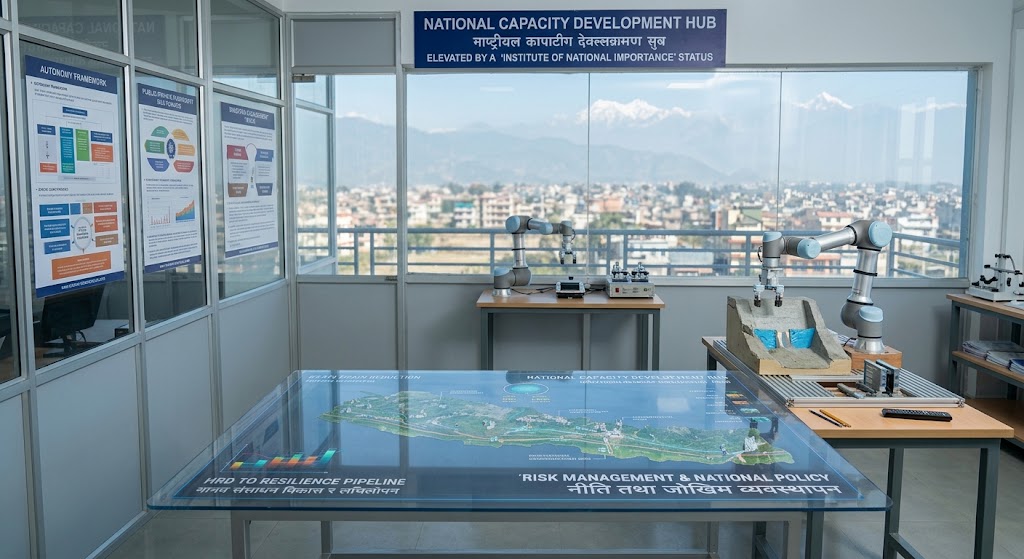
An INI is not just another university. It is a premier technical institution granted full operational, academic, and administrative independence. By protecting the university from political changes, an INI serves three major roles:
1. Fair Governance and True Independence
To keep talented scholars from leaving, an academic center must be fair, efficient, and merit-based. Parliamentary autonomy protects university leadership, research grants, and hiring decisions from political party cycles. This allows long-term research to continue without interruption.
2. Practical STE(A)M Education
An INI shifts teaching away from memorizing textbooks and toward hands-on STE(A)M (Science, Technology, Engineering, Arts, and Mathematics) education. Students learn by tackling actual local challenges—such as designing climate-resilient roads, creating ethical AI frameworks for regional governance, and managing local resource shortages.
3. Connecting Research Directly to National Policy
Talented professionals migrate not just for higher salaries, but because they want their work to matter. An INI gives experts a direct seat at the government policy table. When local engineers and scientists see their research being used to build national roads or draft laws, they have a strong reason to stay and build their own country.
Working with Foreign Experts and the Diaspora
Building local talent does not mean cutting the country off from the rest of the world. An autonomous technical institution provides a respected, trusted platform to collaborate with international experts and scientists living abroad.
Instead of relying on short-term foreign aid projects, an INI can:
-
Create Joint Teaching Positions: Allow scholars living abroad to teach courses, mentor local students, and co-lead research projects without having to move back permanently.
-
Fund Local Research with Infrastructure Budgets: Require that a small percentage of major national construction and technology project budgets go directly to university labs for local testing, quality checks, and student training.
Human Resource Development is National Security
Developing local experts is not a luxury saved only for wealthy countries—it is the foundation of national survival. In fragile environments where politics and budgets are uncertain, a country's best line of defense is the skill, dedication, and problem-solving ability of its own people.
By granting premier technical centers full legal autonomy as Institutes of National Importance, nations can stop brain drain, take charge of their own policy decisions, and build a resilient future.