High in the Himalayan passes, where ancient trade routes carved through granite and fog, history was rarely written in stone—it was spoken. For generations, the stories of mountain merchants, borderland artisans, and resilient communities survived through living memory: passed down around fires, carried in song, and embedded in everyday cultural rituals.
Today, as urbanization, rapid migration, and digital noise sweep across the region, these living archives face a quiet crisis. When an elder passes away, an entire library of unrecorded regional history, ecological wisdom, and cross-border trade knowledge vanishes with them. Preserving these voices is not merely an exercise in nostalgia; it is an urgent act of cultural sovereignty and historical continuity.
The Fragility of Unwritten History
Official history is often written from administrative centers, favoring formal treaties, political regimes, and top-down economics. But the true fabric of the Himalayas was woven by those on the move. Consider the legendary Newar traders who navigated the Lhasa trade routes for centuries, acting as economic and cultural ambassadors between Kathmandu, Tibet, and India. Their lives were defined by extraordinary cross-cultural synthesis, enterprise, and grit.
Yet much of this history remains undocumented in conventional textbooks. The nuanced realities—how trade networks adapted during diplomatic shifts, how women managed households and communities during multi-year commercial expeditions, and how indigenous medical and architectural knowledge crossed mountain passes—exist almost exclusively in oral recollections and private family archives.
Without active documentation, we risk relying on fragmented external narratives that misinterpret or overlook the agency of mountain peoples.
Sandeyā Lisah: A Living Testament of Mountain Memory
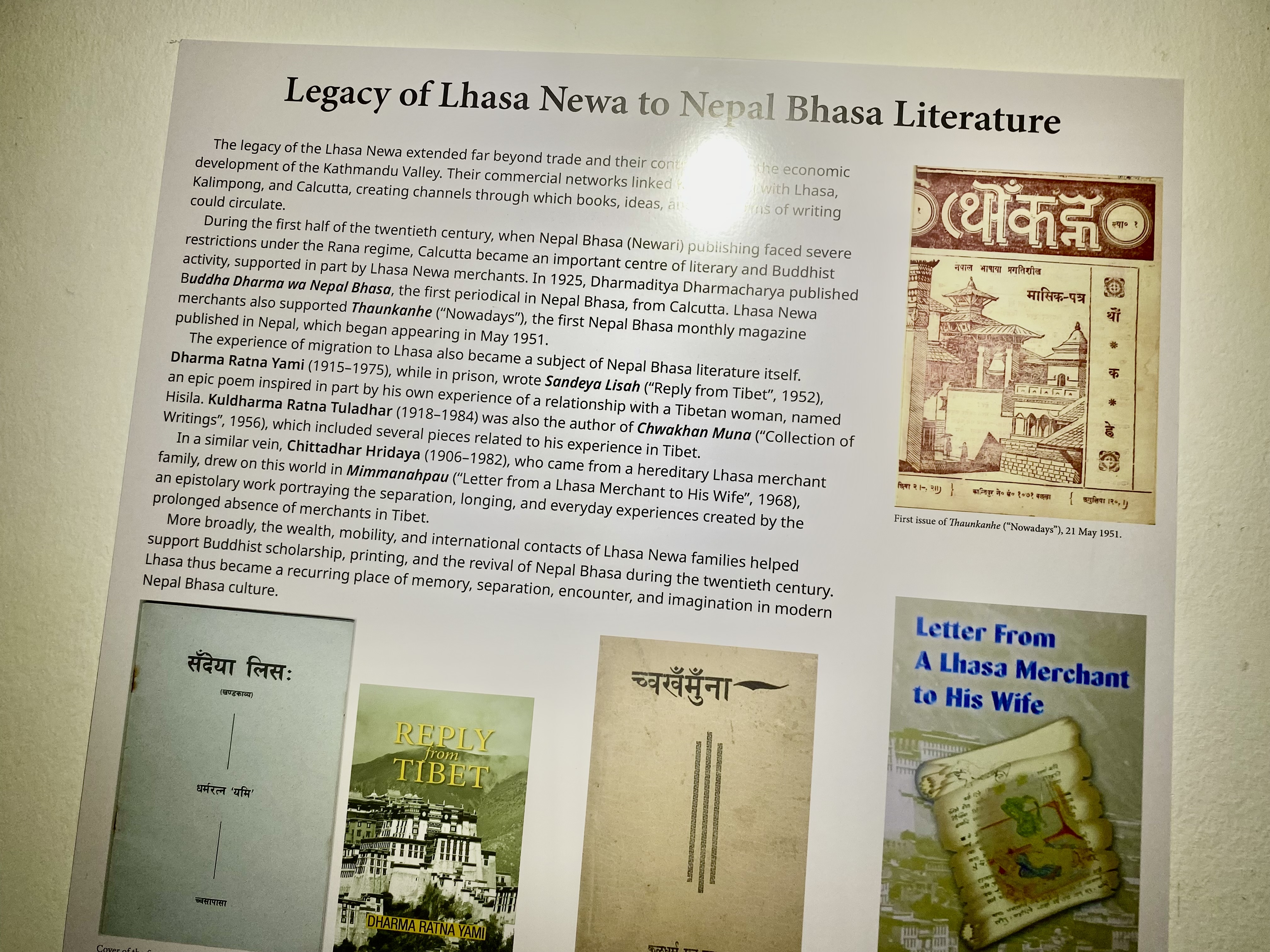
A striking example of preserving this trans-Himalayan heritage is found in Sandeyā Lisah (Reply from Tibet, Lhasa Bolchhe), composed by the scholar, writer, and activist Dharma Ratna Yami. Written in 1950 while imprisoned in Bhadragol Jail following seven years in Lhasa, Yami transformed personal recollections, merchant accounts, and cross-border cultural encounters into a seminal epic.
Works like Sandeyā Lisah demonstrate that oral histories and literary memoirs are not passive reflections—they are active acts of cultural preservation. They capture the personal human experiences behind the Lhasa Newar merchant routes at a pivotal time when geopolitical shifts threatened to erase those lived realities forever. When primary literature and oral recollections converge, they provide an irreplaceable lens into the social and economic resilience of mountain communities.
From Rote Memory to Living Archives
To safeguard this legacy, our approach to heritage must evolve. Archives should no longer be viewed as static rooms filled with dusty, inaccessible documents. Instead, we must construct living archives—dynamic platforms that blend oral history, community participation, and digital technology.
1. Intergenerational Archival Work
Preservation begins at home and in local communities. Empowering students and young researchers to record their elders turns history into an active inquiry rather than a passive lesson. Capturing spoken dialect, subtle idiomatic expressions, and personal anecdotes preserves emotional truth that formal records miss.
2. Bridging STE(A)M and Cultural Heritage
Integrating Science, Technology, Engineering, Arts, and Mathematics (STE(A)M) into heritage preservation elevates the work. Digitizing rare manuscripts, mapping historical trade routes using Geographic Information Systems (GIS), and producing high-fidelity audio-visual archives require a fusion of technical skill and artistic sensitivity. Technology becomes a servant of human memory, ensuring regional stories are securely stored and widely accessible.
3. Preserving Family and Community Artifacts
Oral histories are often linked to tangible items—letters, trading logs, old photographs, and textiles kept in family trunks. Community-driven digitization projects allow families to preserve their physical artifacts while sharing high-resolution copies with public research platforms, democratizing access to historical data.
Why Oral History Matters for the Future
Understanding where we come from directly shapes our capacity to navigate the future. A society that loses touch with its ancestral memory becomes vulnerable to cultural disorientation and external influence.
By grounding young minds in the resilience, critical thinking, and enterprise of their ancestors, we cultivate cognitive strength and identity. The merchants, educators, and social reformers who built our historical pathways faced immense geopolitical, physical, and economic obstacles. Their stories offer a blueprint for resilience in an increasingly unpredictable world.
As we look toward an automated and fast-paced digital future, our most human asset remains our collective memory. It is time to record, honor, and pass on the living archives of the Himalayas—ensuring that the voices who built our past continue to guide our future.