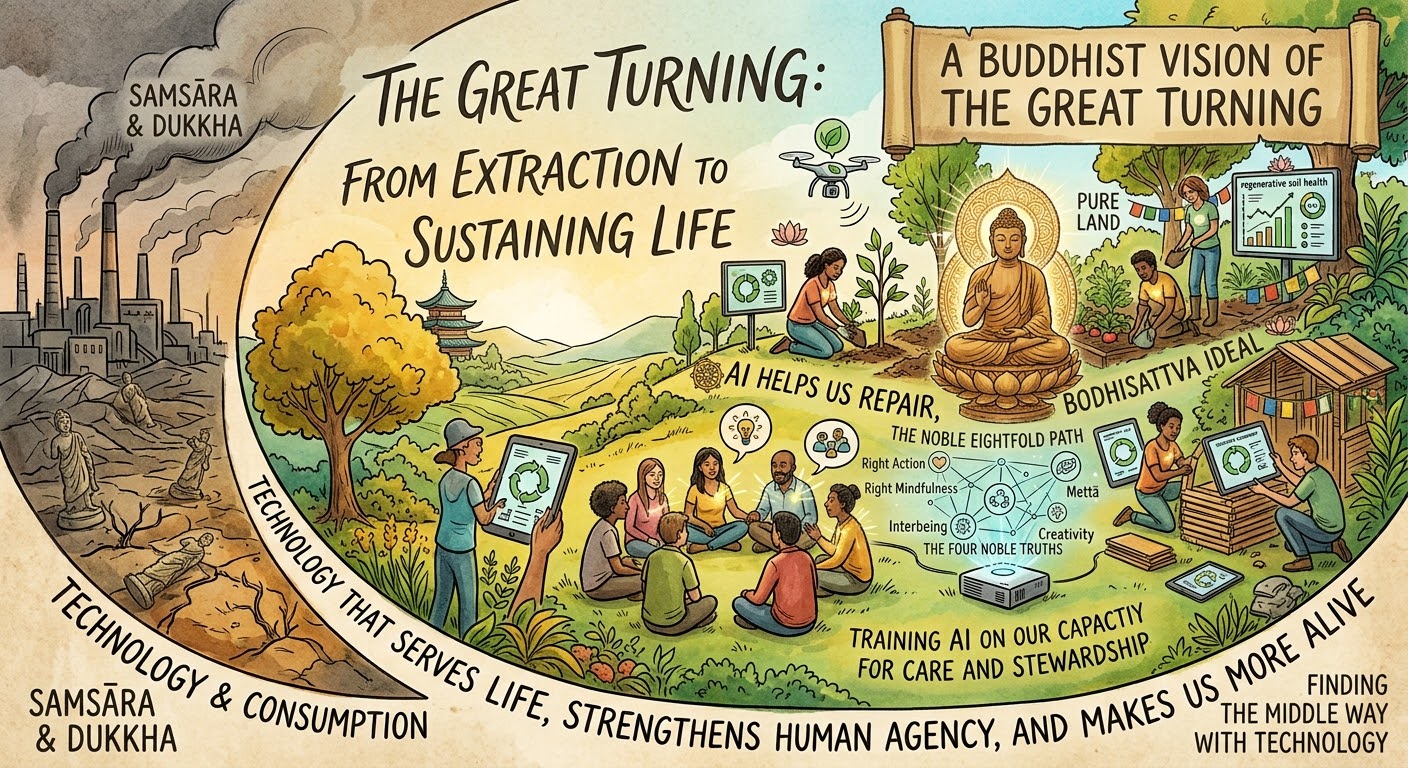
The Great Turning represents a profound epochal shift—a transition from an extractive, industrial civilization toward a regenerative society built to sustain and elevate life. As artificial intelligence reshapes the contours of human capability, a defining question emerges: Can we imagine—and boldly demand—a world where powerful AI becomes an active instrument of this transformation? Rather than accelerating resource extraction, market commodification, and social fragmentation, AI can be harnessed to repair our ecosystems, restore our environments, and deepen our communal bonds.
Language is never neutral. It is the vessel of human consciousness—carrying our shared history, our ethical dilemmas, our fears, and our collective wisdom. Because AI models are trained on the vast corpus of human expression, they are, in a very real sense, trained on us. This endows humanity with both an extraordinary opportunity and a sacred responsibility:
If artificial intelligence learns from humanity, what legacy do we choose to teach it?
Shall we train these systems only on our historical patterns of competition, hyper-consumption, prejudice, and short-term exploitation? Or can we intentionally imbue them with our capacity for compassion, cooperation, critical inquiry, creative stewardship, and care for the living world?
The ultimate metric of AI's advancement is not merely its technological capacity, but whether its power enables us to become more deeply human. AI must not diminish human dignity or displace human purpose; it must return to us our most precious resources—time to care, time to connect, time to create, time to regenerate nature, and time to cultivate flourishing communities.
From Philosophical Vision to Practical Safeguards: AI as a Pillar of Truth
This vision of a life-affirming technology finds urgent practical expression during moments of crisis. When natural disasters strike, fear and information voids create fertile ground for predatory actors, pseudoscientific hoaxes, and unscientific narratives—ranging from wild conspiracies about artificial weather manipulation to dangerous fake remedies.
When deployed in service of truth and human agency, AI can serve as a vital mechanism for counteracting panic and protecting vulnerable communities. AI systems can cross-reference viral misinformation with empirical scientific consensus and real-time sensor data, flagging malicious fabrications before they cause real-world harm. By identifying coordinated disinformation and clout-chasing intermediaries who capitalize on public grief, AI helps prevent the secondary exploitation of marginalized groups in distress. Through localized, accessible, and multilingual communication, AI can deliver accurate, life-saving guidance directly to citizens, strengthening local resilience without overriding human judgment.
In this paradigm, artificial intelligence operates not as an arbiter of control, but as an engine of clarity—serving life, strengthening human agency, and neutralizing the narratives that divide and exploit us.
Honoring the Visionaries: The Legacy of Dharma Ratna Yami
This synthesis of technological capability and moral responsibility is not a novel invention; it is the continuation of a long tradition of visionary thought. Great scholars and thinkers—such as Nepal’s prominent intellectual Dharma Ratna Yami—were frequently sidelined or underappreciated in their own eras. Yet, the foundational principles he advocated—human dignity, ethical stewardship, social transformation, and the relentless pursuit of truth—are precisely the values that leading contemporary AI researchers now recognize as essential to building wise, aligned, and human-centered systems. The Great Turning ultimately invites a fundamentally new relationship between humanity and artificial intelligence Technology that serves life rather than exploits it; Intelligence that amplifies human wisdom rather than replaces it; and Progress that leaves us more connected, more compassionate, and more profoundly alive.
As artificial intelligence capabilities scale rapidly across academic, technical, and social domains, current technical alignment models face a fundamental bottleneck: optimizing for raw computational speed and benchmark accuracy fails to account for systemic societal impact and ethical governance.
To position our institution at the forefront of responsible innovation, we propose the establishment of the Interdisciplinary AI Red-Teaming & Ethics Advisory Board (IAB). Grounded in systems theory and traditional humanistic governance frameworks—specifically drawing from Buddhist philosophy—the IAB provides a rigorous, multi-stakeholder framework to evaluate, red-team, and govern AI deployment across four critical phases: data provenance, systemic red-teaming, domain protection, and restorative post-deployment auditing.