Historical Context: The Climax of Rana Autocracy (1947–1949 CE / 2004–2005 BS)
For over a century (1846–1951 CE), Nepal was ruled by the hereditary autocratic Rana regime, which stripped the Shah monarchy of power, severely restricted public education, forbidden freedom of expression, and barred political organization. By the late 1940s, however, the geopolitical landscape shifted dramatically: British colonial rule collapsed in neighboring India in August 1947, depriving the Ranas of their chief external backer and sparking deep democratic aspirations across Nepal.
In early 1948 (2004 BS), responding to mounting public unrest, reform-leaning Prime Minister Padma Shumsher drafted Nepal’s very first constitution (Nepal Sarkar Ain 2004). However, hardliners within the family forced his resignation in April 1948 (early 2005 BS), elevating Mohan Shumsher to power. Mohan Shumsher immediately revoked the constitutional reforms, banned political parties like the Nepali Rastriya Congress, and enforced a total state of terror. The central demand of the anti-Rana movement thus converged on a single defining mandate: the securing of a written Constitution (Vidhan) and the establishment of a democratic state.
1. A Valley Frozen in Fear (2005 BS / 1948 CE)
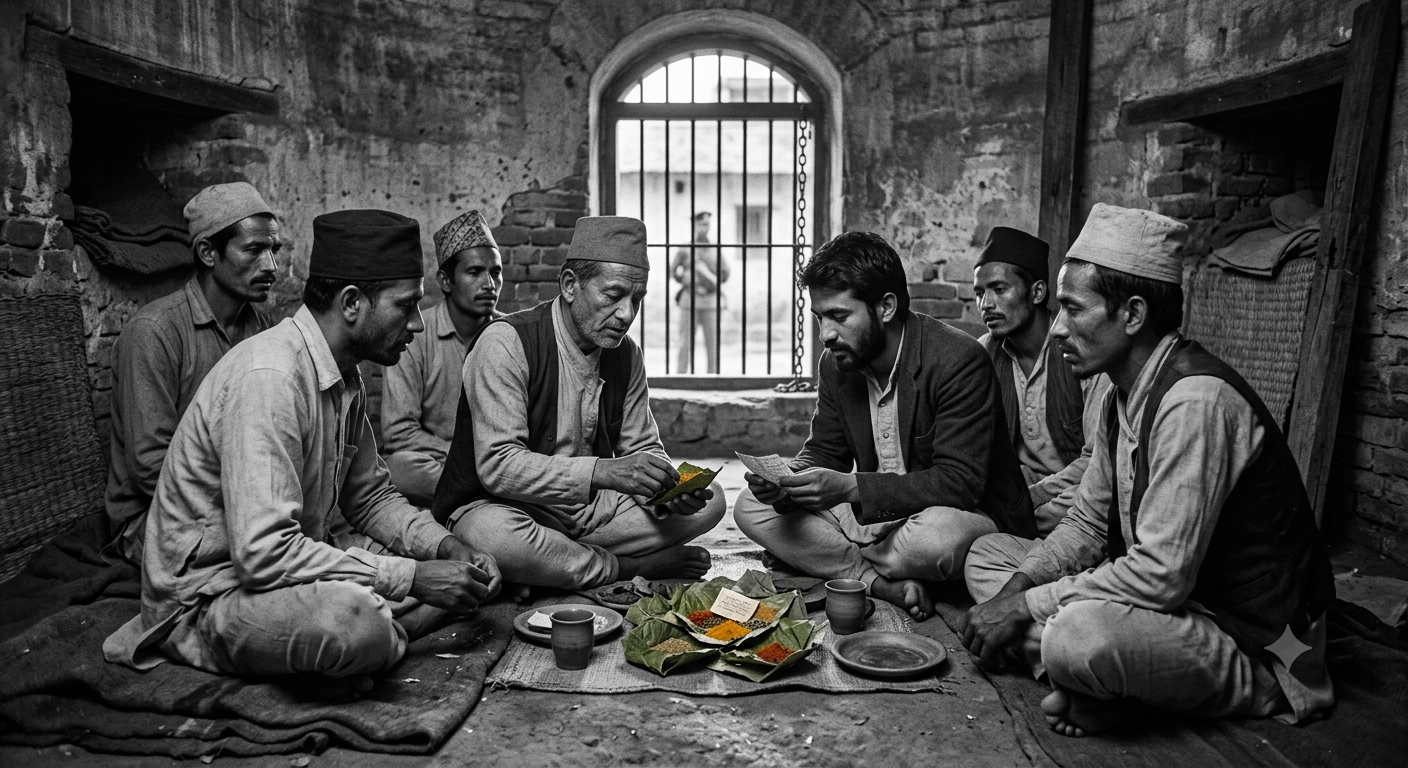
When Prime Minister Mohan Shumsher launched a total crackdown against democratic reforms in 1948 (2005 BS), Kathmandu was consumed by terror. The Rana regime arrested not only prominent political leaders but anyone even remotely suspected of subversion. Inside Bhadra Golghar—the strict, high-security circular isolation block of Kathmandu’s Central Jail—imprisoned activists feared the revolution would collapse into total silence as they were cut off entirely from the outside world.
2. "Lane Miss" and the Underground Network
Stepping into this vacuum was Heera Devi Yami. Educated by Jagat Lal Master of Keltol and hardened by her exposure to India’s anti-colonial independence movement while living in Kolkata and Kalimpong, she became the movement’s primary anchor and secret coordinator in the valley.
To earn money for the cause, she took a secret teaching position at Buddhi Vikas School, located behind Hanuman Than on the northern side of Hanuman Dhoka in Basantapur. To evade ubiquitous Rana spies (suharas), she taught children inside hidden inner courtyards (chowks), carrying her few-month-old daughter (born in 2003 BS). Shifting her makeshift classroom constantly from one interior courtyard to another, the young students affectionately called her "Lane Miss."
By night, Heera Devi disguised herself in the traditional attire of a farm laborer. Hunching her back to alter her posture, she slipped through the dark city alleys to deliver secret messages between the jailed inmates and underground cells. She also used her meager earnings to feed starving political prisoners and support their evicted, destitute families.
3. The Bengali Doctor
The danger extended deep into the medical care of those involved in the movement. When Heera Devi fell ill, treating her carried immense risk under the watchful eyes of Rana intelligence.
The only medical professional available in town willing to help was a dedicated Bengali doctor—the father of Rupa Haldar (who later served as General Manager at Nepal Telecom . Because directly visiting Heera Devi’s residence was far too dangerous and would draw immediate suspicion from the regime, Heera Devi had to be covertly transported in a Tam Nani (a four-person palanquin/litter) to her brother's house in Naradevi, Kathmandu.
Under the cover of this clandestine location, the Bengali doctor would carefully examine her, balancing his busy medical practice with the life-threatening responsibility of treating a primary target of the regime.
4. Childbirth Amidst Isolation and Dhana Kaji Kansakar’s Presence
As Heera Devi went into labor, the atmosphere in Kathmandu was so thick with terror that even neighbors and acquaintances were too afraid to step near her home, leaving her utterly vulnerable. Her husband, the prominent activist, writer, and freedom fighter Dharma Ratna Yami, had been arrested and went missing, his fate completely unknown to the family.
In this moment of profound isolation, her brother, Dhana Kaji Kansakar, risked his own safety to stand by her side, acting as the sole person present to assist during the home delivery of her baby boy.
5. The Desperate Midnight Search in the Month of Magh
Driven by the terrifying fear that the regime had executed her husband in custody, Heera Devi could not stay still. Late at night, around 11:00 PM in the freezing winter month of Magh (2005 BS / c. January–February 1949), she stepped out into the pitch-black streets.
Cradling her newborn—wrapped in a sari still wet with her own postpartum blood—she trekked through the freezing night to the home of fellow activist Tribhuvan Man Singh Pradhan, desperately seeking any clue or news regarding her husband's fate. The sight of a bloodied, freezing mother clutching a newborn in the dead of night left an indelible traumatic memory on Tribhuvan Man Singh Pradhan’s wife, who recalled the encounter years later as a powerful testament to Heera Devi's incredible endurance and sacrifice.
6. The Birth of Vidhan and the Secret Leaf Message
Inside Bhadra Golghar, paper was strictly banned to prevent information leaks and communication between revolutionaries. However, a secret note announcing the child's birth was smuggled inside a leaf-wrapped spice packet (dunya).
Reading the message hidden among the spices, the moved prisoners saw the child as a beacon of hope amidst their isolation. Inspired by their ongoing, arduous fight for democratic rule over autocratic decree, they collectively bestowed upon the newborn child the name Vidhan—meaning Constitution—immortalizing the very political dream for which they were caged.
7. Arrest, Interrogation, and Chhal Kumari’s Silent Heroism
Baffled that the underground movement remained active despite sweeping arrests, Rana intelligence eventually uncovered Heera Devi’s nighttime courier network.
Shortly after giving birth, while still severely hemorrhaging from childbirth, Heera Devi was seized by the regime for brutal interrogation sessions. Because she was physically unable to walk, four men carried her away in a Tamdan.
The ordeal left her sari continuously soaked with blood. Her survival depended on her neighbor, Chal Kumari—the wife of a local florist whose father worked as a gardener inside the Rana compound. At immense personal risk, Chal Kumari would sneak over under the cover of darkness:
She would quietly exchange Heera Devi’s blood-stained sari for her own clean one.
Under extreme secrecy, Chal Kumari carried the bloodied clothes to the river at night to wash them, knowing that discovery meant immediate imprisonment or execution by the state.
Despite the brutal interrogations and relentless terror, Heera Devi Yami, and their circle remained unbroken—sustained by the quiet, heroic solidarity of allies like Dhana Kaji Kansakar, Chal Kumari, Tribhuvan Man Singh Pradhan, and the lone Bengali doctor. Their endurance laid the groundwork for the ultimate fall of the 104-year-old Rana regime shortly after, in 1951 CE (2007 BS).
Heera Devi Yami’s early life—shaped by her roots in a Lhasa Newar merchant family and the abrupt, harsh reality of sudden economic hardship—profoundly forged her lifelong dedication to social reform, women’s empowerment, and justice.
Growing up within the traditional trade network that connected the Kathmandu Valley with Tibet, her early exposure to hardship rather than privilege instilled in her a deep, grounded resilience. Poverty became a powerful teacher, exposing the vulnerabilities women faced when deprived of economic independence and formal education.
Key Lessons Formed by Early Hardship
-
Education as the Ultimate Tool for Freedom: Recognizing that financial vulnerability trapped women in cycles of dependency, she became a fierce advocate for female literacy, founding schools and teaching girls so they could secure their own autonomy.
-
Resilience Over Circumstance: Rather than allowing economic strain to limit her potential, she turned adversity into an engine for social activism, realizing that structural change requires active, fearless intervention.
-
Empathy for the Marginalized: Her personal experience with hardship cultivated an unshakeable solidarity with the underprivileged, driving her lifelong fight against caste discrimination, gender inequality, and political oppression.
-
Self-Reliance and Duty: She internalized the principle that character and purpose are defined by how one responds to adversity, choosing a life of public service, sacrifice, and radical social progress.
Her journey transformed personal trial into a national legacy, demonstrating how resilience born of struggle can spark widespread social movement.