Nepal’s Kathmandu Valley stands as an enduring monument to nearly two millennia of Trans-Himalayan commerce. Built upon empirical, observation-based mastery, early Newar trade networks—spanning from the Licchavi period through the early medieval era—fostered sophisticated art, architecture, and socio-economic systems. However, subsequent political shifts introduced rigid, ritual-driven educational paradigms rooted in fear and dogma. By examining domestic trade practices—specifically the processing of raw Tibetan wool using traditional tools like the dhuni, kaat, and tukali—this paper highlights the historical value of hands-on, evidence-based learning. Furthermore, it details how trans-regional artifacts, scripts (such as Ranjana and Siddham), and behavioral patterns across Tibet, China, and Japan attest to this early empirical network. Finally, it explores how Artificial Intelligence (AI) can serve as a modern catalyst to reclaim this empirical legacy, transforming Nepal’s education system from passive rote memorization into a dynamic framework for critical inquiry.
The 1,800-Year Legacy of Trans-Himalayan Newar Trade
Nepal possesses a documented history of approximately 1,800 years of Newar trade, positioned along a historical timeline that extends from early period through the early medieval era. Far from being merely passive conduits between giant empires, Newar merchants (Lhasa Newars) were the principal architects of the Himalayan branch of the Silk Road.
The wealth generated through trans-border commerce financed the Kathmandu Valley’s iconic urban centers, including the Durbar Squares, complex water systems (dhunge dhara), and gilded monasteries (bahals). Although numerous stone inscriptions and historical documents were destroyed or lost across successive political transitions, surviving archaeological and epigraphic evidence demonstrates an unbroken depth of commercial and cultural continuity. Standard historical narratives often underrepresent this legacy, which warrants a central place in the study of Asian trade networks.
Empirical Knowledge in Action
In its earliest stages, knowledge within Newar society was fundamentally empirical and observation-based. Rather than relying on abstract doctrine, survival and economic prosperity depended on practical skills passed down through generations.
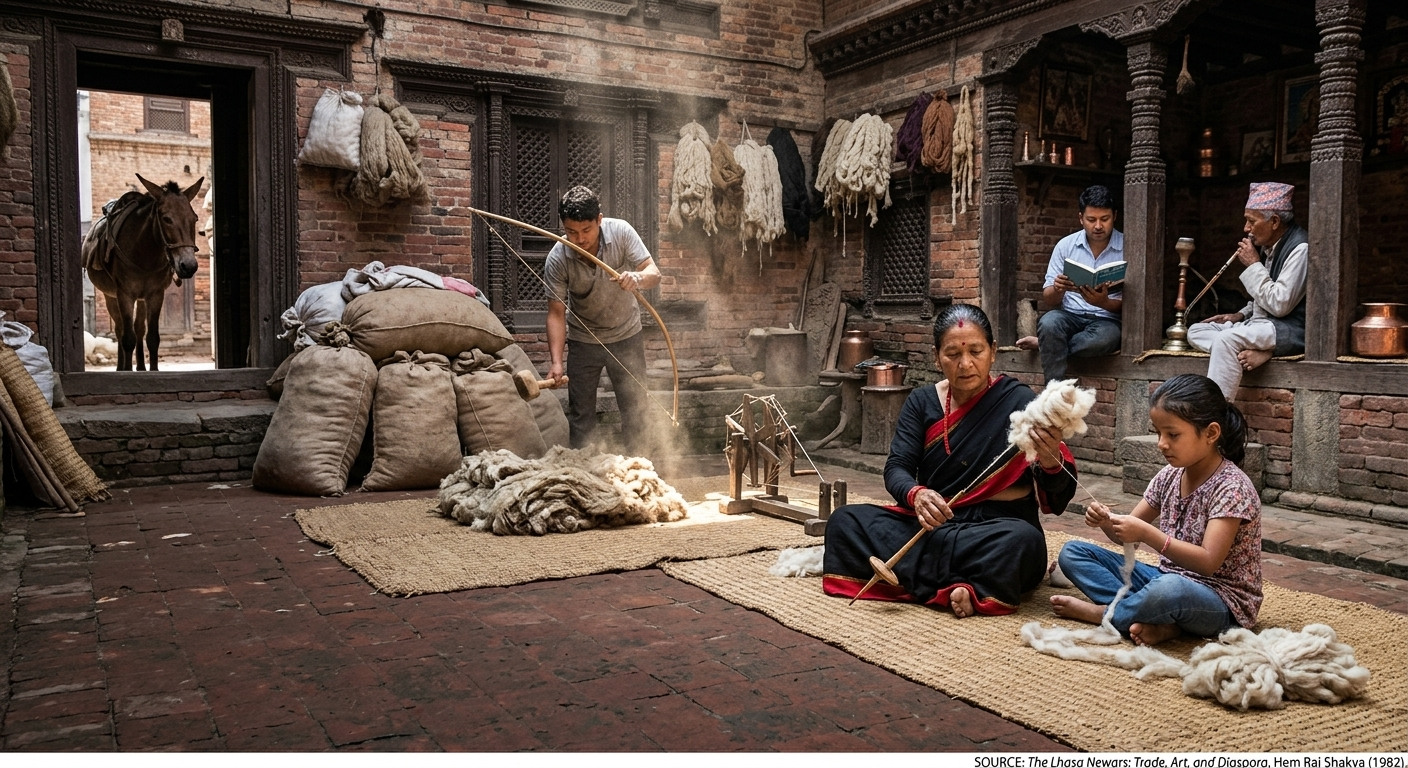
This hands-on mastery was vivid in the domestic sphere of traditional trading houses (chhens), such as Bhansaa Chhen (the maternal home of prominent figure Heera Devi Yami). Raw, matted Tibetan wool (la) arriving on pack animals via high Himalayan passes was brought into brick courtyards to be processed through specialized physical techniques utilizing tools such as the dhuni, kaat, and tukali.
This courtyard environment functioned as an active learning center. Generations sat together—women refining raw trade goods, children observing the physics of fiber and tension, and family members discussing market fluctuations in Lhasa alongside political developments in Kathmandu. Knowledge was validated through tangible results: thread, textiles, warmth, and economic resilience.
Trans-Regional Footprints: Scripts, Artifacts, and Behavioral Patterns Across East Asia
The empirical footprint of early Newar mastery was not confined to the Kathmandu Valley; it reverberated across regional trade and cultural centers in Tibet, China, Japan, and surrounding nations. Over 1,800 years, this network left tangible markers in epigraphy, architecture, and socio-commercial behavior. The calligraphic Ranjana script (Lanzha), developed in the Kathmandu Valley, became a sacred script for Buddhist canonical texts across East Asia. Its physical presence endures on iconic monuments such as the 1345 CE Juyongguan Cloud Platform at the Great Wall of China and the Miaoying Temple (White Pagoda) in Beijing, designed by the master Newar architect Arniko. Similarly, the Siddham script (Bonji in Japan), which traveled via early Himalayan monks and trade emissaries, remains actively preserved in Japanese Shingon and Tendai Buddhist ritual traditions—serving as a living linguistic artifact of early trans-regional transmission. The multi-tiered pagoda style, repoussé metalwork, and woodcarving methods developed by Newar artisans directly shaped regional aesthetics. The early architectural layout of Tibetan monuments, such as the Jokhang in Lhasa (associated with Princess Bhrikuti and King Songtsen Gampo), reflects Licchavi-era structural engineering. Furthermore, painted paubhas laid the artistic foundation for Tibetan thangka painting, demonstrating an active exchange of physical craftsmanship. Operating across vast distances, Lhasa Newar merchant communities (Kachhas) established structured behavioral norms, standardized accounting systems, and residential headquarters (chhens) in Lhasa, Shigatse, and Gyantse. Long before modern banking, these trade networks operated on observational market literacy, precise record-keeping, and empirical trust.
The Shift Toward Ritual Dogma and Institutional Control
As later rulers consolidated power, the mechanisms shaping everyday life and education underwent a fundamental shift. Practical, observation-based learning was increasingly marginalized by formalized, ritual-driven systems designed to maintain social order.
Education during these later periods became heavily entangled with dogmas rooted in unexplained, supernatural forces and fear of divine retribution. By framing social hierarchies and civic duties around ritual compliance rather than empirical inquiry, ruling institutions fostered passivity. Ordinary citizens were steered away from critical questioning, creating a lasting divide between practical working knowledge and formal education.
The Era of AI: Unearthing History and Transforming Education
Today, the emergence of Artificial Intelligence (AI) provides an unprecedented opportunity to dismantle dogmatic educational habits—such as passive rote memorization—and restore an evidence-based approach to learning in Nepal.
Digging Out Lost and Suppressed Facts
The historical record of Nepal has suffered from missing stone inscriptions (shilapatra) and fragmented family logs (thyasapu). Modern AI technologies offer tools to bridge these historical gaps. Neural networks trained on ancient and medieval scripts (Ranjana, Prachalit, Brahmi, Siddham) can rapidly translate, reconstruct, and cross-reference weathered inscriptions and damaged manuscripts found across Asian archives. AI can synthesize scattered trade logs, monastic records, and merchant correspondence across Lhasa, Beijing, Tokyo, Kolkata, and European institutions, reconstructing objective historical timelines of Trans-Himalayan commerce.
Reclaiming Nepal's Empirical Legacy
Reclaiming Nepal's empirical legacy through AI requires a fundamental shift in educational philosophy. By integrating AI-driven analytical tools into classrooms, educators can move students beyond memorizing static facts toward questioning evidence, recognizing cross-cultural patterns, and conducting original research. AI can simulate historical trade dynamics, model ancient engineering solutions, and visualize missing epigraphic data, bringing historical problem-solving back into the learning process.
Conclusion
Nepal’s 1,800-year history of Newar trade demonstrates that the nation's greatest architectural, artistic, and cultural achievements were built on practical innovation, trade acumen, and empirical mastery. From the domestic processing of raw Tibetan wool using tools like the tukali to the enduring Ranjana and Siddham inscriptions found across East Asia, learning was historically active, observable, and directly linked to resilience.
In the modern era, leveraging AI to retrieve lost historical evidence allows Nepal's education system to transcend legacy habits of rote learning and fear-based compliance. By grounding education once again in evidence-based inquiry and critical thinking, Nepal can honor its past while preparing future generations for a modern, technology-driven world.