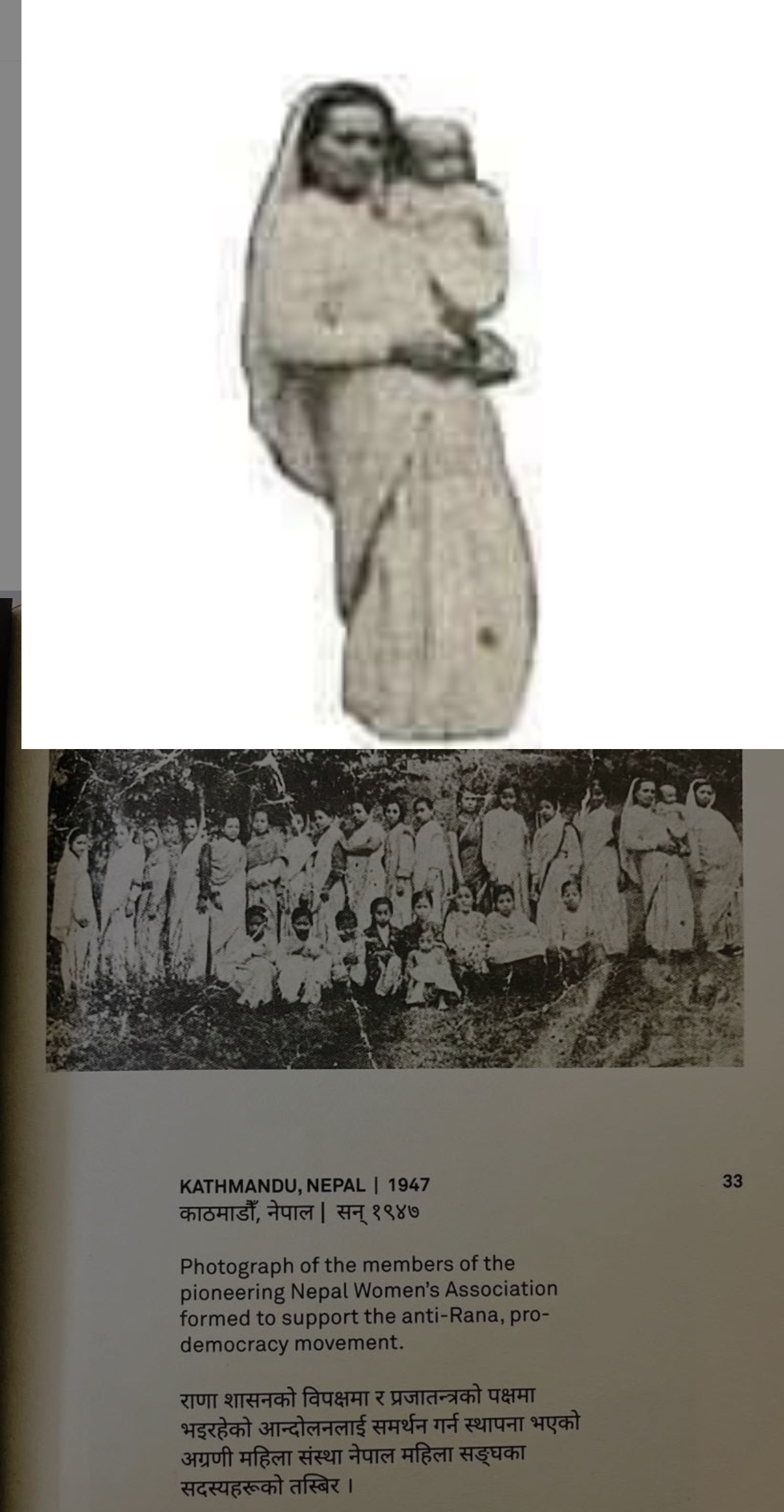
The Women Who Held the Family Together After Heera Devi Yami
During the long years when Dharma Ratna Yami was repeatedly imprisoned for political activities, life inside the household unfolded under constant surveillance, financial strain, and uncertainty. Food was scarce. Debt was familiar. Fear was ordinary. Heera Devi raised her children through pregnancies, illness, and exhaustion with almost no material support.
In those difficult years, one person appeared regularly and quietly: Dhana Maya Tuladhar. Mandas Tuladhar (1900–1975) was a notable Nepalese Buddhist scholar, Nepal Bhasa activist, and pioneer publisher. He was married to Dhana Maya, the daughter of Dharma Sundar Tuladhar of Dhalasikwa, Kathmandu. They married when Mandas Tuladhar was 16.
Dhana Maya was not a political figure, yet family memory preserves her through small, steady acts—bringing what she could, staying when needed, and helping without announcement. Though she herself lived in financial hardship, often in rented rooms while her husband was in jail, she supported Heera Devi without hesitation. Mandas Tuladhar, the paternal uncle of Dharma Ratna Yami, was also imprisoned during those dangerous years from oppresion from Rana regime. The struggles Dhana Maya faced unfolded within a deeply conservative Tuladhar community, where assertive or unconventional behavior—especially by women—was often discouraged and regarded as risky. In such an environment, those who stepped beyond accepted norms were frequently met with quiet disapproval. Relatives and neighbors would distance themselves, and social isolation was common.
At the time, limited access to education meant that many people could not fully understand the deeper realities behind such actions. What appeared to be defiance was, in fact, resilience shaped by necessity—but this distinction was rarely recognized.
Key Relationships
Ratna Das Tuladhar was the great grandfather of Dharma Ratna Yami. He had four sons: Asha Ratna Tuladhar, Bhawani Ratna Tuladhar, Man Das Tuladhar, and Harkha Das Tuladhar. Bhawani Ratna Tuladhar was the father of Dharma Ratna Yami. Man Das Tuladhar was his paternal uncle. Dhana Maya Tuladhar, wife of Man Das Tuladhar, supported Heera Devi during her hardships. Biswa Laxmi Tuladhar, their daughter, later became a mentor to the six daughters of Heera Devi Yami. Heera Devi Yami was the wife of Dharma Ratna Yami.
Relatives recall how Dhana Maya cared for Heera Devi during long periods of frail health following arrests by Rana regime, childbirth, even offering small financial help despite her own severe constraints.
Witnesses of those days saw Heera Devi Yami pregnant and carrying her third child (Timila inside stomach) moved through the streets in a state of near starvation, intensifying movement to overthrow Rana regime. She dragged along her four-year-old child (Dharma Devi) while carrying her two-year-old son (Vidhan ) on her back. No one came forward to help. Fear had silenced the community. At times, she was forced to leave her young children locked inside the house—often with nothing more than a small container for toileting and a little grain for food—while she went out serving underground activists. Neighbors could hear the children crying. A few quietly offered to take them in, but fear held them back.
Under the Rana regime, even an act of kindness could invite punishment. The police would come, harass, and beat those suspected of offering support. People lived in constant terror. No one wanted to risk being associated with her. Relatives, too, shut their doors. It was not indifference, but fear—fear of reprisal, fear of violence, fear of the regime. And so, Heera Devi faced her struggle largely alone, moving through a world where compassion was overshadowed by danger. In those moments of fear and isolation, it was Dhana Maya Tuladhar who quietly and secretly came forward to help her.
Then came the day of Dhana Maya’s death ( 1968 ) . At her cremation, Heera Devi’s grief overwhelmed her already weakened body. Witnesses remember her crying openly, recalling how Dhana Maya had saved her life during critical periods of underground political activity. It was as if years of strain and reliance had suddenly collapsed. Under the weight of sorrow and exhaustion, she suffered a severe heart attack.
After Heera Devi’s Death: The Six Daughters and a Son
Heera Devi Yami managed the home including finance, raised their seven children, even hosted and supported political associates, ensuring that her husband—also a creative writer—remained free from the stresses of domestic life. People would often refered to Dharma Ratna Yami as Heera Devi’s “eighth child,” a reflection of how completely she looked after him. In turn, he described her as his “best companion, wife, and mother,” acknowledging the many roles she played in his life.
Vvvvv
In January 1970, the six daughters and one son suddenly found themselves without their mother, Heera Devi, who passed away at the age of forty-nine. Dharma Ratna Yami, who had spent much of his life in political struggle and prison, had never learned to manage a household.
The daughters would later say, “Biswa Laxmi Tuladhar and Lani Devi Tuladhar (a first cousin and the daughter of Dharma Ratna Yami’s maternal aunt) became mothers to us.” They did not simply advise from a distance—they stepped into the emptiness left behind, offering guidance, care, and a steady presence when the family needed it most. They helped the young girls find direction, while gently supporting Dharma Ratna as he struggled to take on responsibilities he had never before carried.
Yet beneath this care lay a constant, unspoken worry. The question of marriage for the six daughters weighed heavily on them. It was not merely a social expectation—it was a pressing concern shaped by the realities of the time.
Heera Devi had raised her daughters with a vision that reached beyond her time. She believed in education, in dignity, and in a life where her daughters could stand with confidence and independence. She encouraged them to study, to grow, and to think beyond the limits imposed on women of her generation. But society had not moved at the same pace. Early marriage was still the norm, and education for girls was not always welcomed.
This created a quiet but painful contradiction. The daughters, shaped by their mother’s vision, often found themselves more educated than the men considered suitable for them. What should have been their strength became, in the eyes of society, an obstacle. Society still expected early marriages. It still measured a girl’s future within narrow boundaries. Suitable matches were few, and each passing year deepened the uncertainty. In this tension between a mother’s progressive hope and a society not yet ready to accept it, the daughters’ futures became increasingly fragile—and those who cared for them carried that worry every day.
In that household, grief was not the only inheritance Heera Devi left behind. She also left a vision—one that challenged society, but one that society was not yet ready to embrace. It was within this tension that her daughters, and those who stood beside them, had to find their way forward.
What made Biswa Laxmi’s presence especially meaningful was her understanding. As the daughter of Dhana Maya and Man Das Tuladhar, she had grown up witnessing Heera Devi’s struggles during the Rana years. She understood that this was not only a grieving family, but one shaped by sacrifice, reform, and resistance. She reminded the daughters who their mother had been and why her life mattered. Her care was not only practical; it preserved memory, dignity, and values.
Heera Devi’s Quiet Challenge to Social Custom
Heera Devi consistently spoke out about the suffering of daughters within the community. She had witnessed how women, when rejected by their husbands or forced to leave their marital homes, were often left with little support and faced immense hardship. Deeply affected by these realities, she extended help to many women in such situations. She also spoke openly—among neighbors, relatives, friends, and even political figures—about her intention to challenge social norms by giving property to her daughters. In the period before 1970, such an idea was widely considered unacceptable, even unethical, and was strongly discouraged by society. Few, if any, supported such a move.
Yet Heera Devi was determined to demonstrate that meaningful social change must begin at home. Through her actions, she sought to set an example and initiate a transformation that others might one day follow.
Heera Devi held a conviction that went far beyond political struggle. She believed daughters should inherit property just like sons. She spoke openly about this among relatives and neighbors, saying: “Look, I am giving property to my daughters.”
At that time, this was unheard of in the Tuladhar community and in most others. Property passed through sons; daughters married and left without claim. Even many female relatives opposed her, believing tradition should not be disturbed.
But Heera Devi believed social change must begin at home. She had seen cases where daughters, after failed marriages, returned to their maternal homes with no security. She wanted to break this norm—not through argument, but through action.
The Legal Process She Began
Nepal’s earliest modern legal code, the Muluki Ain of 1854, did not guarantee women meaningful property rights. Sons were prioritized as heirs, while daughters were largely excluded. In her final months, Heera Devi initiated the formal legal process to transfer one ropani of land to each of her six daughters. Documents had been prepared, and the transfer had reached its final procedural stage. Then her health collapsed. She was rushed to the All India Medical Hospital in New Delhi in January 1970. After returning to Kathmandu, from her sickbed she repeatedly asked for help to complete the remaining legal steps at the Charkhaladda office. She turned to Moti Laxmi Upasika, one of the few educated relatives familiar with legal procedures.
Heera Devi explained clearly why this mattered—not only for her daughters’ security, but as an example for society. However, the process was never completed. Family memory holds that Moti Laxmi Upasika strongly opposed the idea, viewing it as a dangerous break from social norms. For her, this was not a reform to encourage; for Heera Devi, it was a principle she wanted society to witness. The transfer remained unfinished at the time of Heera Devi’s death. Moti Laxmi is remembered within the family as having exercised influence that ultimately blocked the property registration process.
Moti Laxmi Upasika and Her Background
Moti Laxmi Upasika (1909–1997) was a pioneering Nepal Bhasa (Newar) writer and is widely regarded as the first modern female story writer of Nepal. She married at an early age and was divorced at the age of 12. She is credited with breaking ground for women in Nepali and Nepal Bhasa literature and inspiring future generations of female writers.
Her work and life are celebrated in Nepalese literary circles for their social, cultural, and linguistic importance. Scholars, Nepal Academy publications, and literary historians consistently recognize her as someone who opened the door for later generations of women writers. She was not just a writer—she was a pioneering female literary voice at a time when social structures restricted women’s intellectual participation.
She was also the sister of Chittadhar Hridaya (1906–1982), one of the greatest literary figures of Nepal and a central leader of the Nepal Bhasa literary renaissance. Writing during a time when the Rana regime had banned Nepal Bhasa, he continued his work secretly and became a symbol of cultural resistance. His prison-written epic on the life of Gautama Buddha is considered one of the greatest works in Nepal Bhasa literature. Chittadhar Hridaya and Moti Laxmi Upasika were first cousins of Dharma Ratna Yami.
Words Spoken After Her Death
In the days following Heera Devi’s passing, the house filled with relatives. It was then that Biswa Laxmi Tuladhar spoke words the daughters never forgot: “You six daughters are very lucky. Your mother has legally given one ropani of land to each of you. This is unheard of. Parents do not give property to daughters. But your mother did.” Through these words, the daughters realized something profound: their mother had tried to change a social rule within her lifetime, though the legal process had ultimately been stopped.
Regret Among First Cousins
Heera Devi’s first cousins, especially Latan Devi Shakya, later spoke with regret. Living next door to Moti Laxmi Upasika, she had witnessed the objections and tensions firsthand. She remembered clearly that there was active resistance to the idea of transferring property to daughters. For her, the tragedy was not only Heera Devi’s death, but that she died without seeing her intention fulfilled. This memory remained within the family as a moment when social custom proved stronger than individual resolve.
Illness, Anxiety, and a Painful Contradiction
In her final years, Heera Devi suffered from asthma, heart problems, and constant worry for her children—especially her daughters. An article later written by Moti Laxmi Upasika in the Dharma Ratna Yami Smriti Granth (2046 B.S.) described Heera Devi as deeply anxious about her children’s future. Family members who read it felt a painful contradiction: the same person who documented her anxiety had opposed the concrete step she took to secure her daughters’ future.
At that time, inheritance without a son passed to male relatives, not daughters. Women, too, upheld this norm. For Heera Devi, this became a source of deep frustration in her final days. She had tried to demonstrate change in practice, but society—and even family—was not ready. Heera Devi died at the age of forty nine in 1970 in the lap of her third child, Timila, pleading for Moti Laxmi Upasika to be called.