History remembers Heera Devi Yami as a political activist, educator, and one of the guiding forces behind the early women’s movement in Kathmandu during the Rana regime. But those who lived with her remember something deeper. They remember her hands that wove wool from Tibet into carpets as a child. hands that stitched clothes overnight for newborn babies in the neighborhood, hands that prepared identical dresses for six daughters before dawn, hands that garlanded satyagrahis in Bhugol Park, Hands that shielded her infant from mosquitoes in a filthy jail cell. Her life was not divided between politics and home.
She turned everyday life into a training ground for courage.
A Child Prodigy of Wool and Design
As a little girl in a joint Newar merchant family that traded with Tibet, Heera Devi grew up surrounded by fine Tibetan wool used for carpet weaving. Elders recalled with amazement how she would sit among her aunts and learn intricate carpet patterns on her own. She could reproduce designs with remarkable skill at a very young age. People in the family spoke of her as an unusually talented child. Years later, underground activist Nutan Thapaliya, imprisoned during the Rana rule in the harsh winter, recalled how he preserved a woolen blanket woven by Heera Devi’s hands from Tibetan wool. He kept it for years, remembering not just its warmth, but the care woven into it.
The Woman Who Prepared Clothes for Every Newborn
Even in adulthood, this habit of working with cloth never left her. Women over 80 years old still recall whenever a child was born anywhere in the neighborhood or among relatives, Heera Devi would spend the entire night cutting and stitching tiny cholos, soft inner vests padded with cotton and wool, and clothes for both mother and child. She never arrived empty-handed. She arrived with garments made by her own hand. This is what elderly women still tell her children today. She trained ladies also.
Six Daughters, One Bundle of Cloth
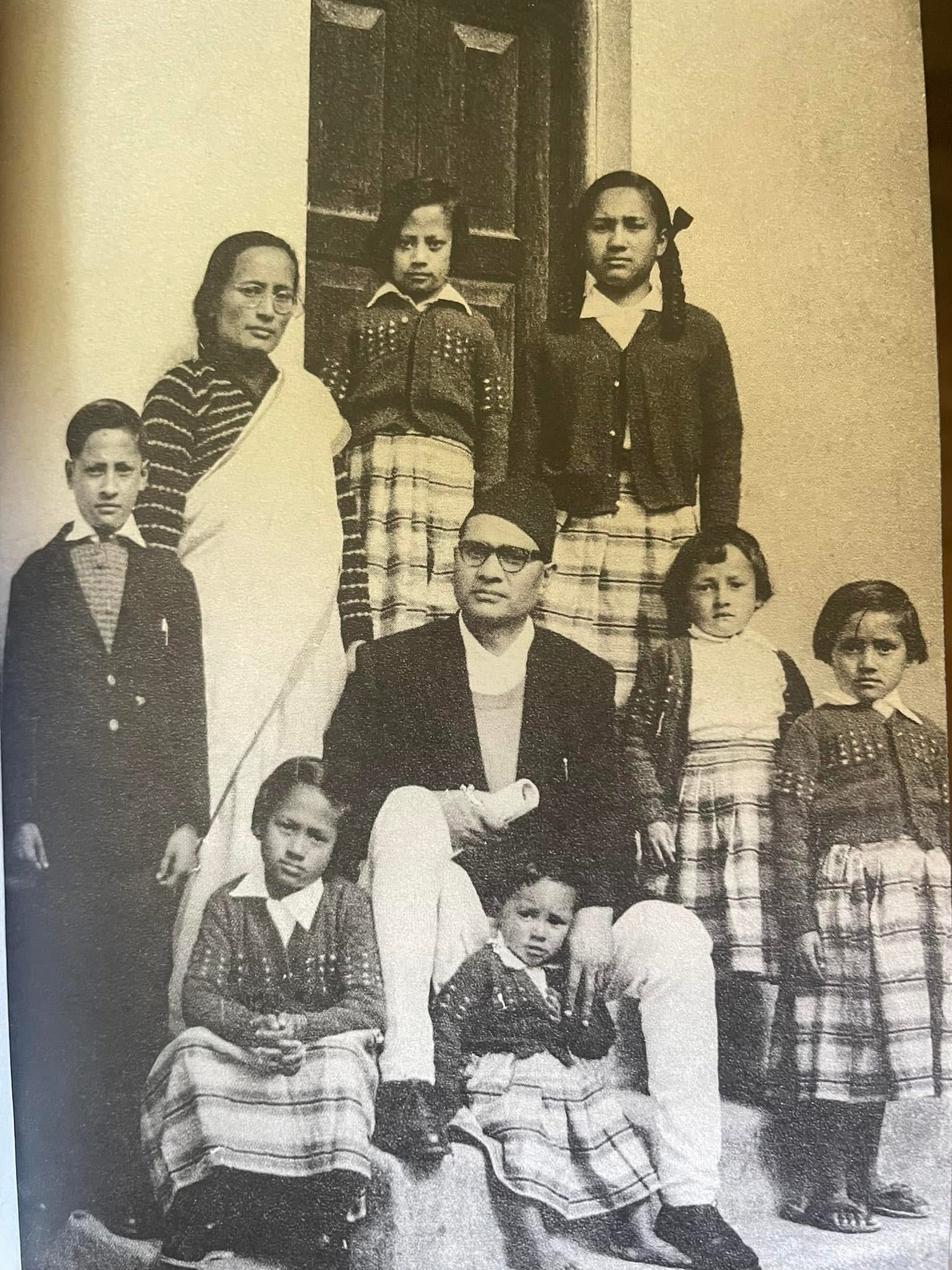
We were six daughters of Heera Devi Yami. Whenever there was a wedding, puja, or festival, our mother brought out one bundle of cloth. She stitched through the night. By morning, six identical dresses were ready. Same frocks. Same sweaters. Same shoes. We walked everywhere. There was no transport. And on the road, boys would shout: “Left, right! Left, right! The army is marching!”. Embarrassed, we begged for different dresses. She scolded us. “You will wear the same dress.” “You will learn to walk confidently when people tease you.” She was training us to ignore ridicule. To walk straight. To be unshaken in public spaces.
No Gold, No Bangles, No Tika — The Discipline of Simplicity
We six daughters of Heera Devi Yami were never given ornaments. We were not allowed to wear bangles.
We were not allowed to put tika on our foreheads. We were not allowed to use any makeup. Our mother herself never wore bangles. She never put tika. She never decorated herself.
Senior citizes now recall and say that she owned only two sarees for going out — one to wear and one to wash. In a community like ours, this was extraordinary. We belonged to Newar merchant families whose trade routes ran along the Silk Road into Tibet. Gold was not a luxury in such homes — it was tradition. Women in our community were expected to be adorned with gold necklaces, bangles, earrings, and ornaments even inside the house. During festivals, marriages, and rituals, women glittered with jewelry that reflected generations of trade wealth. But our mother never bought gold. Not for herself. Not for her daughters.
Whenever we attended weddings, pujas, or cultural ceremonies, our cousins arrived dressed in expensive clothes, decorated with ornaments. We went in simple dresses. Plain. Undecorated. Without jewelry.
As children, we noticed the difference. We felt it. But our mother never allowed us to feel deprived. She would say “You must learn to remain simple.” “Do not make your body a place to display wealth.” “Let your behavior, your thinking, and your conduct be what people notice.”
A Philosophy, Not a Limitation
This was not because she could not afford gold. She came from families that traded across Tibet and Kalimpong. Wealth, in her childhood home, was visible. Gold was common. Her simplicity was a decision. She was quietly rejecting a culture where women were decorated but not empowered. She wanted her daughters to be recognized for their mind, their walk, their speech, their confidence — not for what they wore. She did not want us to measure ourselves against others through ornaments and clothing. She wanted us to be free from that comparison.
What She Was Really Teaching
Much later, we understood. She was preparing us for a life where dignity came from within, not from display. She had lived through a political struggle where appearance meant nothing and courage meant everything. She had seen how women could be reduced to decoration in wealthy households. So she raised us differently. And in that simplicity, she gave us a wealth far greater than ornaments.