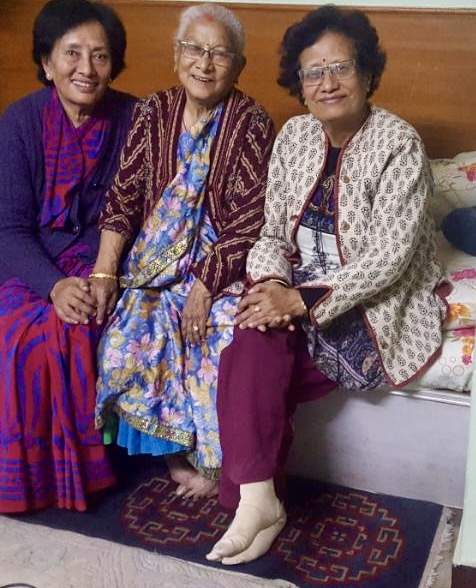
When people speak about the struggle against caste and untouchability in Nepal, they often talk about movements, leaders, and speeches. But for us, the struggle was lived every day, inside our own home. Our house in Bhurankhel, Kathmandu—known to many as Yami House—was not just a place to live. It was a place where we chose, consciously and repeatedly, to reject caste hierarchy.
My parents, Heera Devi Yami (Tuladhar) and Dharma Ratna Yami (Tuladhar), believed that equality could not remain an idea. It had to be practiced. At a time when caste rules controlled who could enter a house, who could eat together, and who could touch whom, our home followed a different rule: everyone was human first.
I saw this most clearly through my mother, Heera Devi. She refused to act as the guardian of caste purity, a role society expected women to perform. People from all castes came into our house. They sat inside. They ate the same food. Children were fed and taught without anyone asking who they were or where they came from. These may sound like small things today, but then, they were considered dangerous acts.
Neighbors complained. Some warned us that we were ruining our social standing. Others said my mother was breaking tradition. But she did not stop. She believed that if we claimed to oppose untouchability, then our kitchen, our courtyard, and our hands could not practice it. Her resistance was quiet, steady, and fearless. Looking back, I understand that this everyday courage was political.
My father, Dharma Ratna Yami, carried the same values into public life. He fought against the Rana regime, went to jail for democratic ideals, and later served as a deputy minister. He was also a writer and thinker. But for him, politics did not end outside the house. What he believed in public had to be lived at home. That is what gave our household its strength.
Over time, our home became a place where ideas met practice. Writers, thinkers, and activists came and stayed with us. Dr. B. R. Ambedkar, a global leader of the anti-caste movement, stayed at our house during his visit to Kathmandu. Knowing that he lived under a roof where caste was actively rejected still feels deeply meaningful to me. Even while traveling and in poor health, he continued working on his manuscripts—ideas that later shaped works like Buddha and Marx and Revolution and Counter-Revolution in Ancient India.
Rahul Sankrityayan, the revolutionary scholar, also stayed with us during his visits to Nepal. My father shared long conversations with him. Our house was never grand, but it was open—to people, to ideas, and to disagreement with injustice.
Dharamvir Bharati, a renowned poet, author, playwright and a social thinker of India. He was the chief editor of the popular Hindi weekly magazine Dharmayug was also vistor in our house.
When I think about Yami House today, I do not think of it as a monument. I think of shared meals, open doors, criticism endured, and choices made again and again. The fight against caste was not something we performed for history. It was something we lived, every day, even when it was difficult.
That is the legacy of Heera Devi Yami and Dharma Ratna Yami. They showed that real social change does not only come from laws or leaders. Sometimes, it begins at home—when someone decides that equality will not stop at the doorstep.
The Open Kitchen and the Open Code: My Mother’s Legacy in the Age of AI
We often speak of inheritance in terms of land, wealth, or titles. But the most enduring legacy I ever received was a radical sense of integrity—a gift passed down by my mother in a household that refused to bow to the social prejudices of its time. Today, as I work to shape the ethical landscape of Artificial Intelligence in Nepal, I realize that the fight for equity hasn't changed; only the tools have. To understand my vision for a human-centered digital future, one must first understand the woman who taught me that no system is above the dignity of a human being.
My mother, Heera Devi Yami, died when she was only 49 years old, leaving behind seven children. We were vulnerable—young, without her protection, in a society that had never approved of her radical practices or how she ran our household. It would have been easy, even expected, for us to quietly return to conventional ways. In the face of such loss, no one would have blamed us for seeking the comfort of the status quo.
But she had prepared us. Through the quiet strength of her example and the certainty with which she rejected caste hierarchy, she made equality a part of our DNA. She didn’t just practice fairness; she instilled the belief that integrity was the only way to exist. All seven of us understood this, passing it down to the younger ones not as a burden to carry, but as an inheritance more valuable than any property.
So, we continued. The doors stayed open. The kitchen remained a sanctuary where caste was neither asked nor observed. Even as we navigated our own grief, we carried forward what she had begun. This, I now understand, was her greatest achievement—not just living her principles, but ensuring they were woven so deeply into our character that they would outlive her.
Today, as I navigate the complexities of Artificial Intelligence and its governance in Nepal, I find that my mother’s kitchen remains my moral compass. Just as she dismantled the rigid, visible hierarchies of caste to protect human dignity, I now work to ensure that the invisible hierarchies of algorithms do not become a new tool for marginalization.
The integrity she instilled in us—the bone-deep conviction that no system, whether social or digital, should exist to exclude—is the bedrock of my professional mission. We are at a crossroads where technology can either mirror our old biases or manifest our highest values. By advocating for a human-centered, equitable AI future, I am simply extending her legacy into a new frontier. I am ensuring that the "open door" she fought for in our home remains wide open in the digital age, proving that a mother’s courage can truly become a nation’s conscience.