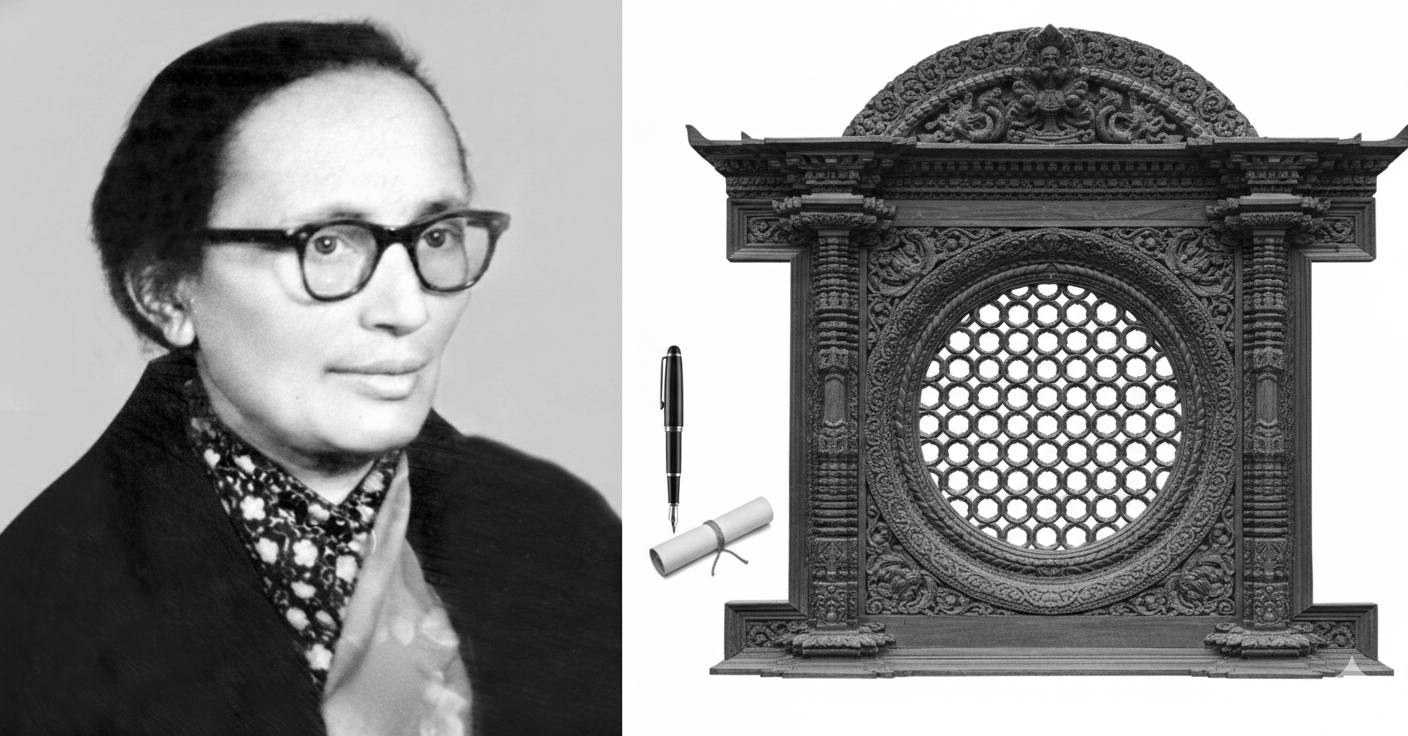
In the heart of the Kathmandu Valley, the Aankhijhyal (the traditional Newari carved window) is celebrated as a masterpiece of human craftsmanship. To the historian, its intricate wooden patterns represent a "proud history" and a "mysterious" cultural philosophy. But history looks different depending on which side of the wood. For Heera Devi Yami during her early days, that celebrated lattice was not a work of art; it was a barrier to the present.
The Architecture of Silence
The Aankhijhyal was historically designed with a specific social function: to allow those inside to watch the world without being seen. It was a "one-way mirror" of wood. However, in Heera Devi’s community, the social control went even deeper. Girls and women were not just hidden; they were forbidden from even "peeping" through the gaps. To look at the world was considered a transgression—a sin against the "discipline" of the household. Girls and women used to be wisked away by the rulers then.
The very wood we celebrate today for its "mystery" was used to mask a profound system of social control. While the world looked at the window from the outside and saw beauty, during early years Heera Devi was trapped on the inside, growing up in a shadow where the outside world was forbidden.
A Rebellion of Survival
Heera Devi Yami is the living embodiment of this truth. She felt the crushing weight of fear, the hollow ache of hunger, and the cold sting of isolation. Yet, she acted inorder to transform society.
Her story isn't found in the glorious inscriptions of Malla-era temples; it is written in the harrowing reality of a woman left to fend for herself in a society that preferred her invisible. When she was starving during underground revolution, the social structures that enforced her confinement remained silent. No one came to her rescue. She faced the immense challenge of being pregnant, delivering, and nursing a newborn babies Dharma DEvi, Vidhan Ratan and Timila while the world outside remained indifferent and unhelpful. Every time she stepped onto the street to continue the revolution , she was defying a century of enforced "discipline."
Heera Devi Yami stands as a powerful testament to principle that "you are responsible for how you act, no matter how you feel." Despite living in an era where women were often silenced and the "god-fearing" narrative of fatalism was used to justify social stagnation, she chose the path of radical agency.
Her life was a direct challenge to the idea that "destiny" is unchangeable. While many were paralyzed by the fear of challenging religious and political authorities, she became a bridge between the "ground reality" and the underground revolutionary movement.
Heera Devi Yami was far more than a witness to history; she was its quiet strategist. By transforming her Kathmandu home into a 'mini-auditorium' for radical discourse, she provided the intellectual sanctuary the movement required. She took upon herself the immense physical and financial burden of the revolution, sustaining frustrated and weary activists with both food and space, ensuring that the fire of political change was never extinguished by hunger or hardship.
Heera Devi Yami stood in fierce opposition to the religious hegemony of her era, recognizing it as a mask for political control. She saw through the weaponization of 'Bhagya' (fate), understanding that the masses were kept 'innocent' only to ensure their submission. To her, the narrative of 'karma' was not a spiritual truth, but a calculated Rana strategy designed to make the oppressed accept their chains as divine will.
Alongside her husband, Dharma Ratna Yami, she took practical, often shocking steps to dismantle "god-ordained" social structures. They famously hosted Dr. B.R. Ambedkar in 1956 and openly challenged untouchability—actions that led to them being social pariahs among the religious elite of that time.
The Living History
History traditionally remembers the woodcarvers. It records the names of kings and the dates of temple consecrations. But it is time we remember the woman who had to step past the shadow of the carved window to save her own life, the lives of her children and saving the lives of underground activists to continue the spirit of underground revolution to overthrow the Rana regime.
Heera Devi’s survival was her greatest rebellion. Her story is a "living history" that is far more valuable than any carved temple or ancient palace. It reminds us that behind every beautiful architectural "mystery" lies a human experience—one of struggle, immense resilience, and the quiet heroism of a woman who refused to be erased by the shadows.