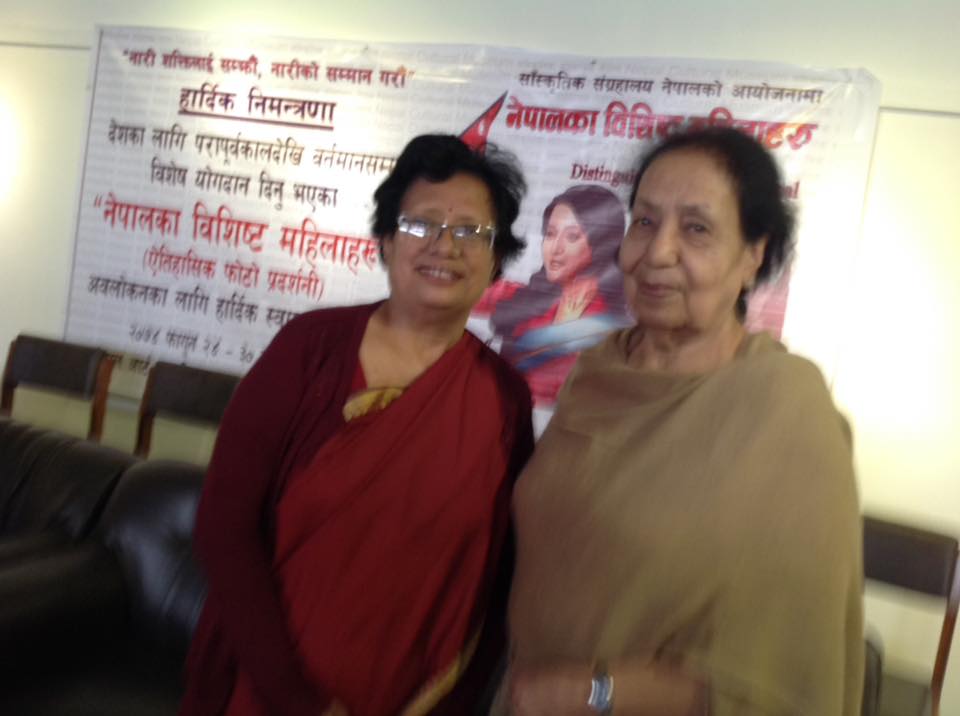
With my Shanta Shrestha Auntie.
She was a next door neighbor of my mother's maternal house. The group photo taken was on 22nd Srawan 2004 B. S. at Mhaipi Jungle., Kathmandu. I heard she was only nine years old then. This was the time when Rana rulers arrested all the underground activists and there was no one to lead the revolutionary movement to overthrow the Rana movement. The activists were demanding a new constitution. Among the people in the group in that photograph, Heera Devi Yami (with a little baby in the Lap Dharma Devi) was exposed to the world of Gandhi Movement in India where a total six Lakh people died. She had taken keen interest in that movement during her stay in India. She was in Calcutta and Kalingpong then. She was educated by Master Jagat Lal Shrestha who was her next door neighbor in Kel Tole Kathmandu.
Because of the absence of activists during the crackdown on revolutionaries in B S 2004 by the Rana regime, there was a serious need of more political forces to keep the movement alive. Women were not educated then. They stayed inside engaged in household affairs and were not allowed to step out of their houses because of security reasons. Heera Devi had a tough time collecting women and had to encourage women from lower classes like Pode, Chaimis etc. from Nara Devi, Kathmandu Ganesh Than regions during the high risk period.
The ruling regime used to loot and confiscate the property of those political activists. Heera Devi used to teach children. She used to raise funds to feed those sufferers affected by political unrest by teaching children secretly. Heera Devi faced a lot of hardships collecting girls and women to create groups to participate in political movements under such a high risk environment. It used to be risky to send children out for learning also. She led processions using these children and she was arrested with her child in her lap. The news of her arrest was censored in Nepal. This news appeared in the cities of Lukhow, Patna, Banaras Delhi in various newspapers. Lot of activists, their chidden and wives of activists perished unrecorded.
There should be a detailed survey on this.
We need not remember everything and document everything, Humans were busy surviving and competing in the food chain hand to mouth and remained speechless. Life has to be lived in the present. Its good to know our history but science has evolved this much only just 200 hundred years from now and western world people are able to decode so much. Grateful to those scientists! Whatever Nepalese people are publishing in the form of books with details before B S 1951 are not evidence based. People who have resources are writing. People who truly had contributed had no access to resources and the true historical evidence were mostly washed away.
In regards to the beginnings of Nepalese history there likely were no records anyway. The focus would have been surviving day to day and constant threat from the tyrant ruling government. There was no need for record keeping nor the capacity to do so.
One can also guarantee that verbal stories passed down from family to family would have differed greatly and changed over time. It's also worth noting that knowing our true beginnings has very little beneficial outcome and any answers will almost always most likely be refutable or countered by another idea/evidence. So what's the point??
For those who want to do research on the history of political revolution, a lot of evidence based narratives are important. Details on Nepalese revolutions and women freedom revolutions , the impact on Nepal from freedom of India from British regime, how political parties evolved, how these underground revolution activists along with local social institutions fought collectively, mobilized strengths to succeed in political transformation resulting in opening educational fields etc. The hardships faced by revolutionaries, how women played key roles etc need to be studied.
In B. S. 1946 I published a book called Smriti Grantha Dharma Ratna Yami containing articles on my father written by one hundred well-known figures of Nepal. All political and renown figures from various fields were surprised to see this book and expressed wishes to have books written about them also. Lot of them expressed strong wishes to write to my mother too.
Lots of old photographs have to be uploaded in social media so that old evidence-based narratives can be analyzed to capture feedback from the general public in order to leave behind true co-created history for current and future generations.