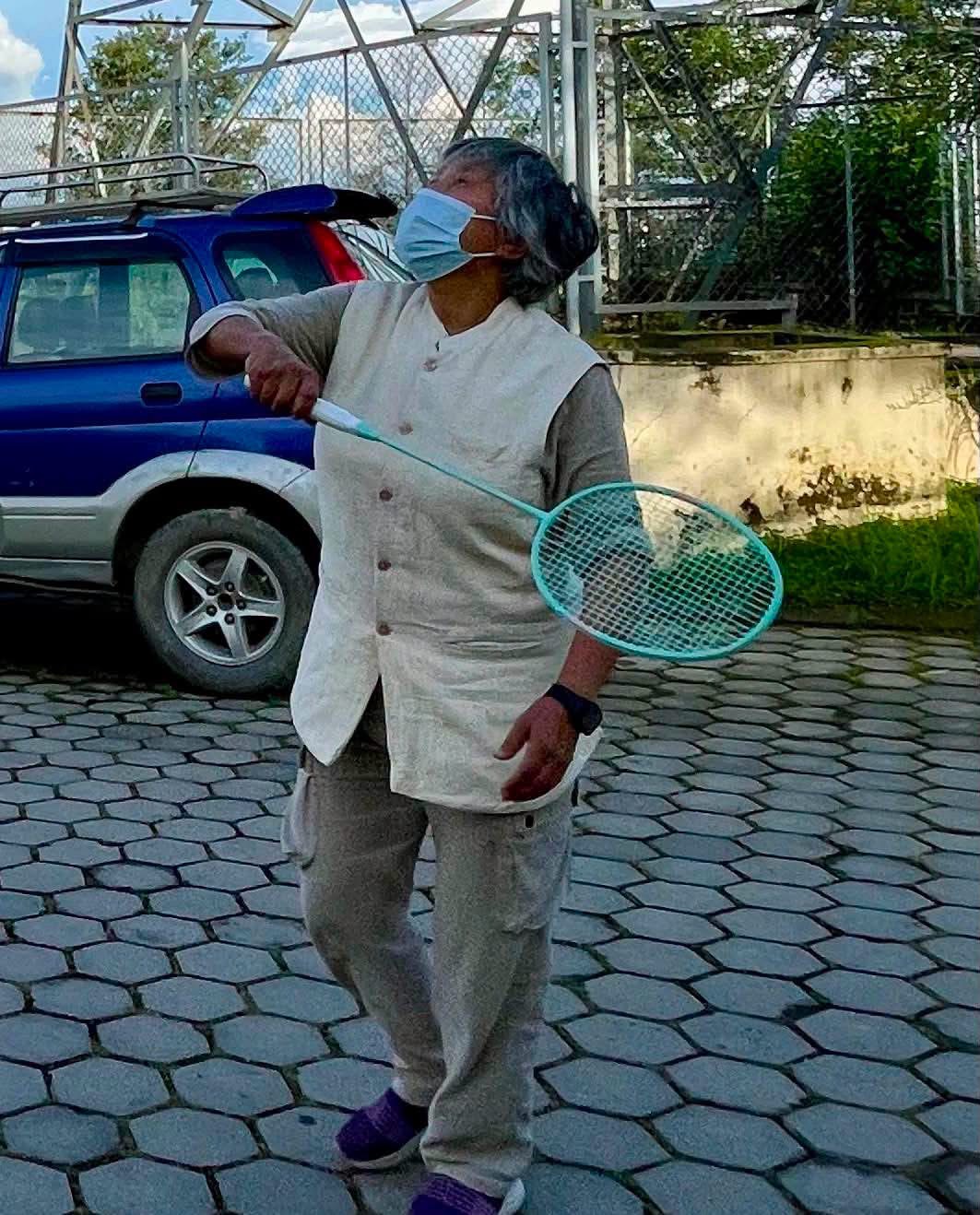
Hisila Yami attended Kendriya Vidyalaya—located inside the IIT Kanpur campus—from Class 7 to Class 11 (1971–1976). From the very beginning, she loved sports and excelled at hockey, badminton, and several other games. She was also a regular swimmer at the IIT Kanpur pool.
When she was barely 13 years old, Hisila won a consolation prize playing against adults at the Kanpur City Club. She received a large leather bag as her reward—a bag I can never forget.
I also vividly remember her playing table tennis with the older students at the IIT Kanpur Girls’ Hostel. Between games, this little girl would play badminton with the IIT Kanpur boys on the court set between the large dormitories. The net was quite high for someone her size, so she had to jump high every time to reach the shuttlecock, smashing it back with powerful shots. Boys watching from the verandas and rooftops would shout and cheer every time she landed a good hit.
Rising Through the Ranks
Every year, Kanpur hosted inter-school sports competitions. Hisila performed exceptionally well and quickly gained popularity, soon winning badminton tournaments across the entire city. From there, she advanced to the state level, competing against schools throughout Uttar Pradesh and bringing home numerous shields and trophies for her school.
Her athletic achievements made her well-known not only among students but also among the IIT Kanpur faculty. Since most faculty children attended the same school in the early 1970s, many of them looked up to her. Living in the Girls’ Hostel, her popularity grew even further. Eventually, she made it all the way to the national level—where top teams from every state competed—and finished as the runner-up in the national badminton final.
A Sister’s Constant Fear
While Hisila was thriving, I was overwhelmed with worry. Studying at IIT Kanpur was already intensely competitive and stressful, but my biggest source of anxiety was Hisila’s travel for sports. Having come from Nepal, I did not understand the structure of these inter-school, state, and national tournaments. All I saw was my younger sister being constantly taken away to distant cities by bus and train.
I was terrified that she would be kidnapped, lost, or harmed during her travels. I firmly believed that young girls were not safe traveling like that in India. Since she had come all the way from Nepal to study, I felt she should focus strictly on her education rather than traveling around to play sports.
My fear was so intense that every time she was scheduled to travel, I would burst into tears. I repeatedly went to the school principal’s office—and even visited his home on campus—begging him not to send her away. Crying, I would ask him, "If my sister gets lost or stolen, what will I do?" He would patiently explain that sports were a crucial part of her development, but I was too consumed by anxiety to listen.
In the year our mother passed away, Hisila and Kayo were sent to Darbhanga Medical College to spend their winter vacation. While the two children were in Darbhanga, our mother—even in her critical condition—always made me write letters to Dharma Tata (our elder sister) on her behalf. In every letter, she made sure I included the same warning: to be careful with the little children, Kayo and Hisila, since students would be busy with their studies and might not watch them closely enough. She was afraid that someone in India might target small children and take them away, so she insisted that the two children should never step outside the Darbhanga Medical College campus alone. These were the lines our mother made me write in almost every letter I sent. That fear stayed with me and constantly brought back the same worries later while I was at IIT Kanpur.
Looking Back
Balancing the academic pressure of IIT Kanpur with the constant fear for Hisila’s safety made those years extremely tense for me. I spent so much energy trying to figure out how to stop her from going to those out-of-town competitions.
It was only many years later that I realized how valuable those opportunities truly were. Such sports programs did not exist in Nepal at the time, and competing at that level gave Hisila immense confidence for the rest of her life. Looking back, it was actually one of the best outcomes of our time at IIT Kanpur—but as a young, anxious student, I was simply too young to see it then.