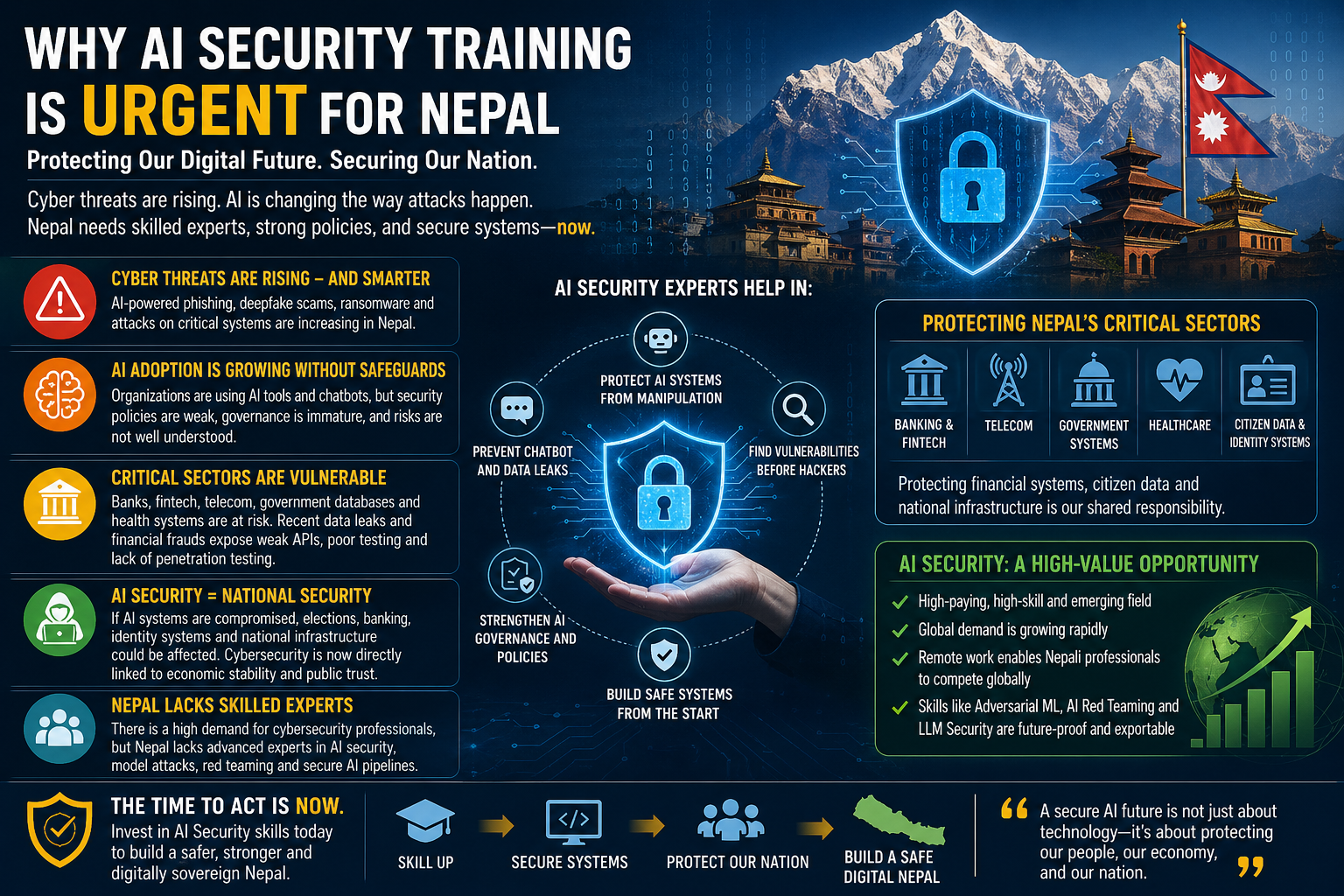
Why AI Security Training Is Urgent for Nepal
Cyber threats are evolving rapidly, and artificial intelligence is accelerating both their scale and sophistication. Attackers are now using AI to automate reconnaissance, generate highly convincing phishing content in local languages, and launch adaptive attacks that bypass traditional defenses. This shift is transforming cybersecurity from a technical challenge into a strategic national concern.
At the same time, Nepal faces a critical shortage of cybersecurity expertise—particularly in emerging domains such as AI security. While the adoption of AI technologies is increasing across sectors, the capacity to secure these systems is not keeping pace. This imbalance leaves digital infrastructure vulnerable at a time when dependence on technology is growing.
A Growing Risk Landscape
AI-powered threats are no longer theoretical. They are already emerging in forms such as AI-generated phishing messages in fluent Nepali, deepfake voice and video scams targeting financial and corporate institutions, and automated attacks exploiting weak APIs and untested systems.
These risks are especially concerning for critical sectors, including digital banking and fintech, telecommunications, government databases and identity systems, and healthcare infrastructure. Recent incidents of data breaches and financial fraud highlight systemic weaknesses—such as inadequate testing, poor access controls, and limited security awareness.
Gaps in Skills and Governance
Nepal’s cybersecurity ecosystem is still developing. Key challenges include a shortage of professionals trained in advanced areas such as adversarial machine learning and AI red teaming; limited institutional capacity for secure AI deployment; weak policy frameworks and underdeveloped AI governance structures; and fragmented collaboration, often limited to informal networks rather than structured national efforts.
Without intervention, these gaps will widen as AI adoption accelerates.
Why Training Matters Now
AI security training directly addresses these vulnerabilities by equipping professionals to identify and mitigate risks in AI systems before deployment, prevent data leakage from chatbots and AI tools, detect and defend against model manipulation and adversarial attacks, and build secure, trustworthy AI systems from the ground up.
This is not just about improving technical skills—it is about strengthening national resilience, protecting public trust, and safeguarding economic stability.
A Strategic Opportunity for Nepal
Beyond risk mitigation, AI security presents a significant opportunity. It is a high-demand, globally relevant field where skilled professionals are in short supply. With the rise of remote work, Nepali talent can compete in international markets without leaving the country.
Developing expertise in areas such as Large Language Model (LLM) security, adversarial machine learning, and AI system auditing and red teaming can position Nepal not only as a consumer of technology but also as a contributor to global cybersecurity.
Building National Capacity Through Collaboration
A critical priority for Nepal is the deliberate development of a large pool of AI security experts through government-led initiatives. Given the country’s current limitations in advanced research infrastructure, real-world AI security case exposure, and specialized faculty, this goal cannot be achieved in isolation.
Strategic collaboration with leading institutions such as Indian Institute of Technology Kanpur and other global research centers is essential to provide depth, hands-on experience, and access to cutting-edge knowledge. By investing in structured international partnerships, joint training programs, and academic exchange, Nepal can accelerate the development of true AI security specialists.
These experts will not only strengthen national systems but also contribute globally, positioning Nepal as a talent hub in a high-demand field. Embedding this approach into national policy—particularly within the Ministry of Education—would represent a forward-looking strategy to address a critical skills gap while creating long-term economic and security benefits.
Conclusion
Nepal stands at a critical juncture. AI adoption is accelerating, but security and governance are lagging behind. Without immediate investment in AI security training, the country risks exposing its financial systems, public infrastructure, and citizen data to increasingly sophisticated threats.
Addressing this gap now will not only reduce risk—it will build a skilled workforce, strengthen national security, and unlock new economic opportunities in the global digital economy.
Translation editing required
नेपालका लागि एआई सुरक्षा तालिम किन अत्यावश्यक छ
साइबर खतराहरू तीव्र रूपमा विकसित भइरहेका छन्, र कृत्रिम बुद्धिमत्ता (AI) ले तिनीहरूको दायरा र जटिलता दुवैलाई तीव्र बनाइरहेको छ। आक्रमणकारीहरूले अब AI प्रयोग गरेर निगरानी (reconnaissance) स्वचालित बनाउने, स्थानीय भाषामा अत्यन्त विश्वसनीय फिसिङ सामग्री तयार गर्ने, र परम्परागत सुरक्षा प्रणालीलाई छल्ने अनुकूल (adaptive) आक्रमणहरू सञ्चालन गरिरहेका छन्। यस परिवर्तनले साइबर सुरक्षालाई केवल प्राविधिक चुनौतीबाट राष्ट्रिय रणनीतिक मुद्दामा रूपान्तरण गरेको छ।
यसै समयमा, नेपालले साइबर सुरक्षा विशेषज्ञताको गम्भीर अभाव भोगिरहेको छ—विशेष गरी एआई सुरक्षाजस्ता उदीयमान क्षेत्रमा। विभिन्न क्षेत्रमा AI प्रविधिको प्रयोग बढ्दै गए पनि, ती प्रणालीहरू सुरक्षित गर्ने क्षमता त्यसैअनुसार विकास हुन सकेको छैन। यस असन्तुलनले प्रविधिमाथिको निर्भरता बढिरहेको अवस्थामा डिजिटल पूर्वाधारलाई कमजोर बनाइरहेको छ।
बढ्दो जोखिम परिदृश्य
AI-आधारित खतरा अब सैद्धान्तिक मात्र होइनन्। ती पहिले नै विभिन्न रूपमा देखिन थालेका छन्, जस्तै: नेपाली भाषामा तयार गरिएका AI-आधारित फिसिङ सन्देशहरू, वित्तीय तथा कर्पोरेट संस्थाहरूलाई लक्षित गर्ने डिपफेक आवाज र भिडियो ठगी, र कमजोर API तथा परीक्षण नभएका प्रणालीहरूलाई लक्षित गर्ने स्वचालित आक्रमणहरू।
यी जोखिमहरू विशेष गरी महत्वपूर्ण क्षेत्रहरूका लागि चिन्ताजनक छन्, जस्तै: डिजिटल बैंकिङ र फिनटेक, दूरसञ्चार, सरकारी डाटाबेस तथा पहिचान प्रणालीहरू, र स्वास्थ्य सेवा पूर्वाधार। हालैका डेटा चुहावट र वित्तीय ठगीका घटनाहरूले प्रणालीगत कमजोरीहरू—जस्तै अपर्याप्त परीक्षण, कमजोर पहुँच नियन्त्रण, र सीमित सुरक्षा सचेतना—उजागर गरेका छन्।
सीप र शासनमा कमी
नेपालको साइबर सुरक्षा इकोसिस्टम अझै विकासको चरणमा छ। मुख्य चुनौतीहरूमा उन्नत क्षेत्रहरू—जस्तै adversarial machine learning र AI red teaming—मा प्रशिक्षित जनशक्तिको अभाव; सुरक्षित AI कार्यान्वयनका लागि सीमित संस्थागत क्षमता; कमजोर नीतिगत ढाँचा र अविकसित AI शासन संरचना; तथा औपचारिक राष्ट्रिय संयन्त्रको सट्टा अनौपचारिक सञ्जालहरूमा सीमित सहयोग समावेश छन्।
समुचित हस्तक्षेप नभएमा, AI को प्रयोग बढ्दै जाँदा यी खाडलहरू अझ फराकिला हुनेछन्।
अहिले नै तालिम किन आवश्यक छ
AI सुरक्षा तालिमले यी कमजोरीहरूलाई प्रत्यक्ष रूपमा सम्बोधन गर्छ। यसले दक्ष जनशक्ति तयार पार्छ, जसले AI प्रणाली कार्यान्वयनअघि नै जोखिम पहिचान र न्यूनीकरण गर्न सक्छ, च्याटबोट तथा AI उपकरणहरूबाट डेटा चुहावट रोक्न सक्छ, मोडेल हेरफेर र adversarial आक्रमणहरू पहिचान र प्रतिरक्षा गर्न सक्छ, र सुरुदेखि नै सुरक्षित तथा विश्वसनीय AI प्रणाली निर्माण गर्न सक्छ।
यो केवल प्राविधिक सीप सुधारको विषय मात्र होइन—यो राष्ट्रिय लचकता (resilience) सुदृढ गर्ने, सार्वजनिक विश्वास जोगाउने, र आर्थिक स्थायित्व सुरक्षित गर्ने विषय हो।
नेपालका लागि रणनीतिक अवसर
जोखिम न्यूनीकरणभन्दा बाहिर, AI सुरक्षा एउटा महत्वपूर्ण अवसर पनि हो। यो उच्च माग भएको, विश्वव्यापी रूपमा सान्दर्भिक क्षेत्र हो जहाँ दक्ष जनशक्ति अभावमा छ। रिमोट कामको वृद्धि सँगै, नेपाली प्रतिभाले देश नछोडीकन अन्तर्राष्ट्रिय बजारमा प्रतिस्पर्धा गर्न सक्छ।
Large Language Model (LLM) सुरक्षा, adversarial machine learning, तथा AI प्रणाली अडिटिङ र red teaming जस्ता क्षेत्रमा विशेषज्ञता विकास गर्न सकेमा नेपालले केवल प्रविधि प्रयोगकर्ता मात्र होइन, विश्वव्यापी साइबर सुरक्षामा योगदान गर्ने राष्ट्रको रूपमा पनि आफूलाई स्थापित गर्न सक्छ।
सहकार्यमार्फत राष्ट्रिय क्षमता निर्माण
नेपालका लागि सरकार-नेतृत्वमा ठूलो संख्यामा AI सुरक्षा विशेषज्ञ उत्पादन गर्नु अत्यन्त आवश्यक छ। देशमा उन्नत अनुसन्धान पूर्वाधार, वास्तविक AI सुरक्षा केसहरूको अनुभव, र विशेष दक्षता भएका जनशक्तिको अभाव भएकाले यो लक्ष्य एक्लै हासिल गर्न सम्भव छैन।
यस सन्दर्भमा Indian Institute of Technology Kanpur जस्ता अग्रणी संस्थाहरू तथा अन्य अन्तर्राष्ट्रिय अनुसन्धान केन्द्रहरूसँग रणनीतिक सहकार्य अपरिहार्य छ, जसले गहिरो ज्ञान, व्यावहारिक अनुभव, र अत्याधुनिक प्रविधिमा पहुँच प्रदान गर्न सक्छ। संरचित अन्तर्राष्ट्रिय साझेदारी, संयुक्त तालिम कार्यक्रम, र शैक्षिक आदानप्रदानमा लगानी गरेर नेपालले वास्तविक AI सुरक्षा विशेषज्ञहरूको विकासलाई तीव्र बनाउन सक्छ।
यी विशेषज्ञहरूले केवल नेपालको प्रणाली सुदृढ गर्ने मात्र होइन, विश्वव्यापी स्तरमा पनि योगदान पुर्याउनेछन्, जसले नेपाललाई उच्च माग भएको क्षेत्रमा प्रतिभा केन्द्रको रूपमा स्थापित गर्न मद्दत गर्नेछ। यस्तो दृष्टिकोणलाई राष्ट्रिय नीतिमा—विशेष गरी शिक्षा मन्त्रालयमार्फत—समावेश गर्नु दीर्घकालीन रूपमा सीप अभाव समाधान गर्ने, साथै आर्थिक र सुरक्षा लाभ सिर्जना गर्ने दूरदर्शी रणनीति हुनेछ।
निष्कर्ष
नेपाल अहिले एक महत्वपूर्ण मोडमा उभिएको छ। AI को प्रयोग तीव्र गतिमा बढिरहेको छ, तर सुरक्षा र शासन संरचना त्यसअनुसार विकसित भएका छैनन्। यदि तत्काल AI सुरक्षा तालिममा लगानी गरिएन भने, देशका वित्तीय प्रणाली, सार्वजनिक पूर्वाधार, र नागरिक डेटा बढ्दो जटिल साइबर खतराहरूको जोखिममा पर्नेछन्।
यो खाडल अहिले नै सम्बोधन गर्न सकेमा जोखिम न्यूनीकरण मात्र होइन, दक्ष जनशक्ति विकास, राष्ट्रिय सुरक्षा सुदृढीकरण, र विश्वव्यापी डिजिटल अर्थतन्त्रमा नयाँ अवसरहरूको सिर्जना पनि सम्भव हुनेछ।