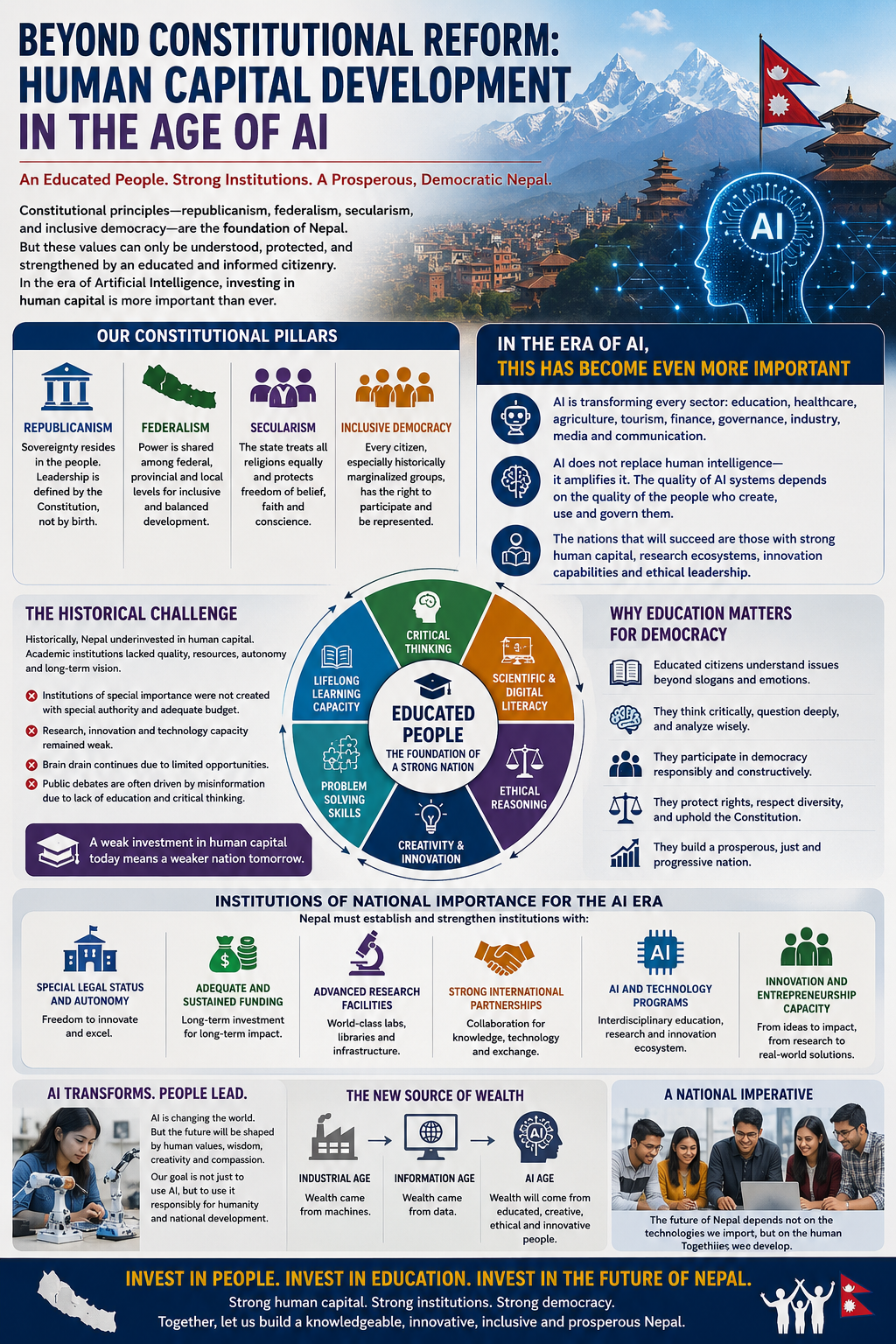
Debates about republicanism, federalism, secularism, and inclusive democracy are ultimately debates about the future of Nepal. However, meaningful participation in such discussions requires an informed and educated citizenry. Constitutional principles can only be understood, protected, and strengthened when people possess the knowledge, critical thinking skills, and civic awareness necessary to engage with complex national issues.
Historically, human capital development has been one of Nepal’s greatest weaknesses. For decades, insufficient attention was given to building strong educational, scientific, technological, and research institutions capable of producing highly skilled human resources. While political transformations occurred, investment in knowledge creation, innovation, and institutional excellence often remained inadequate.
A major challenge has been the absence of adequately funded and empowered Institutions of National Importance with special authority, autonomy, and sustained budgets. Such institutions are essential for developing world-class expertise in science, engineering, medicine, public policy, agriculture, artificial intelligence, and emerging technologies. Without them, Nepal struggles to build the intellectual and technical capacity required for national development.
In the era of Artificial Intelligence, this challenge has become even more urgent.
AI is transforming every sector of society, including education, healthcare, agriculture, tourism, finance, governance, and industry. The nations that succeed in the twenty-first century will not necessarily be those with the most natural resources, but those with the strongest human capital, research ecosystems, and innovation capabilities.
The AI revolution is not simply a technological revolution; it is a human capital revolution.
AI can process vast amounts of information, but it cannot replace human judgment, ethics, creativity, wisdom, leadership, and civic responsibility. Instead, AI amplifies human capabilities. Therefore, the quality of a nation’s AI future depends directly on the quality of its education system and institutions.
To understand constitutional issues, public policy, economic development, AI governance, cybersecurity, climate change, and social inclusion, citizens must possess Critical thinking skills, Scientific literacy, Digital literacy, Ethical reasoning, Problem-solving abilities and Lifelong learning capacity
Without these capabilities, societies become vulnerable to misinformation, manipulation, polarization, and poor decision-making.
An educated population is therefore not only an economic necessity but also a democratic necessity. Democracy functions best when citizens can analyze information independently, evaluate competing arguments, understand evidence, and participate constructively in public discourse.
For Nepal, strengthening democracy and strengthening human capital must go hand in hand. Constitutional values such as republicanism, federalism, secularism, and inclusive democracy can flourish only when supported by a population capable of understanding and defending them through informed participation.
The future of Nepal depends not only on constitutional provisions or political reforms, but on investing in people. This requires establishing and strengthening Institutions of National Importance with adequate resources, academic autonomy, advanced research facilities, international partnerships, and a long-term national commitment to excellence.
In the industrial age, wealth was generated by machines. In the information age, wealth was generated by data. In the age of Artificial Intelligence, wealth will be generated by educated, creative, ethical, innovative, and adaptable people.
Therefore, investing in human capital is not merely an educational policy. It is Nepal’s most important national strategy for democratic resilience, technological leadership, economic prosperity, and sustainable development in the twenty-first century.