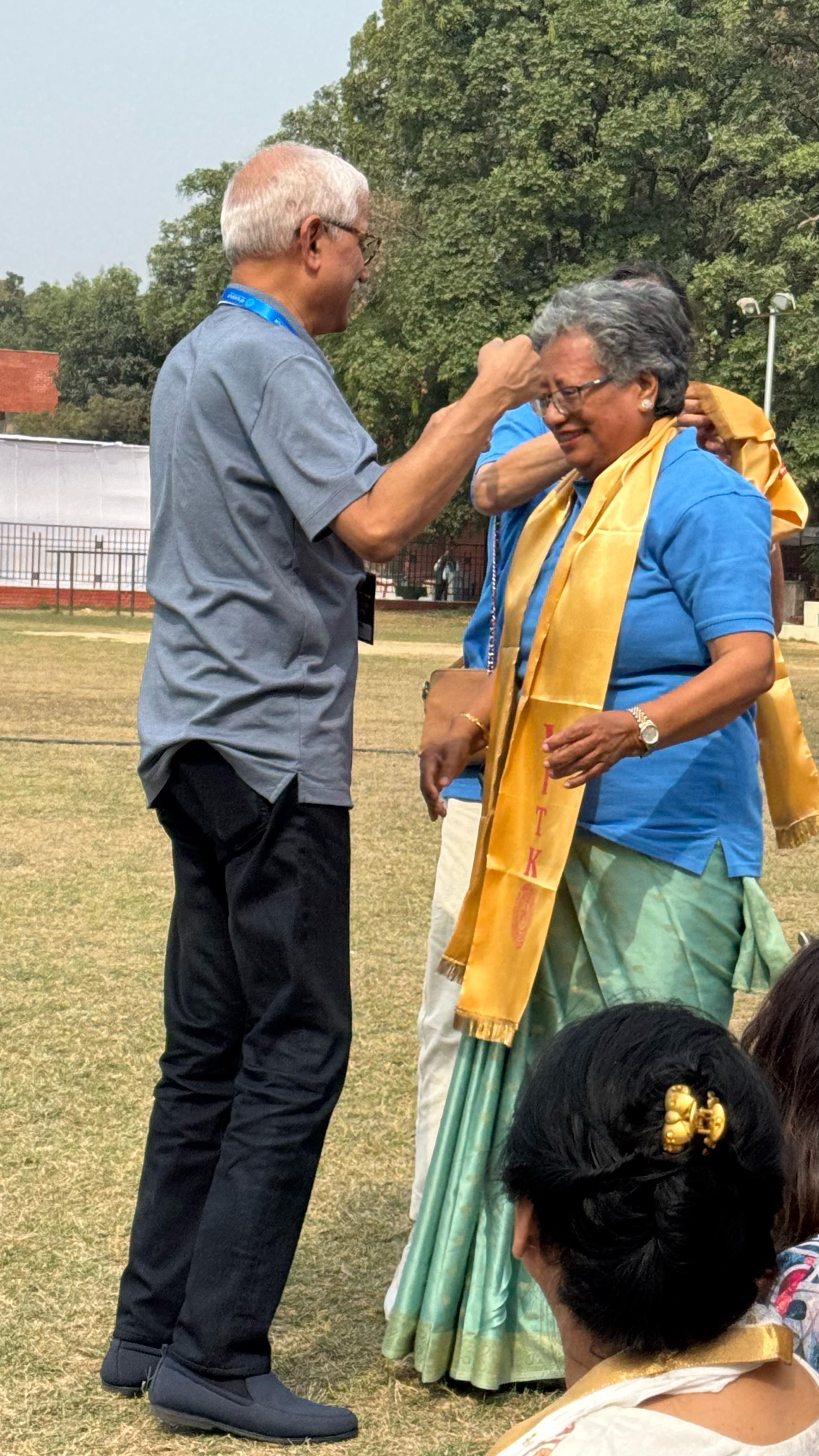
Early Years in IIT-Kanpur, My Grief and My Burden
I joined IIT-Kanpur in 1970, literally orphaned without much parental support, full of resolve to fulfill my mother’s dying wish to get an engineering degree. I was the first female student to go for an Electronic Engineering degree to India in the history of Nepal. I consider it lucky that I was selected to be in the top ranked Indian Institute of Technology, Kanpur (IIT K) – an autonomous prestigious engineering and technology-oriented institute of higher education established and declared as Institute of National Importance by the Parliament of India, and educated with the best students of India.
Entering the Intellectual Crucible of South Asia
During the early 1970s, Electrical Engineering—with a strict specialization in Electronic Engineering—was the undisputed peak of higher technical education. The All India Joint Entrance Examination (JEE) acted as a brutal national filter. Among the five established IITs of that era, IIT Kanpur was the most coveted destination, automatically attracting the absolute top rank-holders of the nation.
These incoming toppers were like "little kings" of their own little princely states. Back in their hometowns and elite schools, they had been celebrated as academic royalty. I often watched their intensely proud parents occupying the campus guest houses, taking grand tours of the sprawling grounds, completely captivated by the immense prestige of what their children had achieved.
However, the moment those campus tours ended and the classes began, the reality of the crucible set in. To find myself enrolled inside that specific peer group was an extraordinary challenge. I was competing daily against a dense concentration of the sharpest, most competitive technical minds on the subcontinent.
There was no room for complacency; the academic pace was relentless, the grading curves were unforgiving, and surviving that environment required a profound level of psychological grit. Yet, it was precisely this environment of "little kings" that stripped away any fear of institutional authority, giving me the fierce independence and structural confidence I needed to later return home and reshape the entire engineering landscape of Nepal.
During the early 1970s, Electronic Engineering was not just a discipline; it was the ultimate global frontier of technology. Across the subcontinent, the All India Joint Entrance Examination (JEE) acted as a brutal filter, and only the absolute highest rankers among the top tier of candidates were granted the privilege of choosing Electronics. Among the five established IITs of that era, IIT Kanpur was the most fiercely coveted destination for these top-rankers. It was the epicenter of the emerging digital revolution in India.
To find myself inside that specific peer group was both an immense privilege and an extraordinary challenge. I was not just studying; I was actively competing daily against the sharpest, most disciplined technical minds on the subcontinent. The academic pressure was relentless, the standards were uncompromising, and navigating that hyper-competitive environment—especially while managing my own fragile health—demanded an intense level of psychological resilience and intellectual grit.
Yet, it was precisely this high-pressure environment that forged my systems-thinking mindset. Surviving and thriving within that elite group gave me the technical confidence and structural blueprint needed to later return to Nepal and single-handedly challenge our own rigid educational status quo.
During the first semester at IIT Kanpur, the shock of my mother's death and the plight of my younger sisters haunted me. I was always preoccupied with the memory of my dear mother and her desire to part good higher education to her daughters. I used to receive melancholic letters from my younger sisters, and used to spend my time writing letters to each of them during my heavy academic schedules at IIT-Kanpur. I continuously grieved about the loss of my mother and worried about my four younger sisters. I silently wept in the hostel at night, and grieved inside the classrooms. Every time I read a letter written by one of my younger sisters stating their misery, I thought about leaving IIT-Kanpur.
My Batch mates and I
My batch had 410 boys and only two girls: Vini and I. I was very shy and apprehensive of the boys due to my cultural upbringing. They tried to communicate with me, but in vain. They soon realized that I was not approachable until very late. Some of my batch mates still introduce me to their spouses as the girl who never talked to them. I was in grief, had to handle my younger sisters' problems, and had to be doing well in academics at the same time competing with the best in India. My class had a large number of regional toppers from India. It was a very rough time for me.
I never shared my problems with my other batchmates. Vini Nigam from Kanpur City was the only batchmate I communicated with during the first year. However, she used to be in a different study-section. She would often find me grieving about the loss of my mother and worrying about my younger sisters. She felt very bad to see my misery and pain. On a few occasions, she even advised me to go back home rather than cry bitterly. Savita Gupta, a Ph. D student, advised me to bring Hisila for enrolling in Central school so that I would have less tension.
Instead of studying hard for my courses, I used to spend most of my time teaching Hisila, my youngest baby-sister who I managed to get admitted to the IITK Central School, so that she could catch up in her class. I also used to spend a lot of time communicating with the remaining younger sisters at home through postal letters.
It was towards the end of the program that I learned to trust my batchmates. I started repenting for not having shared my problems with my batchmates who surely would have helped me with my ongoing stress, coping with the tough academic environment, and managing the responsibility of bringing up my younger sisters.
Girls Hostel and Social Norms
The interesting thing I observed in the girls’ hostel was that the warden Mrs. Nanda got very worried about the safety of the girls when the boys entered the visitors’ room. She introduced rules restricting the boys hanging around the hostel-compound. I hardly understood her restrictions knowing that girls worked in the research laboratories and spent late hours in the library. Besides, we had All India Cultural Programs organized by the Student Gymkhana in which large numbers of colleges from India participated. It is my conjecture that these restrictions were not to protect the girls but to satisfy the anxious Indian parents who allowed the girls away to be studying with the boys for the first time in their lives. Like Nepal, Indian society also had misgivings about pre-marital association of girls and boys. I recall that many parents were outraged after a couple of media coverage regarding the boys being allowed to hang around in the girls’ hostel premises; many conservative mothers got very scared of this news.
Another problem IIT-Kanpur girls faced was their general acceptance in the traditional society. One girl student who completed her M. Tech. told me that her parents had a tough time looking for a boy for her marriage, and the boy's family asked her parents for a larger dowry because she was over qualified and had limited choices. Those days, industries also used to discourage recruiting of girls in an engineering field.
Competing with the Nation’s Best
I was enrolled in the Electrical Engineering (specializing in Electronic Engineering) Program of IIT-Kanpur that was considered to be the top engineering program of the nation, and attracted the best students and top rank holders of the All India Joint Entrance Examination (JEE). They were like "little kings" of little princely states (toppers of schools). I often used to see some of the proud parents occupying the guest house and taking a tour of the campus.
I faced a very difficult situation continuously managing the double burden at such a tender age. However, I had no other choice, but to carry this inevitable burden. I was also very apprehensive then. Had I messed up in my responsibilities, I would have landed nowhere, and nobody could have saved me. Had I fetched help from my youthful batchmates, my life probably would have been less stressful.
Each of my batchmates, being toppers in their respective schools, lived in a magical world of their own. Some of them got the shock of their lives after getting test-scores lower than their peer group at IIT-Kanpur. The burden to prove oneself was very heavy and not without peril. Many good students lose confidence in a tough competitive environment. I used to witness daily some students losing hope and interest in life at such a youthful age. It is still painful to remember some of the brilliant students losing interest in life too. I witnessed five Suicides during my stay in that campus. I also saw large numbers of students who got transformed because of the blend of a highly competitive academic environment and extra-curricular activities.
The faculty members of a top institute of the nation had very high expectations from the students, and grading was very harsh; relative grading among the top students of the nation made life even more difficult. However, most of the faculty members, although very strict in the academic matter, were very helpful and nurtured students to unleash the maximum latent potential in every student in the campus. This was a place where students and teachers were equally enthusiastic to share a happy moment together outside the class.
The best part of IIT-Kanpur was to be with its professors who always ensured that the potential of each and every individual student was well unleashed. They all used to be with the students in the playgrounds and various students' clubs after class-hours. The students were very focused in studies, yet excelled in the extra-curricular activities. This creative environment not only transformed my life but also helped my sister Hisila in an all-round development.
Looking after my younger Sisters at IIT-Kanpur
After completing the first semester at IIT-Kanpur, I came home to spend my vacation. My elder sister Dharma Devi (medical student) and my brother Vidhan Ratna (engineering student) were also studying in India. However, the condition of my younger sisters was pathetic. I decided to take my youngest sister Hisila (Hisila Yami) to Kanpur. She had just completed grade six from a girls’ school in Kathmandu. My relatives back in Nepal were very critical of my decision. With a lot of difficulty, I managed to admit her in grade seven at Central School in IIT-Kanpur. I am so thankful to Professor Narsimha Rao (Chemistry department at IIT-Kanpur) for his special effort to allow Hisila to study at Central School. He was on the Board of Members of that school, and was able to influence the board to help us at the time of sheer need.
The principal of Central School initially refused to admit Hisila in a section instructing in English medium; Hisila was enrolled in a section with Hindi medium of instruction. This situation put me into a lot of stress with sleepless nights. I was not sure that I would be able to keep her in that school, and the Hindi medium of instruction would make her life complicated if she had to go back to her old school in Nepal. I begged the school administration to allow her to sit in the English medium section. However, the school-principal refused to change the section. Hisila realized the extent of the problem, and worked very hard to pick up English. I used to write the required few dialogues in English. Hisila used to learn them by heart and speak them out in class without any fear. She would boldly request the teachers to repeat everything that was taught in Hindi, once again in English. She gave an impression to the teachers that she had good knowledge of English, and lacked the knowledge of Hindi. Her teachers finally complained to the principal, and requested him to shift Hisila into the English medium section. The principal finally yielded. Still, Hisila had to take one compulsory course of Hindi subject which made the situation worse.
It was indeed a very challenging period for her. She made it though. The transition from instructions in Nepali language in a local school in Kathmandu to instructions in English was really tough for Hisila. With some encouragement and effort, however, Hisila flourished and excelled in academics, sports and cultural activities. She was a quick learner and used every opportunity she got. She used to be selected as one of the best athletes in her school, and she was successful in bringing sports awards in all India Junior Sports Competitions held in different states of India. Hisila’s hard work, boldness and excellent all-round performance really saved me from packing my bags for good.
The warden of IIT-Kanpur girls’ hostel refused to provide a room for Hisila because children were not allowed in the adults’ hostel. I never knew that I would run into so many serious problems which disturbed my studies a lot. After a lot of persuasion, I managed to get permission for Hisila to stay in that hostel. It was indeed a miracle. Luckily, there were plenty of empty rooms available during those days in our hostel. She soon became the darling of the girls’ hostel and learnt everything the girls had to teach her. It was a real turning point for our lives.
Hisila was good in sports and travelled to every All India Junior Student Tournaments. She brought many shields and awards for the school. I was horrified, and used to protest in front of the school administration, begging them not to take my sister on sports-trips out of town telling them that "MY SISTER WILL BE STOLEN." She also received a games scholarship in that school.
I am very grateful to the girls at IITK for loving and caring for Hisila. They called her their "darling little sweet bubbly girl." Some of the girls were very good in sports, music and other extra-curricular activities, and participated in Inter-IIT sports competitions. Hisila enjoyed playing with them. Those girls enjoyed developing Hisila in extra-curricular activities of their interests. She literally grew up dancing, singing and playing musical instruments in that seminary.
Vasundhara Choudhary, enjoyed teaching her Sitar (an oriental musical instrument). Other girls taught her Bharat Natyam and Kathak dances. Some taught her Hindi songs. Sandhya Deo taught her table tennis. Kalpana Mehta used to take Hisila to the boys’ hostel to watch various sports competitions. Professional coaches of IIT-Kanpur enjoyed teaching Hisila many sports, and appreciated the knack she had in picking up sports and excelling in them.
Some of the girls of my hostel used to invite Hisila and I to spend time with their families during short holidays when it was not feasible to go back to Kathmandu. During those visits, I used to observe the aged grandmothers of my friends, some of them in the mid-eighties, reading the “Times of India” and other magazines. I used to get shocked to see the level of education of grandmas in India during those days. Suddenly, the educational gap in Nepal created by Rana’s regime became so apparent to me. During my holiday back home I began exploring the education background of grand aunts and other senior citizens of the capital of Nepal. Instead of telling me about their academic background they told me a horror story of moving out of the house wearing good clothes. An enlightened patriotism was punished by the ruling Ranas as they felt threatened by it. As the Ranas were holding absolute power over the country and exploiting the resources mainly for their own benefit, the people they could trust were those who were exclusively loyal to them alone. Anyone with a concern for the society at large and to the future of the country had to be the enemy of the Ranas, so they singled out, punished, jailed and executed anyone who fought for people’s welfare on the pretext that it was high treason.
During my later years, my other two younger sisters, Kayo and Nhuchhe Shova spent months each at the Girl’s Hostel preparing for their examinations. Nhuchhe Shova had a tough time preparing for B.Sc. examination because her in-laws wanted her to discontinue studying. She was five months pregnant too. Kayo came to prepare for the All India Entrance Examination for a Ph.D. program in IARI, New Delhi.
IIT Kanpur: A Portal of Transformation for Our Whole Family
A single educational institution like IIT Kanpur became a transformative space not just for one individual, but for an entire generation of siblings shaped by the political and educational struggles of Nepal. My brother Vidhan Ratna Yami visited IIT Kanpur twice. Each time, it was a profound and eye-opening experience for him. Coming from the constrained and politically fragile educational environment of Nepal, IIT Kanpur felt like stepping into an entirely different world — one where science, freedom of thought, and opportunity flourished. My elder sister, Dharma Devi, a newly graduated medical doctor, also came to IIT Kanpur. She and her husband spent their honeymoon week at the guest house inside the IIT campus. For her too, the environment — the facilities, the intellectual energy, the openness of the academic atmosphere — left a lasting impression. It redefined what higher education could look like, especially for women.
One of my younger sisters, Chirika Shova, was pursuing her MSc at Tribhuvan University (TU) in Kathmandu when she came to India with her classmates on an academic tour too visited IIT Kanpur. Seeing where I studied, the kind of academic and cultural exposure available, left a deep impact on her as well. It allowed her to understand what academic excellence outside the walls of TU could look like.
In the end, all seven children of my parents — Heera Devi Yami and Dharma Ratna Yami — came into contact with IIT Kanpur, either as students or visitors. For each of us, in our own way, the encounter with IIT K transformed us. It wasn’t just the education or the infrastructure — it was the freedom, the access, the exposure, the human dignity the place seemed to offer. It broadened our minds, raised our expectations, and helped us see a world far bigger than the one we had been conditioned into under Nepal’s oppressive systems.
IIT Kanpur, in that sense, was not just my academic institution, it became a portal — a shared turning point in our family’s collective consciousness. It revealed to us what had been denied to generations of Nepalis by regimes like the Ranas: access to quality education in academics, and the dignity of independent thought. We were never the same again.
Six daughters and a mother’s revolution
My mother Heera Devi Yami’s incredible foresight and courage, but also the structural oppression women faced—and still often face—around education, health, and autonomy. My mother’s strength and the painful complexities was followed by her untimely death. In those days, having six daughters in a single household was considered a curse. People constantly whispered about the burden of marrying off so many girls—the costs, the shame, the “failure” to produce sons. My mother, Heera Devi Yami, had to endure not just physical hardships, but also verbal abuse from conservative relatives and neighbors each time she gave birth to a daughter. There was immense social pressure to marry girls off early—often before the age of 14—especially in families with multiple daughters. But my mother defied this toxic norm. She boldly rejected early marriage proposals, placing education above all else. At that time, Nepal had no access to family planning, and my mother’s fragile health only worsened with each pregnancy. Yet she pressed on, committed to raising seven children with dignity, courage, and vision. When my mother passed away at just 48, it was a catastrophe for our family—not just emotionally, but structurally. My father, a veteran writer and fiery political thinker, had little understanding of how to run a household. Our relatives, especially from mother's side, were all very traditionally minded. Education was banned for the general public in Nepal till 1950. They had no knowledge about the value of education. Most of them used to put pressure on us for early marriage. They were worried that we daughters would have difficulty getting married off if not married off at early age,
My father was passionate, even brilliant, but emotionally unequipped for the daily labor of raising children. My mother had protected him from domestic and financial stress throughout their life together, believing a creative mind needed freedom from mundane tensions. Foreseeing what might come, she had quietly taken measures. She added rental rooms to our home to generate income—not just for daily survival but to keep the door to education open for her children, even after her death. My mother had made sure that my father didn't suffer from financial tension in her absence. She added extra rooms for rent for collecting additional rent of rooms to meet total expenses which included daily feeding large numbers of visitors to my father. Our living room always used to be filled with writers, frustrated politicians and social workers and used to be like a mini party palace. She also ignored spending on her last days of critical health treatment expenses. Health workers used to warn her regarding critical health conditions. She used to be very worried that after her death our education would be stopped due to shortage of resources. My mother's passing away was a big disaster. After my mother passed away my father engaged his first cousins and aunts ( mini mothers ) to run our household affairs. Our relatives, especially from mother's side, were all very traditionally minded and used to put pressure on us for early marriage. This used to be the most irritating issue every time I visited home during my vacation days at IITK. My father passed away five years after my mother’s death.
My father was a very angry (sanki) politician, mostly never understood what confusion we seven children were going through with the fragile critical health of our mother. He had no clues about how to run the household, including financial matters. My mother knew how we seven children including my father would suffer after her death because my father knew nothing about family affairs. One of my father's first cousin Lani Devi Nini used call my father as "eighth child (emotionally immature when it came to looking after household affairs) of wife Heera Devi" . My mother had always pampered him and never wanted to give him tension about financial matters including raising the children. She knew that a creative writer should be free from all the tension. She ignored her own critical health needs to make sure her children wouldn’t drop out of school. Health workers warned her repeatedly, but she brushed aside her pain, consumed with one fear: that after her death, our education would be cut short. She also worried about my father. After her passing, my father—political preoccupations—brought in his aunts and cousins (our “mini mothers”) to manage household affairs. Most of them were from traditional, conservative backgrounds and lacked any understanding of the value of education. Their priority was to get us daughters married off quickly. These tensions came to dominate our home. Every time I returned from IIT Kanpur for vacation, I was bombarded with pressure and arguments about why we needed to marry soon. I had to fight to protect my younger sisters’ right to continue schooling.
Despite everything, my mother had a dream. She wanted her seven children to become seven role models—each able to challenge outdated social norms and become agents of transformation. She never lived long enough to see that vision unfold, but she had already planted it in our young minds. It was only later, through her friends and through our own reflections, that we began to realize what she had truly envisioned for us. The environment at IIT Kanpur helped us understand her dream even more clearly. It gave us a world far from the suffocating norms of our home, a space that validated our hunger for learning, our desire to serve society, and our drive to prove that daughters, too, can carry the dreams of a nation. Our journey was one of extraordinary hardship and resilience. Pursuing higher education wasn’t just a personal goal—it was an act of rebellion, of honoring a mother who had quietly waged her own revolution in a deeply patriarchal world. Still, not all of us could escape the weight of tradition. Despite our efforts, two of my younger sisters were married off into conservative families before completing their studies. It broke my heart. It felt like a betrayal of everything our mother had fought for, a reversal of her lifelong effort to shield us from precisely that fate. It happened while I was still at IIT Kanpur—when I was too far and too young to stop it.
My immediate younger sister Nhuchhe Shova, who later became Campus Chief of IOE Thapathali under Tribhuvan University, faced a lot of difficulties being married to a family who believed in traditional thinking affecting her academics during B. Sc. program. I had to bring her to IIT K to prepare for her final examination. She was pregnant then. I arranged for a teacher Mr. Sareen from the Physics department for her tuition. She went back to Nepal and delivered a baby just before her final examination and cleared the degree also. Dr. Kayo, ex- chairperson of Lok Seva (Public service commission) was a skinny one mostly with fragile health problem during her early days. Because of the depressive environment in the house I shifted her to IIT Kanpur. I made her go through research practices at IARI New Delhi in between. At G. hostel of IIT Kanpur I made her prepare for all India competitive examinations for Ph. D degree at IARI New Delhi and she succeeded. These were very critical moments in our lives which were life changing moments making us even stronger to face any challenges and adversities in our lives.The ground realities of the then society and the hurdles, struggles and difficulties a family and specially six daughters in it had to go through for obtaining higher education was really challenging.
IIT Kanpur: A Shelter, A Struggle, A Silent Revolution
When I entered IIT Kanpur in the early 1970s, it wasn’t just to pursue higher education—it was to carry the broken, burdened dreams of an entire family into one of the most elite institutions in India.Established with support from MIT and nine top-ranking U.S. universities, IIT Kanpur had become a hub for India’s finest minds. Competing among them was hard enough. Doing so while carrying the emotional and logistical weight of raising my younger sisters, grieving my mother, navigating poverty, and holding a fractured household together—that was beyond what anyone could imagine.
Most of my batchmates came from highly educated, privileged families. I came from a home shattered by loss, where my mother had passed away too soon, and my father—a writer and politician—was emotionally unprepared to raise seven children. I hardly spoke to anyone in my batch. There was no vocabulary back then to express the trauma I was carrying. Only a few hostel mates ever knew. Despite receiving a scholarship, it didn’t cover everything. Twice, I was granted special permission to work part-time in the library—a rare exception, because scholarship students weren’t normally allowed to earn. That kindness from the administration was silent but powerful. They may not have said much, but they recognized the pain I was hiding and gave me the dignity of survival.
There were only 32 girls in the hostel with 64 rooms. No inclusion policies existed back then. But somehow, through objections and institutional hurdles, I managed to accommodate my younger sister Hisila Yami in my room for five years. Stringent hostel rules, strict wardens, and an unfriendly director made it nearly impossible—but I always believed in silent miracles. With quiet mind I raised her there like a daughter. Hisila would go on to become an architect, a political leader, and the author of “Hisila: From Revolutionary to First Lady.” published by Penguin in her book, she writes about those IITK years as the golden period of her life. And I believe it’s true—because those were also the years when we transformed our pain into purpose. My elder sister, a medical doctor, even celebrated her honeymoon at the IIT Kanpur guest house. Another sister, who later retired as Dean of Science at Tribhuvan University, visited with her classmates during their student tour. My brother, who later served as a senior engineer and tragically passed after the 2015 earthquake, visited twice. We all took shelter there, one by one, like displaced birds finding a nest in a storm.
Even during the 2000 alumni reunion, I brought my daughter to show her the place my first home because for me, IIT Kanpur was never my second home. It was my first. To this day, my sisters and I often recall those days—the tears, the laughter, the fights with the warden, the warmth of professors who didn’t need to say much to show they cared. And through it all, I always felt one presence hovering above us:
Our mother:
Her soul watching quietly over the skies of IIT Kanpur, proud that her daughters were learning to solve problems not just in science labs, but in life.
Financial Burden and Hardships
After my mother’s saddening demise, the family went through very difficult financial times. Despite my scholarship, I was always short of cash. We bought clothes from shops selling inexpensive materials. My mother had instilled in us to stay simple and never crave for ornaments and good clothes unlike our community people who take pride in wearing expensive ornaments. We six daughters carried on with that mentoring even after her death. Thus, “simple living, high thinking” is still in our thoughts.
My worst days at IIT-Kanpur were when the hostel warden abused me in front of some of my classmates in the campus corridor when I couldn’t pay the mess-bill for four months (partial payments) in a row. Had I to go through this financial crisis while managing a heavy educational load, competing with the nation’s best, and the burden of raising my younger sisters!
My mother had brilliantly planned well before her death regarding a possible financial crisis in the family. She had extended more rooms in the building for renting more flats in order to have more income to sustain the family so that my father remained free from financial burden after her death. However, he was not hard wired that way. Any financial deals and complexities he would ask relatives to handle and dissociated with money matter making life complex for us. This is the part we could not understand about my father those days - maybe the first stage of Buddhism. This is the typical case I suppose of how wives and children suffer in the hands of such intellectual personalities, especially those who also have passion for writing and rebuilding the nation. For example Yeshodha begged Buddha to understand the feelings of her son when he refused to allow his son to enter in the "SANGH" directly and told him to come through the decision of the "SANGH". During those moments how Rahul would have thought about the father?. It may be a similar feeling we child carried. Why didn't my father focus more on seven children after mother's death? Was it right? Maybe he was caught up between a choice of reforming the society, reconstructing the nation or choosing to take charge of the role of mother for seven children. Understanding the ideology between my mother and father I, at that young age, got influenced more by my mother as per typical culture of Nepalese society. I was always mother's daughter rather than father's daughter. My mother's role model influenced me more in my life all the time. Instead of focusing on family responsibilities he devoted all his energy to give vision to the society. We were too young to understand all these details during those early days of our lives.
Every time I came home during holidays from IIT Kanpur I found my father with the crowd in the living room as usual. I wanted to convince him to start focusing on working to meet the family expenses, however I used to be too terrified speaking to him on such a sensitive matter. I would come back to Kanpur and wished to write to him, however, I felt scared to write and didn't want to hurt his feelings. I am grateful to IIT-Kanpur for allowing me to work part time in the IIT-Kanpur library when I had an acute shortage of money. My father continued feeding his friends, including frustrated politicians and writers every day without bothering about growing children facing so many financial constraints.
I am also very grateful to Professor T. R. Vishwanathan for offering me a reliable job after graduating from the B. Tech. program from the Electrical Engineering Department for a tenure of three years in a research project sponsored by the Department of Electronics (DOE) under the Government of India at IIT-Kanpur. This became a continuous source of income that helped me sponsor Hisila’s architecture program at the Delhi School of Planning & Architecture (SPA), until she managed to get a scholarship of her own. It helped me to support my sister, Kayo’s PhD program at Indian Agricultural Research Institute (IARI), popularly known as Pusa Institute, New Delhi, financially until she managed to get a scholarship of her own]. It also helped my two sisters Kayo and Nhuchhe Shova for their brief stay at IIT-Kanpur. These two sisters were undergoing tough times in Kathmandu. After I became free from any financial burden, I left IIT-Kanpur for good.
Inspiring Persons during IIT-Kanpur Stay
I came to know many faculty families through Hisila's friends. This included Meera Parasnis, wife of Professor Arawind Parasnis of the Physics Department. Her son was Hisila's classmate. I had gone to borrow children's books in English at her flat so that Hisila could pick up English. I was overwhelmed with her compassion. Her nature resembled my mother’s. Knowing and being with her was like finding my own mother once again in my life. Meera Parasnis was indeed a motherly figure though in a different nation.
I appreciated the role of Counseling Services of IIT-Kanpur. My student counselor Professor Raghubir Sharan and his wife Raka Sharan used to give us lovely food while mentoring the students. My student guide Neeru Mohan, a final year student, helped me in minimizing the gaps of English standard of Nepal and IIT-Kanpur.
One of my father's aunts, Maya Nini Aji, had dedicated all her life to Buddhism. She was living at Saranath, Kushinagar. She used to be very worried about my personal safety in Kanpur. Once, she sent a Buddhist monk (Mr. Chandra Mani ) from Kushinagar to check out whereabouts and safety measures at IIT Kanpur. A Buddhist monk from Kanpur used to come all the way to our hostel to invite me for different programs.
Environment and My Personal Growth
My batchmates excelled both in studies and in extra-curricular activities. The teachers and learning methods were really good. The faculty members gave an environment for the students to excel in the flying club, the electronics club, the dramatic club, the music club, the sports club and the photography club etc.
This was a place where students organized the national-level students’ festivals spanning technology, arts and sports, primarily on their own (with the help from administration of course), inviting participants and popular personalities from all over India and abroad. This was the place which gave the students opportunities through experiential learning, taught us the responsibility that came together with freedom, and made us learn this by experiencing the consequences of our actions. I still cherish its outcome even after such a long time.
One of the lessons I learnt from my IIT-Kanpur days is, that in one's life, any disaster can happen, and we should learn to go through without fear in mind. The more responsibility one takes, more the person grows with diverse perspectives, and learns to respect different view-points. One should never complain about being constrained due to limited resources. I had so many limitations compared to my batchmates. I could have easily given up. However, everything worked out well. I emerged mature and full of resolve after this challenge. This was how my mother used to mentor us. Mothers indeed are great motivators for their children.
The Memorable Day
My Father’s Visit to IIT Kanpur and the Unspoken Lecture in L-7
“When giants visited our home, we didn’t just host guests. We hosted history.”
Two Worlds Collide in Lecture Hall 7
One of the most profound moments of my time at the Indian Institute of Technology (IIT) Kanpur occurred in 1975. I was still physically fragile, slowly recovering from a grueling, recurring bout of typhoid, when my father arrived from Nepal to visit me. A renowned scholar, writer, and political thinker, he carried with him the fierce independence of a completely self-taught man.
I remember guiding him through the campus and eventually walking into L-7, one of IIT Kanpur's most iconic, cavernous, and imposing lecture halls. As we stood together in the heavy silence of that vast, echoing room, he looked around with a thoughtful, almost skeptical gaze.
"Why do you even attend these classes?" he asked with total sincerity. "I never stepped foot in a classroom in my life, yet I have authored over twenty books. You are supposed to master knowledge yourself—not depend on teachers."
For him, self-learning wasn't just an educational method; it was a rebellion. Having come from an era in Nepal where formal education was fiercely locked away from the masses until the fall of the Rana regime in 1950, his intellect was a product of his own defiance. To his revolutionary mind, my rigorous engineering program felt like a cage of rigid technicalities. He often expressed a quiet sadness that I hadn't chosen journalism—the path of the pen, the activist, and the public square.
Then, standing right there in the middle of L-7, he made an completely unexpected request:
"Can you call your classmates and professors? I would like to give a lecture here."
I froze. My mind raced with the logistical rigidities and strict protocols of IIT life. Caught between my father’s spontaneous, creative power and the disciplined, hyper-logical academic world I was struggling to survive, I felt an overwhelming wave of uncertainty. I was young, unprepared, and entirely unaware of how official guest lectures were arranged.
Would these elite academics and engineering students relate to a Nepali writer and political activist? Would his revolutionary ideas resonate with a community built entirely on mathematical equations and structured logic?
Paralyzed by the weight of these two diametrically opposed worlds, I stayed silent. I didn’t inform a soul.
The Unspoken Lecture: A Tribute to my father Dharma Ratna Yami
At the time, I didn’t fully grasp the weight of what had just slipped through my fingers. I was completely submerged in the daily rigors of a technically demanding engineering program—a path my father never truly embraced. I hadn't yet understood the fire of his world, nor the silent resistance he waged through his learning and writing.
Decades later, I find myself wishing I had found the courage to act. Had I gathered the strength to ask for help from the administration, my father might have delivered one of his legendary, spellbinding five-hour discourses right there in L-7. He would have spoken on self-learning, radical social transformation, Buddhist philosophy, and the infinite depths of human consciousness. He might have left a permanent spark in those rigid technical minds, building a rare bridge between mathematical logic and the fluid wisdom of the soul.
That missed opportunity stays with me today—not as a burden of paralyzing regret, but as a vital life lesson. It serves as a profound reminder of the multiple forms of education we carry, the unique voices we sometimes inadvertently silence, and the generational wisdom we must never take for granted.
My father never stepped into a formal classroom. He never wore a school uniform, never sat for a standardized board exam, and never held an academic degree. But life? Life was his university, and the world was his witness.
He endured imprisonment, exile, poverty, and severe political persecution. Yet, instead of breaking under that weight, he turned every pain and adversity into a curriculum of his own making. Where others saw suffering, he extracted lessons. Where the state demanded silence, he wrote books—literary works that became household names across Nepal. He built his education out of pure resistance. His textbooks were real-life struggles, and his degree was earned in the fight for human dignity, knowledge, and justice. He proved that true education is not merely what we receive inside a school—it is what we actively extract from life.
A Sanctuary of Ideas and Subcontinental History
My father was a remarkable testament to the fact that wisdom, courage, and systemic impact do not require formal credentials—only vision, conviction, and unshakable resilience. His landmark book, Reply from Tibet, stands as an extraordinary artifact of his intellect; to have written such a powerful text from inside a prison cell, and to see it later translated into multiple languages, shows how far his voice traveled despite every institutional effort to suppress it.
Because of his stature, our family home in Kathmandu was far more than a shelter—it was a vibrant sanctuary for the greatest thinkers, revolutionaries, and visionaries of South Asia:
Pandit Rahul Sankrityayan: The legendary Indian literary figure and champion of radical social reform visited and stayed in our home three times. His deep scholarship and fearless rejection of religious orthodoxy left a permanent impression on our family.
Dr. B.R. Ambedkar: Even more unforgettable was the presence of the architect of India’s Constitution and the towering leader of the Dalit movement. Dr. Ambedkar stayed as a guest in our home for two weeks in 1956, just two months before he passed away. His late-night conversations with my father resonated with deeply shared values of justice, absolute equality, and the power of education to liberate the oppressed.
Dr. Dharamvir Bharati: The renowned Indian poet, playwright, and iconic editor of Dharamyug magazine was a frequent visitor. He was drawn to our home by my father's sharp intellect, fearless political voice, and his deep, academic engagement with Buddhism and post-colonial South Asian transformation.
Looking back, I realized we were living at the absolute crossroads of history and revolution. The very walls of our home carried the echoes of debates, dreams, and doctrines that were actively shaping the geopolitical future of the region.
My Greatest Sorrow and the Final Telex
My greatest sorrow is that I was simply not of an age to understand or appreciate the true magnitude of my father's contributions to society while he was alive. During those intense college years, I often wondered with bitterness why he would not quit his political activities and focus on solving our immediate family problems, especially when seven growing children needed him most in absense of my mother .
Furthermore, during the three years leading up to my mother Heera Devi Yami's passing, I was entirely consumed with nursing her as she battled for her life. During that painful period, taking care of my ailing mother was my absolute priority; I had no emotional bandwidth left to understand the lofty ideals or the grand social dedication of my father, and I felt deep resentment toward what I perceived as his negligence of her comfort.
The darkest day of my youth arrived just two months after his visit to IIT Kanpur, in 1975.
Just as I was preparing for my demanding examinations of IIT K, a disastrous telex arrived announcing my father's sudden death. He was only sixty years old. My sister Hisila and I had never heard of him having any health problems, and the news shattered our world.
My mind completely refused to function. I wept bitterly, totally heartbroken. In that moment of immense grief, the competitive world of IIT engineering lost all meaning—I decided to completely abandon my examinations, packing my bags to leave for Nepal to attend his funeral and bid farewell to a giant I was only just beginning to truly see.
Honoring Meera Parasnis
The news of my father’s passing threatened to completely derail everything I had fought to build. Brokenhearted and unable to process the grief, I was entirely ready to abandon my examinations, pack my bags, and leave for Nepal—a choice that would have effectively ended my academic journey at IIT Kanpur. In that moment of absolute crisis, a saving grace appeared. Meera Parasnis, my dearest aunt and the wife of Professor A.S. Parasnis of the Physics Department, stepped in. She took immediate, compassionate control of the situation. With the fierce love of a guardian, she pleaded with me to stay and carry on with my academic program. She begged me not to rush back to Nepal at the cost of destroying my examinations. Had she not intervened with that precise mixture of strength and tenderness, I would have vanished into the grief of my father's funeral, leaving my engineering career behind in the ruins of that semester. For me, IIT Kanpur was never just a place for equations, laboratories, or academic degrees. It was the crucible where I found extraordinary souls like Meera Parasnis, who shielded me from a drastic, emotionally charged decision that would have altered the trajectory of my life. Her profound kindness, maternal wisdom, and loving memory have stayed with me, haunting me with deep gratitude throughout my entire life.
Support Systems at IIT Kanpur: Informal but Meaningful
I would like to reflect on the support systems that existed during my student years in the early 1970s. Unlike today, most educational institutions did not have formal mentoring programs, counselling services, mental health awareness initiatives, or structured student wellbeing frameworks. Students were generally expected to cope with academic pressures, personal challenges, and homesickness through their own resilience and determination.
Yet, despite the absence of institutional support mechanisms, IIT Kanpur offered something equally valuable: a culture of informal human support. Much of this support emerged through relationships, community bonds, and simple acts of kindness.
Compassionate professors often played a role beyond teaching. Some took a genuine interest in students' academic progress and personal wellbeing, offering encouragement when students struggled with difficult coursework or faced personal challenges. Their guidance was not part of any official program; it stemmed from personal commitment and concern for their students.
Hostel life also created a strong sense of community. Friendships formed in classrooms, hostels, dining halls, and study groups became an important source of emotional support. Students from different regions, cultures, and backgrounds learned to help one another navigate the demands of campus life. Conversations late into the night, shared meals, collaborative study sessions, and mutual encouragement often helped students overcome periods of loneliness or self-doubt.
Senior students frequently acted as informal guides and mentors. They shared practical advice about academics, campus culture, examinations, and career planning. Their willingness to help newcomers adjust to an unfamiliar environment eased the transition for many young students who were living away from home for the first time.
Equally significant were the small acts of kindness that often go unnoticed in official histories. A classmate sharing notes after an illness, a friend offering words of encouragement before an examination, a hostel mate helping solve a difficult problem, or a professor taking extra time to explain a concept—these seemingly ordinary gestures contributed greatly to a supportive environment.
Looking back, I realize that while IIT Kanpur lacked the formal student support structures that are common today, it benefited from a strong culture of interpersonal care and mutual assistance. These relationships helped many students persevere through challenges and shaped not only our academic journeys but also our personal growth. The experience taught us the importance of empathy, community, and human connection—values that remain relevant in education today.
As institutions increasingly invest in structured mentoring, counselling, and wellness programs, it is worth remembering that the most effective support systems often combine formal services with a culture of kindness, inclusion, and genuine human concern.
We had a very hard time getting out of the shock of losing my dear father so abruptly. Hearing from close friends of parents discussing the pathetic situation of my father after my mother’s death, I felt really sad. Those days I could hardly understand and analyze the situation my father must have been facing in the sheer absence of my mother. I realized this only after my father's untimely demise. My father was completely devoted to a cause greater than himself — the fight for democracy, justice, and equality. That cause became his lifelong companion. He sacrificed everything for it: comfort, stability, and even the chance to live a normal family life. My mother, Heera Devi Yami, stood by him through it all. Her silent strength carried the weight of his struggle. In supporting that cause, she neglected her own health, her own needs. She passed away before her time at young age — a martyr to a revolution.
The Mirror in the Reading Room: A Legacy Revealed
While I remained at IIT Kanpur to complete my examinations—shielded and sustained by the love of Meera Parasnis—the reality of my father’s death still hung over me like a heavy fog. Then, a singular moment in the quiet confines of the girls' hostel reading room permanently altered how I viewed my family, my country, and my own purpose.
Resting on a table was a copy of Dharmayug, the premier weekly magazine published by The Times of India. Turning the pages, my eyes fell upon an article written by its acclaimed editor, Mr. Brahmanand Mishra. It was an extensive piece documenting the sudden passing of my father, Dharma Ratna Yami.
As I read, the text unveiled a history I had only ever known in fragments. The article described in vivid detail how my father had repeatedly been invited as a chief guest to prominent programs across India by Dr. B.R. Ambedkar. It spoke of their mutual intellectual respect, their shared vision for breaking the shackles of social inequality, and the profound impact of my father's progressive writings on the subcontinent.
That obituary woke me up. In the midst of my personal sorrow, it forced me to step outside my identity as a grieving daughter and look at my father through the lens of global history. He did not belong just to our family; he belonged to the historic movement for human dignity.
Sitting in that reading room, surrounded by the elite technical world of IIT Kanpur, I realized that the blood of a social reformer ran through my veins. It was the exact moment my grief transformed into a solemn, lifelong digital and social dharma: a quiet vow to ensure that his fight for equity, critical thinking, and intellectual defiance would continue through my own work in technology and education.
Every time I traveled to IIT-Kanpur from Patna, my father's dearest friend late Upendra Maharathijee and his daughter Gopa used to drop Hisila and I at the Patna Railway Station - a major junction in Bihar, India. At his residence, I used to meet many freedom fighters of India. They used to praise my father, and would always mention that my father was a powerful speaker (Hindi) who could speak non-stop for three to four hours in front of a huge audience with pin-drop silence during different programs in India. My father had delivered powerful speeches in Buddhism, literature, and his vision on social and political transformation both in Nepal and India. Upendra Maharathijee told me that Jay Prakash Narayan was remembering my father a few days before his death.
IIT-Kanpur student life made me focus totally into the technical area under a highly competitive environment and gave me less time to think and understand about my father's activities. During the holiday period, I hardly had a chance to be with my father to understand what he was engaged in. He used to be always pre-occupied with the routine schedules and surrounded by the press people, politicians and sufferers of the freedom struggle, writers and social workers whenever I went home during the summer vacation. All those engagements gave him little time for his own beloved children. Hence, during our learning period at Kanpur, Hisila and I were literally cut off from my father. This sudden death gave us a colossal shock indeed.
My Greatest Lament
Today, after decades, my greatest lamentation is my inability to respect the friendly gestures of my batchmates during my IIT-Kanpur stay. I feel embarrassed to recall my aloofness and silence. It was indeed a real tough life for me at such a tender age. Overall, this tough life made me mature faster to handle the future.
A batchmate called Pulin Kinkhabwala, settled in Chicago, USA, introduced me to his son while he visited Kathmandu in the year 2017 saying "This is Timila and I am speaking to her for the first time in my life" as if I was "an untouchable or an alien from some other planet" during the IIT-Kanpur days of my life. This showed how cut off I was from the batchmates during the student-life at IIT-Kanpur. This used to be a similar scenario when some of my batchmates introduced me to their spouses during the batch-reunion. However, I am so happy that the social media has brought all of us together once again. It was a mood of reconciliation.
My Greatest Satisfaction
I feel satisfied to see that my mother’s wish about the future of seven children is finally fulfilled. During the three years of my mother, she had poured all her worries about the future of her seven children into my head. Finally, all of us managed to get excellent education and have contributed in our own way to the social cause of Nepalese society. From a family of freedom fighters, we also became a family of well-educated professionals who have contributed to the social cause as my mother would profess.
I was in Philips of Holland for a year where researchers were aware of the potential of IIT-Kanpur. I used to tell them that there are other good things too along with academics of IIT-Kanpur. At my rigorous research-intensive master’s degree program at De Montfort University, Leicestershire, United Kingdom, I missed the crowd of IIT-Kanpur in that environment.
Among my sisters, my elder sister Dharma, Kayo and Hisila had inter-caste marriage despite social resistance. The maximum resistance came in Hisila’s marriage who chose to marry Dr. Babu Ram Bhattrai – a boy from a rural peasant family. I married (intercast marriage) last after all the sisters got married and settled down in their life.
I wish my mother had lived longer to witness how her nurturing helped in shaping the lives of her dear children. I can never forget the last days of her life with so much tears pouring down her eyes, praying hard for her seven children. Those tears also used to haunt me in the class rooms of IIT-Kanpur. Sometimes I used to feel like screaming, recalling tears of my dearest mother saying " mother! Mother! Don't worry! Some of your children are growing up under the strict academic environment of IIT Kanpur which is also best equipped to make us realize the importance of Freedom, Independence, Autonomy, and Responsibility". Before her death, she would tell us "study hard...no one will be able to steal your educational qualifications. People may steal wealth and jewelry, but not knowledge."