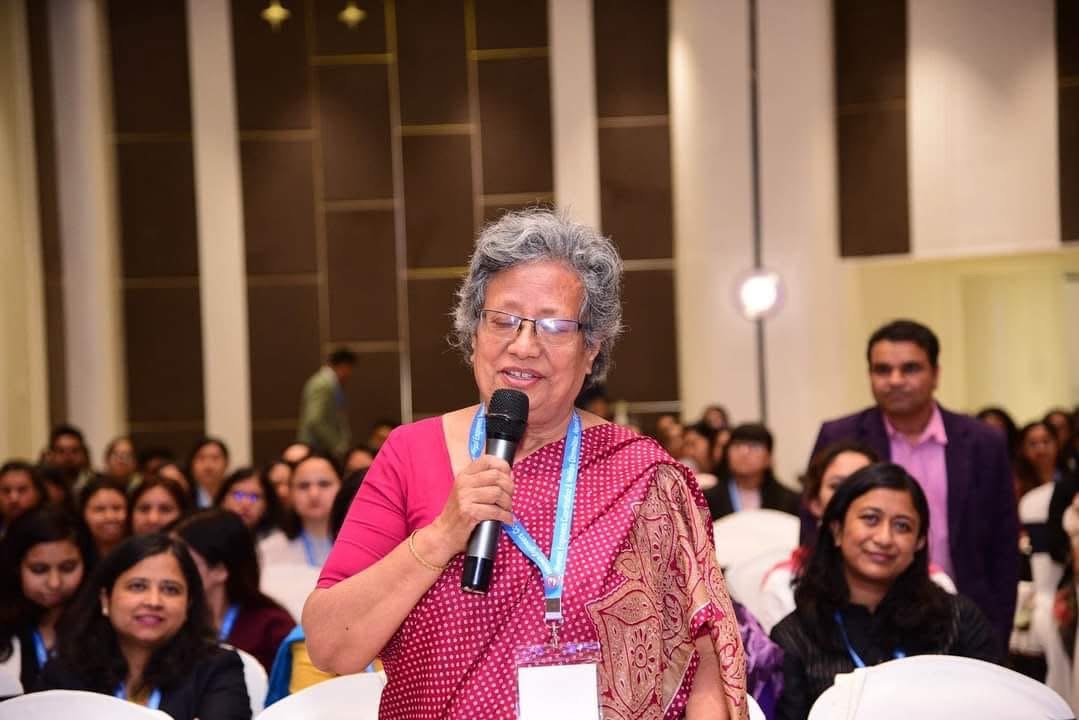
Today, I stand before you not merely to discuss policy, but to issue a clarion call—a summons to our collective conscience. Nepal’s health is the bedrock of our nation’s destiny. Yet today, that bedrock is cracking under the weight of neglect and shortsightedness. We boast of medical marvels abroad, of cutting-edge treatments in distant capitals, while at home:
- We have one doctor for every 3,000 Nepalis, even though the World Health Organization recommends one per 1,000.
- In remote districts, that ratio plummets to shockingly one doctor for 150,000 people.
- Last year, 86% of our newly registered doctors applied for certificates to work overseas—our bravest healers choosing foreign soil over our own.
These are not statistics; they are heartbreaks writ in numbers. They are mothers who cannot find care, fathers who cannot afford treatment, children who grow sick with no one to cure them.
How did we arrive at this crisis?
Because our premier medical institutions—our Institute of Medicine, Nepal Academy of Medical Sciences, and others—are treated like afterthoughts. They subsist on year-to-year budgets, shackled by bureaucracy, starved of research funds, and denied the autonomy to innovate. Meanwhile, our doctors graduate, only to be lured away by better labs, better pay, and better prospects abroad.
We must reverse this exodus, not with empty promises, but with structural transformation. I propose one bold, decisive step:
Declare our premier health institutions as Institutions of National Importance through a Special Act of Parliament.
What does this mean? It means guaranteed, multi-year funding—insulated from the whims of annual budget debates. It means academic and administrative autonomy—boards empowered to recruit world-class faculty and launch cutting-edge research. It means global collaboration—partnerships with the world’s best medical centers, joint PhD programs, and donor-funded innovation hubs.
Look to India’s All India Institute of Medical Sciences—once a single campus in New Delhi. Today, AIIMS ranks among the top 150 medical schools globally. It attracts the brightest minds, publishes groundbreaking research, and treats millions each year. Why? Because India treated AIIMS as a national priority, not as a line item in a spreadsheet.
Nepal is poised for the same ascent. Our Institute of Medicine in Maharajgunj, our medical research bodies at Satdobato—these are institutions with pedigree, legacy, and the potential to change lives. They are our national treasures. Yet without national-importance status, they risk extinction by neglect.
Imagine the transformation:
- Modern labs humming with research into tuberculosis, dengue, and non-communicable diseases—ailments that kill tens of thousands each year.
- Innovation parks spawning health-tech startups that develop affordable diagnostic devices, telemedicine platforms, and mobile clinics for our mountainous terrain.
- Returnee programs that bring back Nepali doctors versed in the latest surgical techniques, offering fellowships and leadership roles at home.
This is not fantasy—it is entirely within our grasp. The cost? A fraction of what families spend on overseas treatment each year. The return? Lives saved. Families spared ruinous debt. A workforce healthier, more productive, and more hopeful.
To those who say we cannot afford this, I say: we cannot afford not to. Every rupee invested in health yields manifold returns—in economic growth, in social stability, in the very soul of our nation. When we keep our people healthy at home, we build a foundation for every other ambition—a stronger economy, a vibrant democracy, a proud global standing.
To those who worry about equity, I say: we will write the law with transparency and fairness. Only a handful of proven, high-impact institutions will be selected in the first phase, on merit alone. Expansion can follow a phased, data-driven approach. And robust oversight—public audits, academic councils, and citizen representation—will ensure accountability.
Honourable Speaker, Members, let us seize this moment. Let us bequeath to our children not a legacy of hospitals in disrepair, but a network of centers of medical excellence. Let us be remembered as the Parliament that refused to let Nepali doctors heal abroad what they could heal at home. Let us be the generation that declared, once and for all, that the health of our people is the health of our nation.
I urge you to pass the Special Act for Institutions of National Importance today. Let this House unite—across party lines, across regions, across ideologies—to send a message to every young Nepali doctor: “Your future is here. Your work matters. Your nation demands your brilliance.”
The path ahead will demand political will, fiscal discipline, and unwavering resolve. But the destination—a healthier, more self-reliant Nepal—is worth every effort.
- Example:
“Our brightest doctors should heal our people, not foreign patients. Our finest engineers should build Nepal, not someone else’s Silicon Valley.”
3. Quantitative Anchors:
- You already cite GDP spending figures and examples from IITs and AIIMS — excellent.
- Consider adding one or two Nepal-specific statistics to personalize the urgency:
- Current health worker-to-population ratio.
- Number of Nepali medical students abroad annually.
- Projected health tourism revenue loss due to weak infrastructure.
4. Optional Add-On: Visuals or Infographics
- If turning this into a policy brief or presentation deck, simple graphics comparing:
- India’s investment vs Nepal’s.
- Graduate retention rates.
- Timeline of IIT/AIIMS growth vs potential Nepali roadmap.
Here are several concrete data points and statistics you can weave into your brief or speech to underscore the urgency and scale of Nepal’s health-sector challenges:
- Doctor-to-patient ratio
- National average: 1 doctor per 3,000 people (WHO recommends 1:1,000).
- In remote districts: as low as 1 doctor per 150,000 people.
- Registered vs. active physicians
- As of January 2024, the Nepal Medical Council had 45,498 registered doctors (including 30,027 MDs and 4,883 dentists), but fewer than 15,000 are actively practising in Nepal.
- Exodus of newly qualified doctors
- In 2023, 2,692 new doctors registered nationally, and 2,318 of them (≈ 86%) applied for Good-Standing Certificates (GSCs) to work abroad.
- Medical students pursuing education overseas
- During the 2023–24 academic year, 972 Nepali students departed for medical studies abroad.
- Projected specialist shortfall
- Nepal faces a deficit of 5,779 medical specialists over 2023–2031, with an annual production growth rate of only 6.41%.
- Overall health spending
- Current health expenditure reached 5.42% of GDP in 2021 (latest WHO data).
- Out-of-pocket payments still cover 54.2% of all health costs (FY 2019–20), risking catastrophic spending for families.
- Public budgeting for health
- For FY 2025/26, the government allocated NPR 95.81 billion to health—just 4.9% of total budget (up from 4.6% last year).
- Health insurance coverage gap
- Social health insurance enrollment plateaued at ~25% of the population by 2023, with significant dropout and adverse-selection issues.
- Top migration destinations
- In 2023 alone, of the doctors seeking GSCs: 843 aimed for the United States and 505 for the United Kingdom.
- Nnnnnnn nnnnnn
Strengthening Nepal’s Health Sector Through Institutional Leadership and Innovation
Honourable Speaker, respected Members of Parliament, and fellow citizens,
Today, I rise not merely to speak of healthcare — but of Nepal’s destiny. A destiny that will not be shaped by slogans, but by action. By the strength of our institutions, the boldness of our investments, and the belief we place in our people.
Across Nepal, families struggle for reliable, affordable healthcare. In our hills and plains, hospitals are scarce, specialists scarcer still. Meanwhile, our most talented health professionals leave for foreign lands — seeking what Nepal has yet to offer.
The numbers are sobering:
- Nepal has one doctor for every 3,000 people, far below the World Health Organization’s recommended ratio.
- In rural districts, this worsens to one doctor per 150,000 people.
- Last year alone, 86% of newly qualified doctors applied for certificates to work abroad.
Our brightest minds — trained here, nurtured here — are leaving. And yet, we speak of health tourism, of becoming a global medical hub.
Honourable Members, let us be honest:
Health tourism cannot ride on slogans. It rides on systems, standards, and trust. Let us build that first — and the world will follow.
And building that foundation starts now — with bold, structural reform:
Declare Nepal’s Premier Health and Technical Institutions as Institutions of National Importance.
This is not ceremonial. It is a strategic act that will:
✅ Provide long-term, stable funding — protected from the volatility of annual budgets.
✅ Grant institutional autonomy — empowering leadership to attract global experts, drive research, and modernize curricula.
✅ Expand world-class infrastructure — from cutting-edge labs to advanced hospitals.
✅ Retain Nepali talent — giving our brightest doctors, scientists, and engineers reasons to stay, innovate, and serve.
Our Neighbours Show the Way
Look no further than India. The declaration of IITs, IIMs, and AIIMS as Institutions of National Importance transformed their academic landscape.
The AIIMS in New Delhi ranks among the world’s top medical schools.
IIT graduates lead global tech firms, found startups, and contribute billions to their economy.
This was not luck — it was leadership backed by law, investment, and vision.
Nepal’s own institutions — IOM Maharajgunj, NAST Satdobato, IOE Pulchowk — have similar pedigree. But without the necessary status and resources, their potential remains shackled.
Meanwhile, the cost of neglect is mounting:
- IoE Pulchowk is drowning in Rs 90 million of debt, forcing a 177% hike in student fees.
- NAST, designed to be the heart of our scientific progress, spends more on administration than on research — not by choice, but by budgetary starvation.
- Our healthcare system relies increasingly on foreign training, foreign care, and foreign solutions.
Other nations have shown us the way.
Japan rebuilt from the ashes of war by empowering its universities.
South Korea became a global technology leader by investing in its research institutions.
India unlocked new frontiers of innovation and entrepreneurship by declaring its IITs, IIMs, and AIIMS as Institutions of National Importance.
They invested in excellence — and today, they are reaping the rewards of innovation and growth.
It is time for Nepal to do the same.
The Return on Investment
Some may ask: Can Nepal afford this?
I ask: Can we afford the alternative?
The return on this investment is not measured in rupees alone. It is counted in lives saved, talent retained, and national dignity restored.
No nation has kept its brightest minds by underfunding ambition.
No country became great by starving its institutions of excellence.
And no people earned global respect by exporting their sick and importing their healthcare.
What It Demands
This path demands political will, fiscal discipline, and unwavering resolve.
It demands that we, as representatives of the people, rise above partisanship and short-termism. It demands that we invest — not only in infrastructure, but in the future of our doctors, engineers, scientists, and innovators.
History teaches us that greatness follows foresight in education. After World War II, the United States committed over 0.6% of GDP to research — unleashing a wave of technological leadership. Nepal’s current allocation to science and technology remains below 0.4% of GDP, well behind the global average of 1.2%.
We cannot afford to lag further behind.
A Call to Action
Let us pass the Special Act for Institutions of National Importance. Let us prioritize IOM, NAST, IOE, and their peers. Let us invest in excellence, retain our talent, and restore faith in Nepal’s ability to provide world-class healthcare — first for our own citizens, and then for the world.
The world will follow when we lead — with vision, with courage, and with the determination to build a Nepal that believes in itself.